Local AI visibility: what it is, and what the numbers say city by city
Part of the complete guide to AI searchability.
Local AI visibility is how often an AI assistant names your business when someone asks it a question tied to your city, your area or "near me". It is measured per assistant and per place, because ChatGPT, Gemini and Claude read different sources and the sources differ from one city to the next. A plumber can be the name Gemini gives in Marseille and absent from every ChatGPT answer about Lyon.
This guide explains the idea and then puts numbers on it: what the two large 2026 studies found across hundreds of thousands of locations, and what our own scans show for seven trades in nine cities. If you want the practical checklist for one location, that is a separate read, AI search for small business. This one is about what you are measuring and what a normal city looks like.
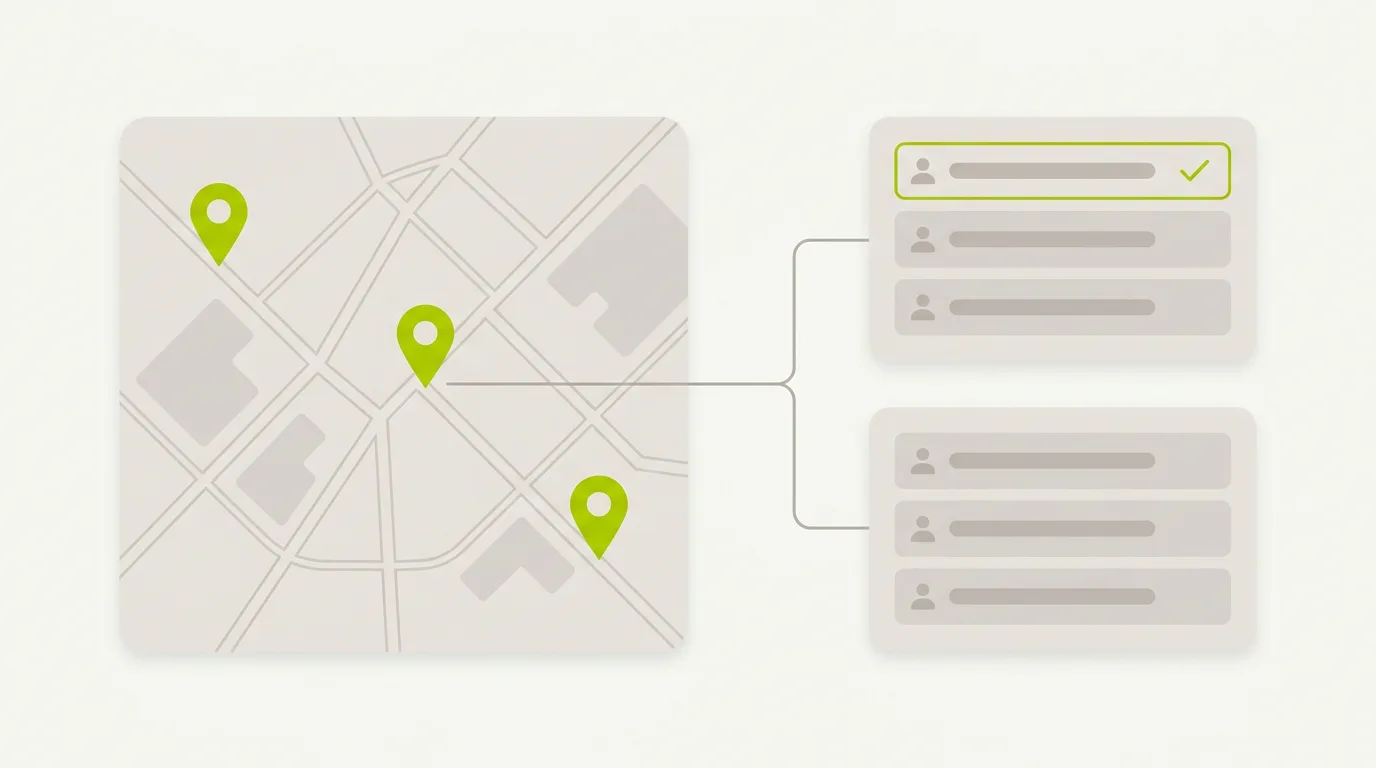
- Local AI visibility is per assistant and per city. Being named in one city on one assistant says little about the next.
- It is rare. SOCi's 2026 index found ChatGPT recommended 1.2% of 350,000 brand locations, against a 35.9% appearance rate in Google's local pack. Local Falcon found 91.5% of ranked estate agents were never cited across 37,500 AI searches.
- It is concentrated. In our nine cities, the most-recommended business for a trade appeared in 33% of that city's AI answers on average, and the two assistants agreed on at least one business in only 32 of 63 city-and-trade pairs.
- It is not local SEO. The local pack lists ten businesses; an AI answer names two or three. Ranking on the map puts you in the pool, it does not put you in the answer.
- Measure it with four numbers per city: presence rate, the leader's share, cross-assistant agreement, and the sources cited. Twelve answers per assistant is the minimum for a reading.
What is local AI visibility?
Local AI visibility is the share of AI answers about a place that name a given business. AI visibility for a local business is therefore a local number first. The question can be explicit, "best dentist in Chicago", or implicit, "a good dentist near me" asked from Chicago. The answer is a short list, usually two or three names, sometimes with a sentence on each. Your visibility is how often you are one of those names, on each assistant your customers use, for the questions they actually ask.
The word local matters because nothing about the measurement transfers. The assistants build each answer from sources they trust for that place: a health directory in France, the NHS in London, a health authority in Dubai, a booking marketplace in Miami. A national brand can have a strong national number and be missing in half its cities. A single-location business only has the one city, so the local number is the only one that counts.
How rare is it to be named? What the 2026 studies found
Two large studies published this year measured local AI visibility at scale. Both found it far scarcer than a Google ranking. SOCi's 2026 Local Visibility Index analysed more than 350,000 locations across 2,751 multi-location brands. It found that ChatGPT recommended 1.2% of them, against a 35.9% average appearance rate in Google's local 3-pack, which the authors describe as nearly 30 times more selective. Coverage of the same index reported 11% on Gemini and 7.4% on Perplexity.
Local Falcon's Realtor AI Visibility Index ran 37,500 "best agent near me" searches across the 100 largest US cities on five AI platforms and found that 91.5% of ranked, website-publishing agents were never cited once. A typical city produced 42 distinct agents across all platforms, the single most-cited agent took 26.6% of a city's citations, and 82.6% of the agents named appeared on only one platform. Those last three figures are the shape of local AI visibility everywhere: few names, a heavy favourite, and little agreement between assistants.
| Study | Scope | What it found |
|---|---|---|
| SOCi, 2026 Local Visibility Index | 350,000+ locations, 2,751 brands, US | 1.2% of locations recommended on ChatGPT vs 35.9% in the local 3-pack; 11% on Gemini, 7.4% on Perplexity |
| Local Falcon, Realtor AI Visibility Index | 37,500 searches, 100 US cities, 5 platforms | 91.5% of ranked agents never cited; 26.6% of a city's citations to one agent; 82.6% of named agents on a single platform |
| Peekl scans | 756 answers, 7 trades, 9 cities, ChatGPT and Gemini | Leader named in 33% of a city's answers; assistants agreed in 51% of city-and-trade pairs; 940 sources, 84% seen once |
What our scans show, city by city
We put six customer questions per assistant to ChatGPT and Gemini for seven local trades in nine cities, 84 answers per city. We recorded every business named and every website cited, which gives a read on AI search visibility by city rather than by country. Two numbers describe each city. The leader's share is how often the most-recommended business for a trade appeared in that trade's answers in that city. Agreement is how many of the seven trades had at least one business named by both assistants.
The leader's share sat between 30% and 36% in every city. Even the favourite is missing from two answers in three, which is why a single screenshot proves nothing in either direction. Agreement swung far more: in Marseille the two assistants overlapped on six trades out of seven, in Paris, Lyon and New York on two. The city changes the sources, and the sources change the names.
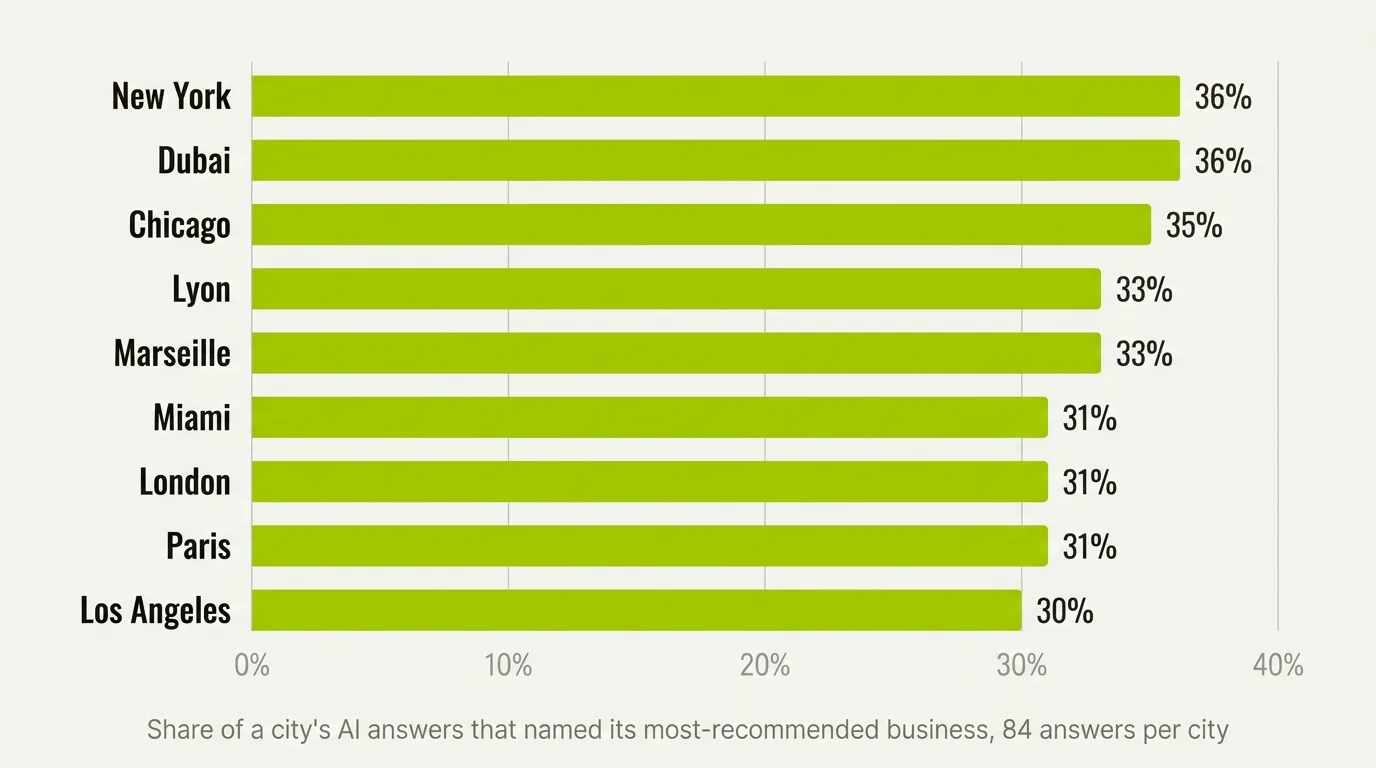
| City | Businesses named | Leader's share of answers | Trades where ChatGPT and Gemini agreed | Most-cited source |
|---|---|---|---|---|
| New York | 137 | 36% | 2 of 7 | A hospital network |
| Dubai | 134 | 36% | 4 of 7 | The health authority |
| Chicago | 132 | 35% | 5 of 7 | A university hospital |
| Lyon | 133 | 33% | 2 of 7 | PagesJaunes |
| Marseille | 132 | 33% | 6 of 7 | PagesJaunes |
| Miami | 136 | 31% | 4 of 7 | A dental chain |
| London | 135 | 31% | 3 of 7 | The NHS |
| Paris | 132 | 31% | 2 of 7 | Doctolib |
| Los Angeles | 133 | 30% | 4 of 7 | A university health system |
Why the same trade looks different in each city
Because the assistants are not choosing from a national list. For each city they lean on the sources that dominate that market, and those sources carry different businesses. In Lyon and Marseille the most-cited source across all seven trades was PagesJaunes; in Paris it was Doctolib; in London the NHS; in Dubai the health authority's own directory; in three US cities a hospital or university health system. A dentist well listed on Doctolib is in Gemini's pool in Paris and nowhere in London, where Doctolib barely exists.
Agreement follows the same logic. Where one or two sources dominate a market, both assistants read them and tend to name the same businesses, which is what Marseille's six of seven looks like. Where the source mix is fragmented, each assistant reads a different slice and the shortlists diverge, which is Paris and New York at two of seven. For what each assistant reads, see which websites AI trusts; for the mechanism underneath, see how AI decides which businesses to recommend.
How do you measure and track local AI visibility for one business?
With four numbers per city, taken from at least twelve answers per assistant, because the answers move run to run. Tracking is the same four numbers repeated monthly. Presence rate: the share of answers that named you. The leader's share: how often the most-named competitor appeared, which tells you how far ahead the favourite is. Agreement: whether the assistants your customers use name you on both, on one, or on neither. And the source list: which websites the assistants cited when they named you, and when they named the competitor instead.
The definitions and the benchmarks for each number live in AI visibility metrics and KPIs, and the logging method in how to track AI sources. The shortcut is a check that runs the questions for your trade and town and counts for you: the free Peekl check does twelve on Gemini, the audit does 135 across all three assistants.
Local AI visibility vs local SEO: what is the difference?
Local SEO gets you into Google's map pack and the organic results for your area. Local AI visibility is whether an assistant names you when a customer asks it directly, and the two overlap far less than most owners expect. SOCi found 35.9% of locations appeared in the local 3-pack against 1.2% recommended by ChatGPT, and only a 45% overlap between the retail brands most visible in traditional local search and those most recommended by AI. Local Falcon found the highest-volume agents in a city, the ones local SEO would call winners, were cited by any AI platform only 21.2% of the time.
The reason is structural. A map pack lists up to ten businesses ranked by proximity, relevance and prominence; an assistant names two or three it can justify from the sources it read. Ranking well puts you in the pool the assistant draws from. Being named requires the sources it trusts to describe you clearly and often. That is why a business can rank on Google and still be invisible to AI.
| Local SEO | Local AI visibility | |
|---|---|---|
| Where it shows | Map pack and results page | Inside the assistant's answer |
| How many are shown | Up to ten in the pack, more below | Two or three names, sometimes one |
| What decides it | Proximity, relevance, prominence signals | What trusted third-party sources say, read per question |
| How stable it is | Fairly stable day to day | Rebuilt on every run; measured as a frequency |
| How to check | Rank tracker, Search Console | Ask the assistants repeatedly, or run a check |
Glossary: the terms in this guide
Short definitions for the words used above, so the numbers on the trade and city pages read the same way everywhere.
- Local AI visibility: how often AI assistants name a business in answers to questions tied to its city or area, measured per assistant.
- Presence rate (or mention rate): the share of answers to a set of questions that name a given business.
- Leader's share: the presence rate of the most-recommended business for a trade in a city. A measure of how concentrated the answers are.
- Cross-assistant agreement: whether two assistants named at least one business in common for the same trade and city.
- Selecting source: a directory, booking platform, review site or forum that lists several businesses and from which the assistant picks. Distinct from a business's own website, usually cited only once it has been picked.
- Source gap: a competitor named from a source that does not list you.
- AI Overviews and AI Mode: Google Search features built on Gemini models. Related to Gemini's answers but shown inside the results page; see what Google AI Mode is and how to appear in Google AI Overviews.
Where to look next
Each trade has its own directory of city results with the cross-city table and the sources behind it: dentists, aesthetic clinics, physiotherapists, plumbers, hair salons, personal trainers and real estate agents, with the French cities under visibilité IA. For the work that moves the number, the checklist is in AI search for small business.
Common questions
What is local AI visibility?
How is local AI visibility measured?
Is local AI visibility the same as local SEO?
How many businesses does AI name for a trade in a city?
Do ChatGPT and Gemini name the same local businesses?
Why is my AI visibility different in one city than another?
Can I see the numbers for my own trade and city?
See where you stand
Reading about AI search is useful; knowing your own place in it is what helps. A free Peekl check asks the assistants the questions your customers ask and shows whether ChatGPT, Gemini and Claude recommend you today, who they name instead, and how often.
Related reading
- AI search and AI SEO for a small local business: what to do without a marketing team
- How to check if ChatGPT recommends your business
- AI visibility metrics: how to measure your AI visibility (the KPIs that matter)
- Which websites does AI trust when it recommends a local business?
- How do AI assistants decide which local businesses to recommend?
- How to track which sources AI cites, and whether they mention your business