AI search for chiropractors: what owners need to know
Part of our series on AI visibility by trade and city. The reference guide is the AI visibility directory by trade and city.
AI search for chiropractors means patients asking ChatGPT or Gemini who to see for back pain. In our New York scan, Gemini's most-named answers were booking platforms such as Zocdoc, and no individual chiropractor was named in more than 2 of 12 answers.
People usually look for a chiropractor when they are in pain and want relief from someone they trust. More of them now begin by asking an assistant who to see nearby, describing the problem and hoping for a confident, local recommendation.
More patients now ask ChatGPT, Gemini or Claude for a chiropractor before they ask their GP or a friend, and how those assistants decide which clinics to name decides whether that patient arrives with you. It is worth understanding why some clinics stay invisible to AI and checking where you stand now rather than later.
What patients ask AI when they are in pain
Chiropractic questions are driven by a specific problem and a need for trust. The answer decides where a patient in pain turns first, and where they turn often becomes their course of care:
- “Best chiropractor near me for back pain”
- “Chiropractor for sciatica in the area”
- “Sports chiropractor nearby”
- “Chiropractor for neck pain near me”
- “Gentle chiropractor close by”
What AI actually says about chiropractors in New York: our scan
On 8 October 2026 we asked ChatGPT and Gemini six questions each that a patient in New York might type, from "Who should I see in New York for ongoing lower back pain?" to "Which chiropractor in New York specializes in sports injury treatment?". Every name and every source in the twelve answers went into our log: a one-day snapshot of one city, not a ranking.
Chiropractors are where the platforms took the names. Gemini's most-named "chiropractors" were Zocdoc and Healthgrades, each in 3 of its 6 answers, and no individual chiropractor was named in more than 2 of the 12 answers. ChatGPT named 23 names and Gemini 20, and the only names in both assistants' top tens were two hospital spine centres, not chiropractic practices. For back pain, the assistants often send a patient to a booking site or a hospital.
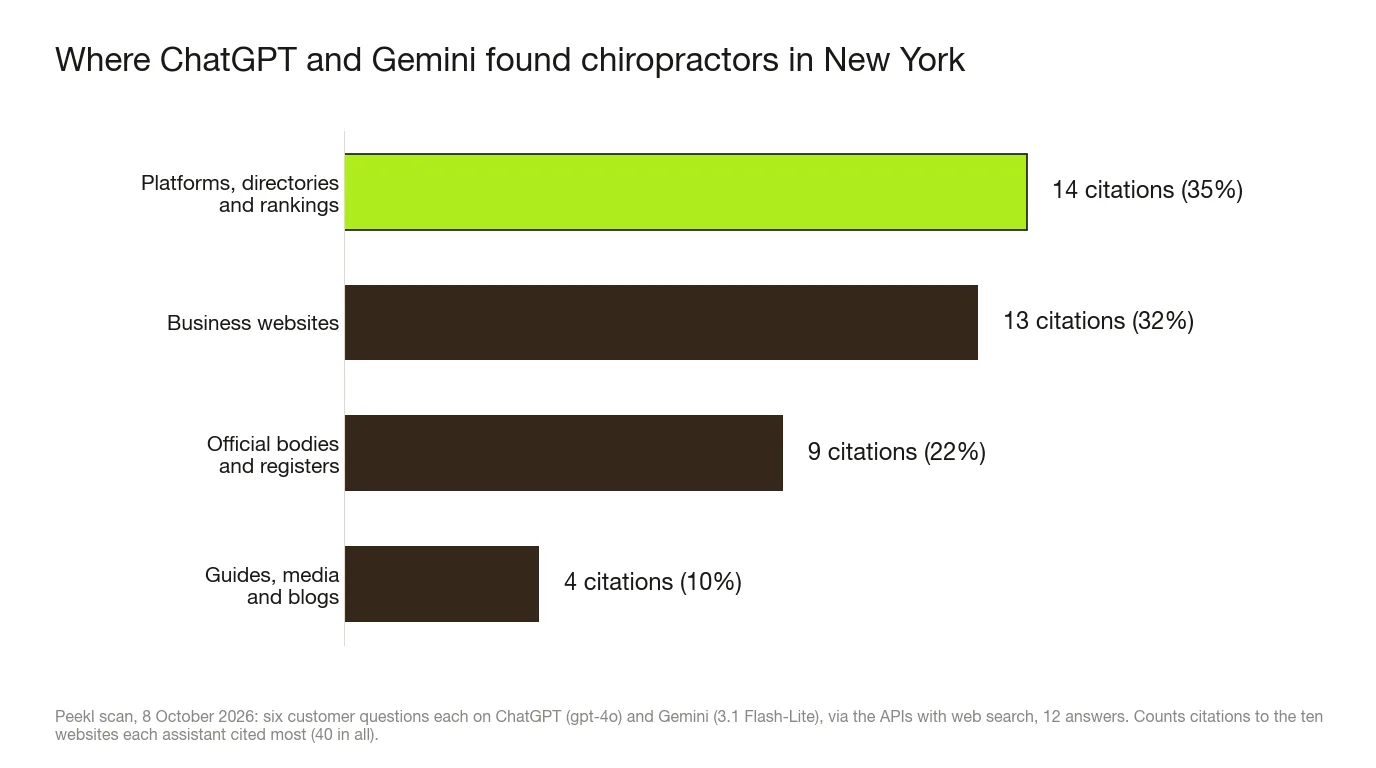
The sources match. A third of the citations went to booking and review platforms (Zocdoc on both assistants, Healthgrades, RateMDs), and 22% to official and professional bodies: New York State's Office of the Professions, where chiropractors' licenses are verified, and the New York State Chiropractic Association. For a practice owner the takeaway is clear: a complete Zocdoc and Healthgrades profile, a license entry that matches your name, and association membership are the sources the assistants cited most often for chiropractors, so make each one complete and consistent.
| Website | What it is | Citations in the 12 answers |
|---|---|---|
| Practices' and hospitals' own websites (8 different) | Business websites | 13 |
| Zocdoc | Booking platform | 6 |
| Healthgrades | Doctor reviews platform | 5 |
| NYS Office of the Professions | State license register | 4 (ChatGPT) |
| New York State Chiropractic Association | Professional association | 3 (Gemini) |
| RateMDs | Doctor reviews platform | 2 (Gemini) |
How AI decides which chiropractors to recommend
Assistants recommend chiropractors from booking and review platforms, the state license register, the professional association and clear clinic pages, sources that establish credibility, focus and how patients rate their results. A clinic well represented and reviewed across those, with its approach and specialisms plain, is easy to recommend for a specific complaint.
So far we have scanned chiropractors in one city, New York (above). The closest trade we scan in six cities, physiotherapists, shows how the pattern holds across markets: who gets named, how often, and from which websites.
More in local AI visibility, city by city and which websites AI trusts. The ChatGPT visibility checker, the Gemini visibility checker and the Claude visibility checker show what each assistant reads.
Common questions
Do patients find a chiropractor through AI?
Our patients come from referrals, is AI relevant?
How do I see what AI says about my clinic?
Why does AI recommend Zocdoc instead of a chiropractor?
See where you stand
Reading about AI search is useful; knowing your own place in it is what helps. A free Peekl check asks ChatGPT or Gemini, your pick, the questions your customers ask and shows whether it recommends you today, who it names instead, and how often. The full audit runs the same questions on all three assistants, Claude included.
More in this series: AI visibility by trade and city
- AI visibility by trade and city: every scan we run
- Local AI visibility: what it is, and what the numbers say city by city
- AI search for restaurants: what owners need to know
- AI search for cafés: what owners need to know
- AI search for electricians: what owners need to know
- AI search for gyms and fitness studios: what owners need to know
- AI search for law firms: what owners need to know
- AI search for accountants: what owners need to know
- AI search for estate agents: what owners need to know
- AI search for veterinary practices: what owners need to know
- AI search for barbers: what owners need to know
- AI search for cleaning services: what owners need to know
- AI search for opticians: what owners need to know
- AI search for dentists: what owners need to know
- AI search for plumbers: what owners need to know
- AI search for hair salons: what owners need to know
- AI search for physiotherapists: what owners need to know
- AI search for personal trainers: what owners need to know
- AI search for aesthetic clinics: what owners need to know