AI search for law firms: what owners need to know
Part of our series on AI visibility by trade and city. The reference guide is the AI visibility directory by trade and city.
AI search for law firms means clients asking ChatGPT or Gemini who to hire. In our New York scan, generic questions got the same large corporate firms, while questions about a specific need, such as personal injury or immigration, let smaller specialist firms in.
Legal help is high-stakes and infrequent, so most clients have no firm in mind and start from scratch. Increasingly, that search begins by asking an assistant which lawyers to consider for a specific matter, rather than trawling a directory alone.
More clients now ask ChatGPT, Gemini or Claude for a lawyer before they ask a contact, and the way those assistants choose which firms to name decides whether the enquiry reaches you or a competitor. It is worth understanding why some firms stay invisible to AI and checking where you stand before the brief goes elsewhere.
What clients ask AI when they need a lawyer
Legal questions are specific to a situation and heavy with consequence. The person asking needs the right specialism and someone they can trust with something that matters. These are the moments that generate high-value enquiries:
- “Best divorce lawyer near me”
- “Employment lawyer in the area”
- “Immigration lawyer near me”
- “Conveyancing lawyer for buying a house nearby”
- “Personal injury lawyer close by”
What AI actually says about law firms in New York: our scan
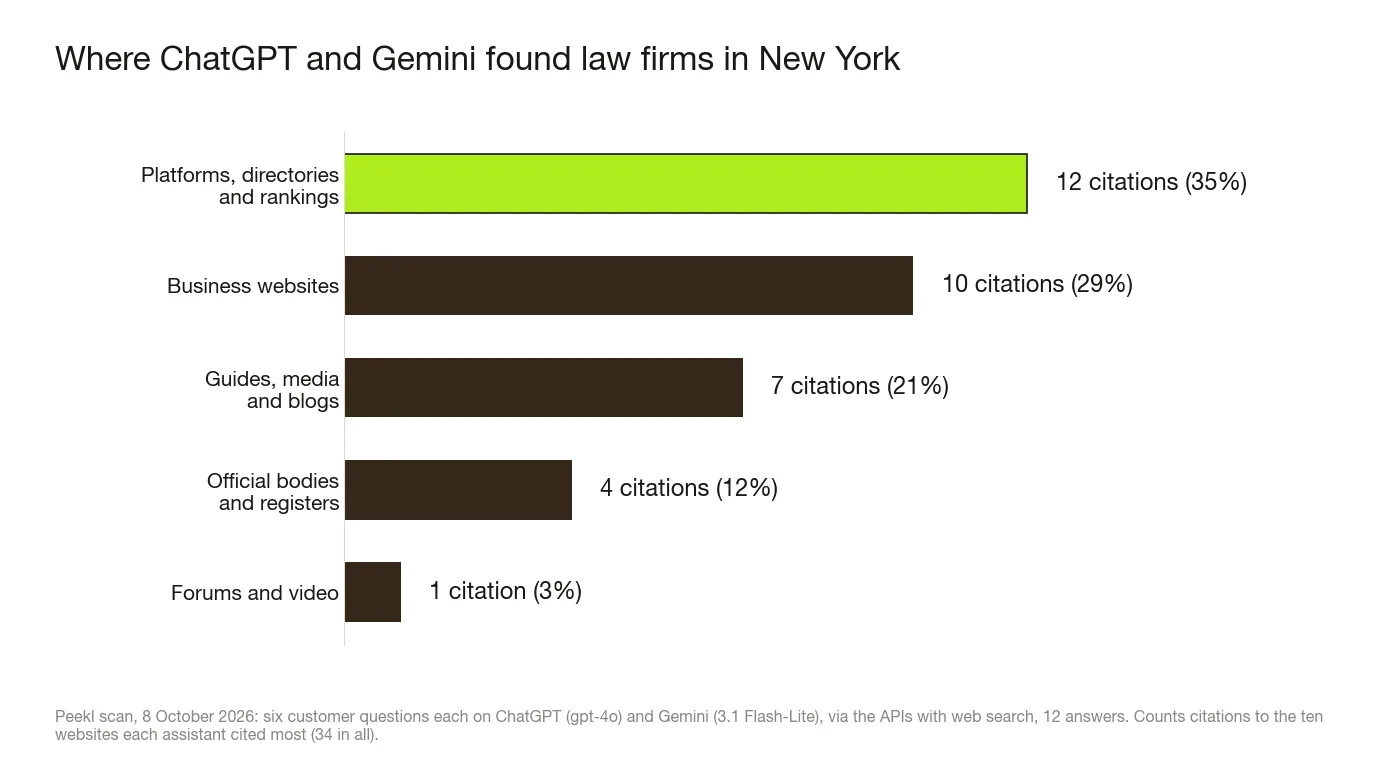
On 8 October 2026 we asked ChatGPT and Gemini six questions each that someone looking for a lawyer in New York might type, from "What is the best law firm in New York?" to "Who should I see in New York for help with a personal injury claim?". From the twelve answers we listed every firm and every website cited, which shows how the assistants behave rather than who is best.
The generic questions were answered with the same handful of large corporate firms. ChatGPT named 37 firms and Gemini 33, their top tens shared six names, all of them corporate firms that top the national legal rankings, and two were each named in 7 of the 12 answers. The questions that named a need (personal injury, immigration, a landlord dispute) were different: that is where specialist and smaller firms appeared.
The sources follow the same split. A third of the citations went to legal rankings and directories, with Chambers and Partners cited on both assistants, Vault and Best Law Firms. The New York State Bar Association and the New York City Bar were cited by ChatGPT, and firms' own sites made up 29%. For a small or local firm the takeaway is clear: you will not win "best law firm in New York", but the practice-area question is winnable, with a clear page for each practice area, your bar profile, and listings in the directories the assistants cite.
| Website | What it is | Citations in the 12 answers |
|---|---|---|
| Firms' own websites (8 different) | Business websites | 10 |
| Chambers and Partners | Legal ranking | 5 |
| Vault | Legal ranking | 4 |
| A New York legal news site | Legal media | 4 (Gemini) |
| Best Law Firms | Legal ranking | 3 (Gemini) |
| New York State Bar Association | Bar association | 2 (ChatGPT) |
How AI decides which law firms to recommend
For firms, assistants rely on legal directories, professional listings and review platforms, the sources that establish credibility, specialism and reputation. A firm that is clearly present and well regarded across those, with its practice areas plainly stated, is straightforward for an assistant to recommend for the right kind of matter.
More in local AI visibility, city by city and which websites AI trusts. The ChatGPT visibility checker, the Gemini visibility checker and the Claude visibility checker show what each assistant reads.
Common questions
Would someone really pick a lawyer via ChatGPT?
We get referrals from existing clients, is AI relevant?
How would I know if AI recommends my firm?
Will AI recommend a small law firm?
See where you stand
Reading about AI search is useful; knowing your own place in it is what helps. A free Peekl check asks ChatGPT or Gemini, your pick, the questions your customers ask and shows whether it recommends you today, who it names instead, and how often. The full audit runs the same questions on all three assistants, Claude included.
More in this series: AI visibility by trade and city
- AI visibility by trade and city: every scan we run
- Local AI visibility: what it is, and what the numbers say city by city
- AI search for restaurants: what owners need to know
- AI search for cafés: what owners need to know
- AI search for electricians: what owners need to know
- AI search for gyms and fitness studios: what owners need to know
- AI search for accountants: what owners need to know
- AI search for estate agents: what owners need to know
- AI search for veterinary practices: what owners need to know
- AI search for barbers: what owners need to know
- AI search for cleaning services: what owners need to know
- AI search for opticians: what owners need to know
- AI search for chiropractors: what owners need to know
- AI search for dentists: what owners need to know
- AI search for plumbers: what owners need to know
- AI search for hair salons: what owners need to know
- AI search for physiotherapists: what owners need to know
- AI search for personal trainers: what owners need to know
- AI search for aesthetic clinics: what owners need to know