How do ChatGPT and Gemini decide which local businesses to recommend?
Part of our series on Understanding AI search. The reference guide is the complete guide to AI searchability.
ChatGPT and Gemini recommend the local businesses that the pages and data they pull in, at the moment you ask, can vouch for. ChatGPT searches the web through partner search providers and adds partner data such as Yelp's; Gemini and Google's AI Mode draw on Google Search and Google Maps. Neither keeps a ranking of local firms, and neither gives the same list twice: when Peekl asked ChatGPT the same question 10 times, no business was named in all 10 answers.
This guide covers where each assistant's local data comes from, what that means for your Google Business Profile and your Yelp page, how much an answer moves when you ask again, and why no one can buy, submit or claim a place. It draws on Peekl's city scans and on a repeat test run on 11 October 2026.
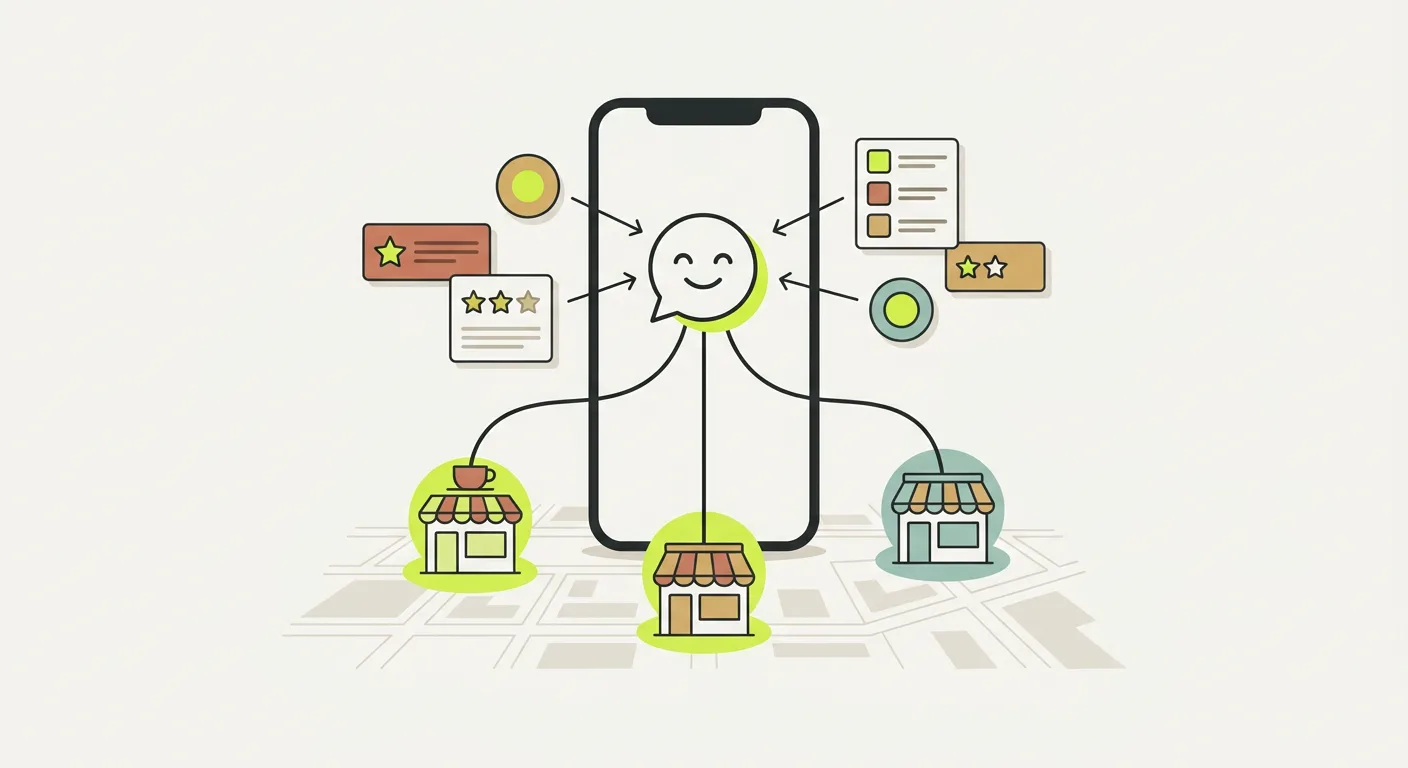
- ChatGPT searches the web through partner search providers and shows partner data: Yelp ratings, photos and details, and OpenTable, Resy or Yelp for restaurant bookings.
- Gemini and Google's AI Mode lean on Google Search and Google Maps, so your Google Business Profile is the listing that matters most there.
- Neither keeps a ranking. Asked the same question 10 times, word for word, ChatGPT and Gemini named 12 to 30 different businesses, and only one business was named in every answer.
- ChatGPT tailors local answers to the user's approximate location and, with memory on, to what it knows about them, so two customers rarely see the same list.
- There is no way to pay for, submit or claim a place in an AI recommendation. You earn it on the sources the assistant reads.
What does AI use to decide which businesses to recommend?
An assistant does not hold a private directory of the best businesses in your town. When a customer asks for a recommendation, it turns the question into several web searches of its own (4.6 on average when Gemini searched, in a Peekl test of 400 answers), reads a few of the pages that come back, adds whatever structured data it has on places, and writes a short answer naming the businesses those sources describe clearly. Without search, it falls back on what it learned in training, which is older and vaguer.
So the answer is decided upstream, by what the web and the data partners already say about local businesses. If the pages an assistant lands on describe a competitor and not you, it names the competitor. Being good at what you do is not enough on its own; the assistant can only work with what it finds.
Where does each assistant get its local business data?
The assistants do not share one source of truth. ChatGPT runs searches through outside search providers and blends in content from partners; Gemini and AI Mode sit on Google's own index and Google Maps. What they end up citing also differs: in our scans of US, UK and Dubai markets (318 answers per assistant), ChatGPT's most-cited websites were official bodies and registers, while Gemini's were Reddit, Zocdoc and Thumbtack. Because each reads your details from a different place, they can also disagree on your hours or phone number; our guide on when an assistant gets your hours or number wrong traces where those mistakes come from.
| Assistant | Where it looks | Local data its maker names | What it cited most in our scans |
|---|---|---|---|
| ChatGPT | Web search through partner search providers, plus pages its own crawler (OAI-SearchBot) can read | Yelp reviews, ratings, photos and details; OpenTable, Resy and Yelp for restaurant availability (OpenAI, Yelp) | Official bodies and registers, such as state licensing boards and city sites: 27% of its citations across our nine-city scans |
| Gemini | Google Search, plus public Google Maps information | Addresses, ratings and opening hours from Google Maps (Google) | Reddit, Zocdoc and Thumbtack, each cited in 6% to 8% of answers |
| Google AI Mode | Google Search, the Knowledge Graph and Google Maps | Ratings, reviews, hours and busyness from Google's local business data (Google) | Not measured by Peekl |
How does ChatGPT decide which businesses to recommend?
ChatGPT recommends the businesses that the pages it reads can vouch for. With web search on, it turns the customer's question into searches, opens a few of the pages that come back and writes its answer from them, naming the businesses those pages mention and describe clearly. If the pages it lands on say nothing about you, it has nothing to name you from.
It reads fewer pages than most owners imagine, and not always the ones they would guess. In Peekl's scans of 378 ChatGPT answers about seven trades in nine cities, ChatGPT cited 2.4 pages per answer, against 3.8 for Gemini, and named 2.2 businesses per answer, against Gemini's 3.0. Of its citations, 27% went to official and professional bodies such as health authorities, licensing boards and trade registers, a kind of source Gemini gave almost nothing to.
In those same scans, across six differently worded questions about one city, its favourite business appeared in 40% of the answers; asked the identical question again, it is steadier, as the repeat test below shows. So with ChatGPT, the practical question is whether you are on the few pages it opens, starting with the register or professional directory for your trade. Peekl's free ChatGPT visibility checker shows which websites ChatGPT read for your questions, and how ChatGPT compares with Gemini and Claude covers where the three part ways.
Does ChatGPT use Bing or Google to find local businesses?
OpenAI does not name a single search engine. Its help page says ChatGPT search "sometimes partners with other search providers" and points to Microsoft's privacy policy among them, so Bing is part of the picture, but OpenAI does not say how much of any answer comes from it (OpenAI). OpenAI has also said in court that it is building its own search index (Courthouse News). Google Maps and Google Business Profile are not among the sources OpenAI lists (its help pages, read on 11 October 2026). When we compared ChatGPT's favourite names from our September scans with Google Maps, fewer than a quarter turned up there at all (AI search vs Google).
Two practical points follow. First, your website can only appear in ChatGPT search results if it lets OpenAI's crawler, OAI-SearchBot, read it, so check that your robots.txt does not block it. Second, being findable in ordinary web search still matters, because the pages ChatGPT opens are the ones its search partners return for your trade and town.
How important are your Google Business Profile and your Yelp page?
Both matter, for different assistants. Gemini and Google's AI Mode draw on Google Maps, where your Business Profile lives, and Google's advice for its AI features is to keep that profile up to date (Google Search Central). ChatGPT leans on Yelp instead: Yelp announced an agreement with OpenAI in February 2026 (Yelp results release), Yelp says its reviews, ratings, photos and business details now appear inside ChatGPT (Yelp), and OpenAI's help pages do not mention Google Business Profile (read on 11 October 2026).
That Yelp content shows up as business details in the app, not as a cited link: through the API, which returns only cited links, Yelp was the cited source in about 1% of the 318 ChatGPT answers from our US, UK and Dubai scans. So keep both listings complete and identical, and do not judge Yelp's weight by whether it appears among the sources. Does Google Business Profile affect ChatGPT recommendations? goes through each assistant in detail.
Which sources does AI trust most?
Outside those listings, assistants gravitate to sources that already organise the world into "best X in Y" answers: trade directories, booking and review platforms, official registers and best-of lists. They are structured, current and easy for a machine to read and repeat. A business those sources barely mention gives the assistant nothing to work with.
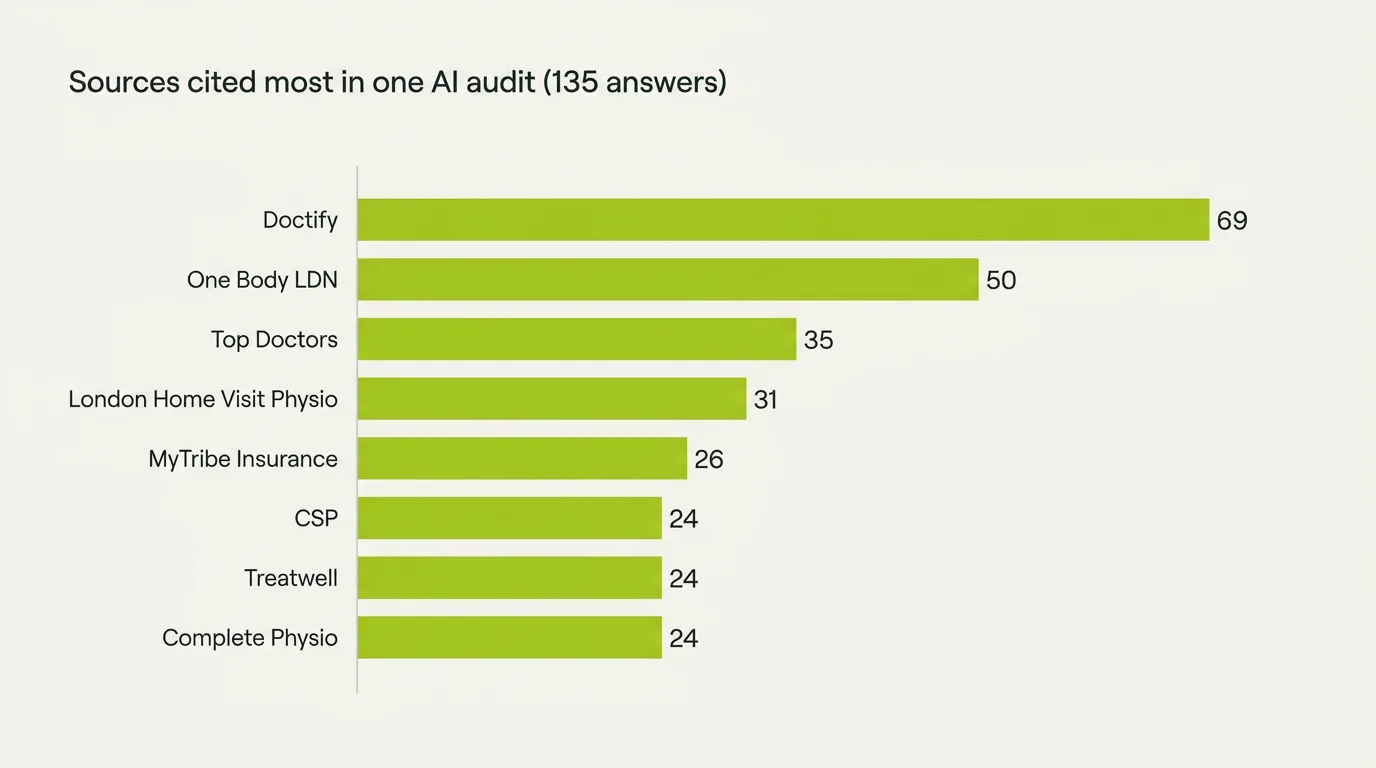
We see this in Peekl's own audits. In one, an established London clinic was named in just 19 of 135 answers, and the assistants cited Doctify, a doctor review and booking platform, 69 times, more than any clinic's own website. Across our wider study of 756 answers, 940 different sources appeared, led by booking platforms and directories, and they change by country and by trade; see which websites AI trusts for the ranked list.
How much do reviews and consistent details matter?
Reviews act as corroboration. A steady, recent trail of genuine feedback on the platforms an assistant reads tells it you are active and worth naming, and it shapes how you are described: two businesses can both make the list while one is called a trusted local favourite and the other gets a lukewarm line. If recent reviews raise a specific concern, the assistant may repeat it.
Consistency lets an assistant match you. When your name, address, phone and services agree across your website, your Google Business Profile, Yelp and your trade directories, an assistant can tie them together and vouch for you. When they conflict, it hedges and names a business it is more sure about.
Does ChatGPT give everyone the same answer?
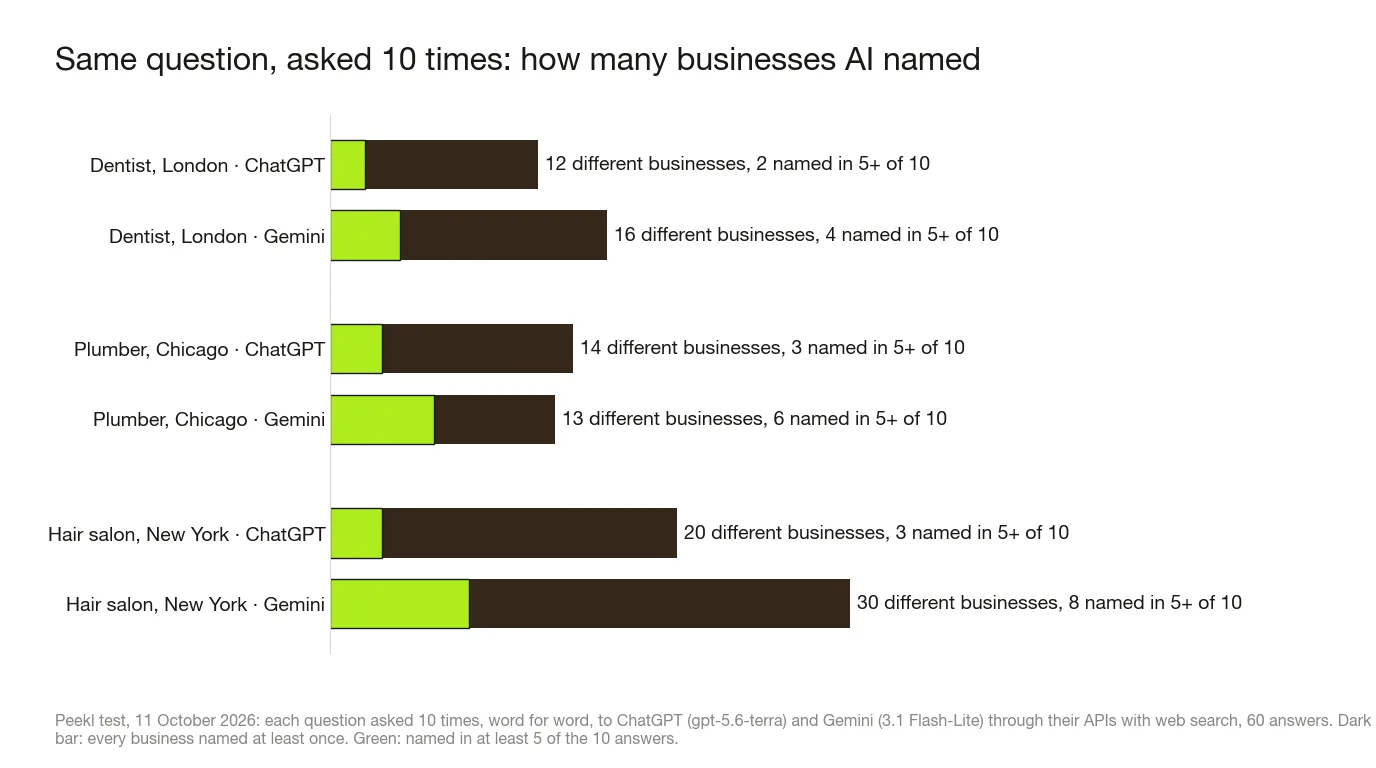
No, and not even the same person twice. OpenAI says there is "an inherent element of randomness" in how its models respond, so the same question can return different answers (OpenAI). We measured how much. On 11 October 2026 we asked three local questions 10 times each, word for word, on ChatGPT and on Gemini: a dentist in London, a plumber in Chicago and a hair salon in New York. We used their APIs with web search on, so no location or memory was involved: the variation comes from the assistants alone. Names were matched across spellings, so one business counts once (how we test).
ChatGPT named 3 to 5 businesses per answer on average and Gemini 5 to 10, depending on the trade. Across the 10 answers to one question, ChatGPT named 12 to 20 different businesses and Gemini 13 to 30. ChatGPT named no business in all 10 answers, and Gemini did so once, for a Chicago plumber. On average, two ChatGPT answers to the identical question shared only 23% of the businesses they named and 26% of the websites they cited. Of the 105 businesses named across the six tests, 46 appeared in a single answer only. Only 2 to 8 businesses per test came back in at least half of the 10 answers, and the top business was steadier: the most-named company appeared in 8 to 10 of them.
Then the answer is tailored to the person asking. ChatGPT may use an approximate location based on the user's IP address to give local results, and if memory is on, it may use saved memories when it rewrites the search: OpenAI's own example turns a vegan's question into a search for vegan restaurants in their city (OpenAI). Two customers in different parts of town, or with different chat histories, can get different shortlists.
The shortlist also moves over time, as reviews build up, listings change and the assistants update what they read. That is why a single check, or a screenshot from a friend, tells you little. What counts is how often you are named across many answers, on each assistant your customers use.
Why do ChatGPT and Gemini recommend different businesses?
Because they read different things. ChatGPT works from its search partners, its own crawler and partners such as Yelp; Gemini from Google's index and Maps. They also weight sources differently, so the same question produces different shortlists. In our repeat test, both assistants put the same company first for the Chicago plumber, but for the London dentist their top five shared a single practice.
That is why being named by one assistant says little about the others. When we put the same questions to ChatGPT, Gemini and Claude 10 times each, only 8 of the 122 businesses they named came up on all three.
Can you pay for, submit or claim a place in ChatGPT?
No. OpenAI has no programme for a local business to submit, claim or verify a listing in ChatGPT, and its help page says plainly that placement is not guaranteed. The merchant programme that exists covers product feeds for online shops, not local services (OpenAI). ChatGPT does sell labelled ads below some answers, but OpenAI says they do not change which businesses the answer names; ChatGPT ads for local businesses explains what they buy.
What you can control are the inputs: a crawlable website, a complete Google Business Profile, a consistent Yelp page and listings on the directories and registers for your trade, and a steady flow of genuine reviews. How to improve your AI search visibility walks through them.
What this means for your business
None of this is about tricking a model. It is about whether the sources each assistant reads give it enough reason to name you when a customer asks. Most owners have never looked, so they do not know whether AI recommends them, recommends a competitor, or has never heard of them.
That is the gap a Peekl check closes. The free check asks your customers' questions on ChatGPT or Gemini, measures how often you are named and shows which websites the answers came from; the $99 audit repeats them on ChatGPT, Gemini and Claude, three times each, because one answer is not a measurement. For the other side of this, see why your business is invisible to AI.
Common questions
Does ChatGPT use Bing to recommend local businesses?
Does ChatGPT give everyone the same answer?
Can I add or claim my business in ChatGPT?
How many businesses does an AI assistant usually recommend?
Why does AI recommend a competitor instead of me?
If I rank well on Google, will AI recommend me too?
See where you stand
Reading about AI search is useful; knowing your own place in it is what helps. A free Peekl check asks ChatGPT or Gemini, your pick, the questions your customers ask and shows whether it recommends you today, who it names instead, and how often. The full audit runs the same questions on all three assistants, Claude included.
More in this series: Understanding AI search
- AI searchability: the complete guide to AI search optimization
- AI search vs Google: does a good Google ranking get you named by AI?
- Do people really use ChatGPT to find local businesses?
- Why isn't my business showing up in ChatGPT and other AI assistants?
- Do ChatGPT, Gemini and Claude recommend the same businesses? We asked all three 10 times
- Which websites does AI trust when it recommends a local business?
- How Gemini recommends local businesses: a study of 1,926 answers
- Does Reddit help AI recommend your local business? What we measured
- What is Google AI Mode, and what it means for local businesses
- What is answer engine optimization (AEO)?
- AEO vs GEO: what's the difference, and does it matter?