Do ChatGPT, Gemini and Claude recommend the same businesses? We asked all three 10 times
Part of our series on Understanding AI search. The reference guide is the complete guide to AI searchability.
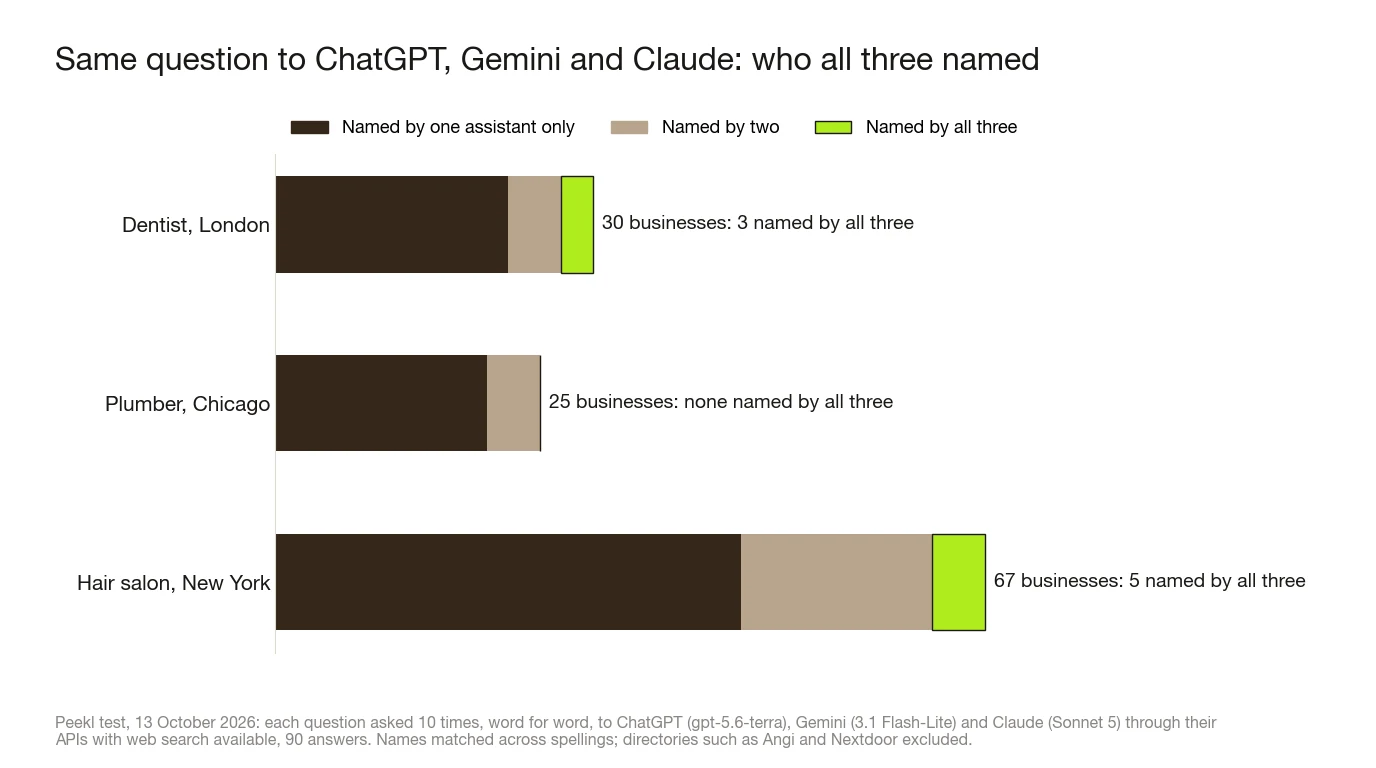
Rarely. On 13 October 2026 we asked ChatGPT, Gemini and Claude the same three local questions, 10 times each. Of the 122 businesses they named, 8 came up on all three assistants and 86 on only one. Claude did not name a single plumber in 10 answers. What one assistant says about you tells you little about the other two.
Below are the side-by-side results for each question, why Claude so often named no one, and how the picture compares with our wider study of 756 ChatGPT and Gemini answers. Why the assistants read different sources in the first place is covered in how AI decides which businesses to recommend.
- Of 122 businesses named across 90 answers, 8 were named by all three assistants and 86 by only one.
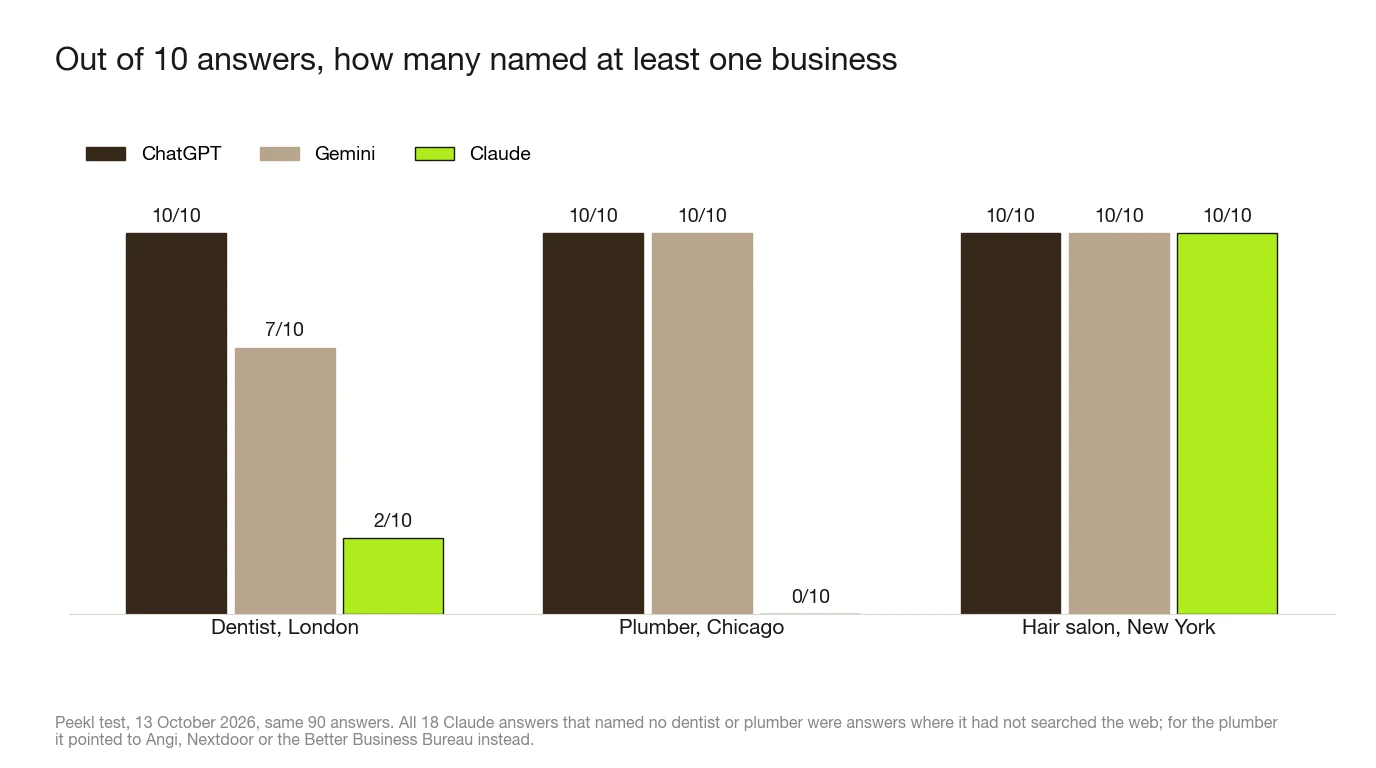
- No Chicago plumber was named by all three: Claude named none in 10 answers and pointed to Angi, Nextdoor or the Better Business Bureau instead.
- Claude searched the web in 8 of its 30 answers. Without a search, it named no dentist and no plumber, and for the hair salon only well-known names.
- Gemini repeated itself most: three Chicago plumbers came up in all 10 of its answers. ChatGPT's most-named business came up in 6 or 7 of 10.
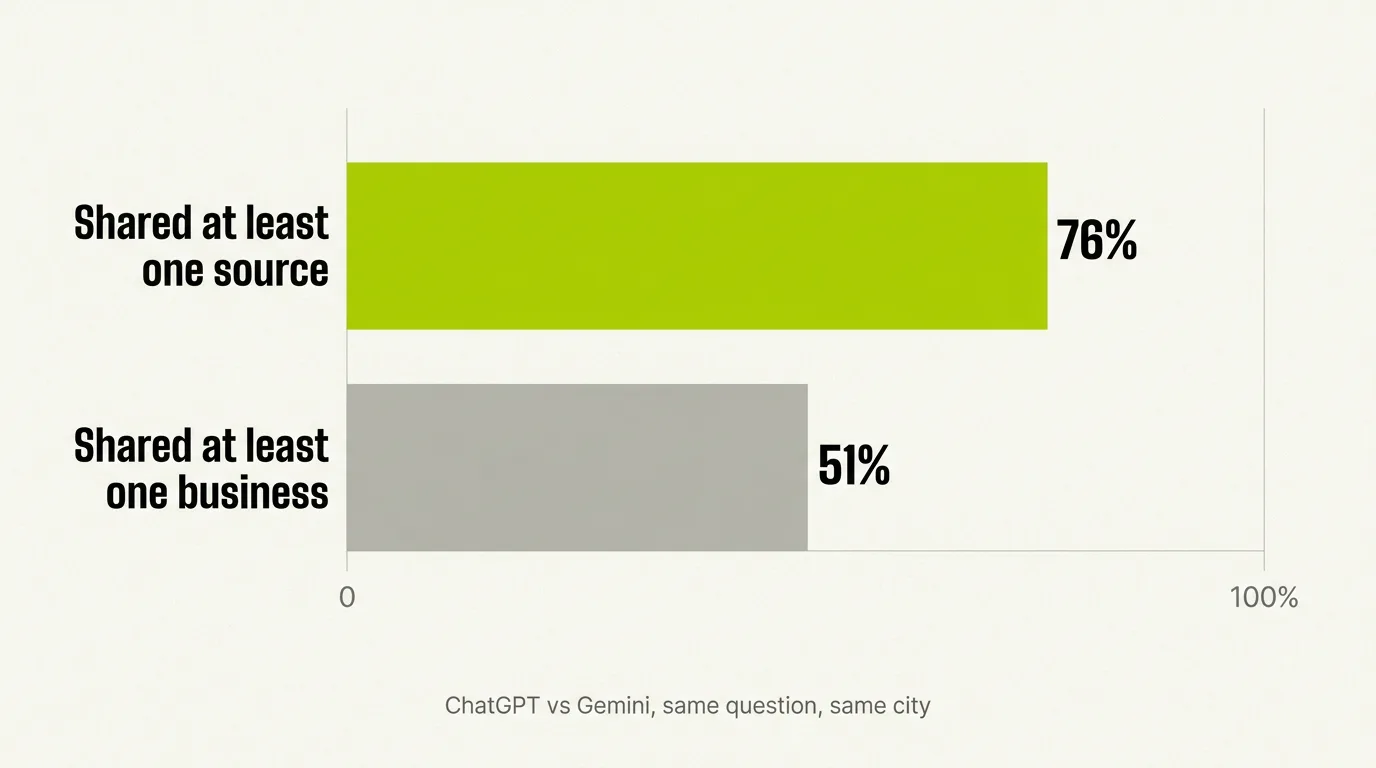
- In our wider 756-answer study, ChatGPT and Gemini had a recommended business in common for the same trade and city only 51% of the time.
How did we compare ChatGPT, Gemini and Claude?
We asked each assistant three questions a customer might type, word for word, 10 times each: "Who is the best dentist in London?", "Can you recommend a good plumber in Chicago?" and "What is the best hair salon in New York?". That is 90 answers, collected on 13 October 2026 through each maker's API with web search available: ChatGPT (gpt-5.6-terra), Gemini (3.1 Flash-Lite) and Claude (Sonnet 5). Each assistant decided for itself whether to search.
We counted every business named, matching spellings so that one business counts once, and left out directories and marketplaces such as Angi and Nextdoor. No location or chat history was involved, so the differences come from the assistants alone. The apps can add both, which only widens the gap between two customers; read this as how the three models behave, not as a screenshot of what one person sees (how we test).
It is a small, focused test: three questions, three cities, one day, and the lighter Gemini model Peekl uses in its audits. It shows how far the assistants can diverge on an identical question, not a ranking of who is right.
Who did each assistant name for the same question?
Mostly different businesses, even when all three answered every time. The table lists, for each question, how many of the 10 answers named at least one business and which businesses came back in at least half of them. These regulars are the closest thing each assistant has to a favourite, and they barely overlap.
For the London dentist, no assistant's regular was a regular for another. Harley Street Dental Clinic, named in 7 of Gemini's answers, appeared once on ChatGPT and once on Claude. For the New York salon, Suite Caroline came up in 9 Gemini answers and 7 Claude answers but in only 1 of ChatGPT's. The plumber is the only question where ChatGPT and Gemini shared regulars: both named Vanguard Plumbing & Sewer and Rescue Plumbing in at least half of their answers.
| Question | ChatGPT | Gemini | Claude |
|---|---|---|---|
| Dentist, London: answers naming a dentist | 10 of 10 | 7 of 10 | 2 of 10 |
| Dentist, London: named in 5 or more answers | Serio Dental (6) | Harley Street Dental Clinic (7), Bow Lane Dental Group (7), The Dental Surgery (5) | None |
| Plumber, Chicago: answers naming a plumber | 10 of 10 | 10 of 10 | 0 of 10 |
| Plumber, Chicago: named in 5 or more answers | Vanguard Plumbing & Sewer (6), Rescue Plumbing (6) | Vanguard, Rescue Plumbing and First Chicago Plumbing (10 each), ABC Plumbing (8) | None |
| Hair salon, New York: answers naming a salon | 10 of 10 | 10 of 10 | 10 of 10 |
| Hair salon, New York: named in 5 or more answers | David Mallett (7), NYC The Team Salon (6), MEY New York (6), Shear Bliss NYC (5) | Suite Caroline (9), Federico Salon (9), Abby Haliti Color Studio (8), 3 more | Rita Hazan, Sally Hershberger, Suite Caroline (7 each), 5 more |
How many businesses did all three assistants name?
Very few: 8 of the 122. Three of the 30 London dentists were named at least once by every assistant, none of the 25 Chicago plumbers and 5 of the 67 New York salons. Being named by one assistant only was the norm, for 86 businesses, and even those eight were rarely steady: only Suite Caroline came back in at least half of the answers on two assistants.
The salon question produced the most names, 67, because Claude listed up to 14 salons per answer. More names did not mean more agreement: 44 of those salons were still named by a single assistant.
Why did Claude name no plumber?
In this test, every answer in which Claude named nobody was one where it had not searched the web. Claude decides for each question whether to look things up, and it searched in only 2 of its 10 dentist answers, none of its plumber answers and 6 of its salon answers. In the 18 dentist and plumber answers without a search, it named no business at all; for the plumber it pointed to Angi, Nextdoor or the Better Business Bureau in 6 answers instead.
For the salon it named businesses even without searching, in 4 answers, but those were well-known, long-running names such as Sally Hershberger, Oscar Blandi and Frédéric Fekkai. Salons such as Fox & Jane, Miss Rizos and Bloom Beauty Lounge came up only in answers where Claude had searched. So for most local businesses, being named by Claude depends on two things: Claude choosing to search, and then finding you on the pages it reads. How to check if Claude recommends your business covers what those pages are.
In the Claude app, people can also turn web search on or off, which changes the same pattern again. That is one more reason to test Claude separately rather than assume it follows ChatGPT.
Do ChatGPT and Gemini agree with each other more often?
Not much more. Across the three questions in this test, ChatGPT and Gemini had 17 businesses in common, against 21 for Gemini and Claude and 14 for ChatGPT and Claude. The larger picture comes from our earlier study of 756 answers about seven trades in nine cities: for the same trade and city, ChatGPT and Gemini named at least one business in common only 51% of the time.
They agreed far more on what to read than on whom to name: in 76% of those cases they cited at least one website in common. The same directories and review sites fed both, and each still reached its own shortlist. Which websites AI trusts lists those sources and explains the method.
What does this mean when you check your own business?
Check each assistant on its own, and more than once. Someone who asked ChatGPT once for a London dentist would most likely have seen Serio Dental, named in 6 of its 10 answers, with no hint that Gemini's regulars were three other practices or that Claude usually named nobody. One answer from one assistant is a sample of one. Our larger Gemini study found the same on one assistant alone: asked three times, only 1 in 4 named businesses came back every time.
Then read the gaps per assistant rather than as one score: on ChatGPT and Gemini it is about which pages each one reads, on Claude also about whether it searches at all. The guides on ChatGPT, Gemini and Claude show how to check each by hand. Peekl's free check asks ChatGPT or Gemini twelve of your customers' questions; the full audit asks all three, three times each.
Common questions
Do ChatGPT, Gemini and Claude give the same recommendations?
Why does Claude sometimes not recommend any local business?
Which AI assistant is the most consistent about local businesses?
How often do ChatGPT and Gemini recommend the same business?
Is checking ChatGPT enough to know if AI recommends me?
See where you stand
Reading about AI search is useful; knowing your own place in it is what helps. A free Peekl check asks ChatGPT or Gemini, your pick, the questions your customers ask and shows whether it recommends you today, who it names instead, and how often. The full audit runs the same questions on all three assistants, Claude included.
More in this series: Understanding AI search
- AI searchability: the complete guide to AI search optimization
- AI search vs Google: does a good Google ranking get you named by AI?
- Do people really use ChatGPT to find local businesses?
- How do ChatGPT and Gemini decide which local businesses to recommend?
- Why isn't my business showing up in ChatGPT and other AI assistants?
- Which websites does AI trust when it recommends a local business?
- How Gemini recommends local businesses: a study of 1,926 answers
- Does Reddit help AI recommend your local business? What we measured
- What is Google AI Mode, and what it means for local businesses
- What is answer engine optimization (AEO)?
- AEO vs GEO: what's the difference, and does it matter?