Which websites does AI trust when it recommends a local business?
Part of our series on Understanding AI search. The reference guide is the complete guide to AI searchability.
When ChatGPT or Gemini recommends a local business, it is not speaking from memory. It is repeating what a small set of websites it trusts already say. To see which ones, we recorded every source both assistants cited across 756 answers about local trades, running the same questions through ChatGPT and Gemini for every trade and city. They lean on directories, booking platforms and review sites far more than on any business's own website.
The most striking part only showed up because we ran both assistants side by side: they rarely name the same business, even for the identical question. This is what the data showed, the exact sites AI reached for, how ChatGPT and Gemini differ, and how the picture shifts by country and trade. For how those recommendations are formed in the first place, see how AI decides which businesses to recommend.
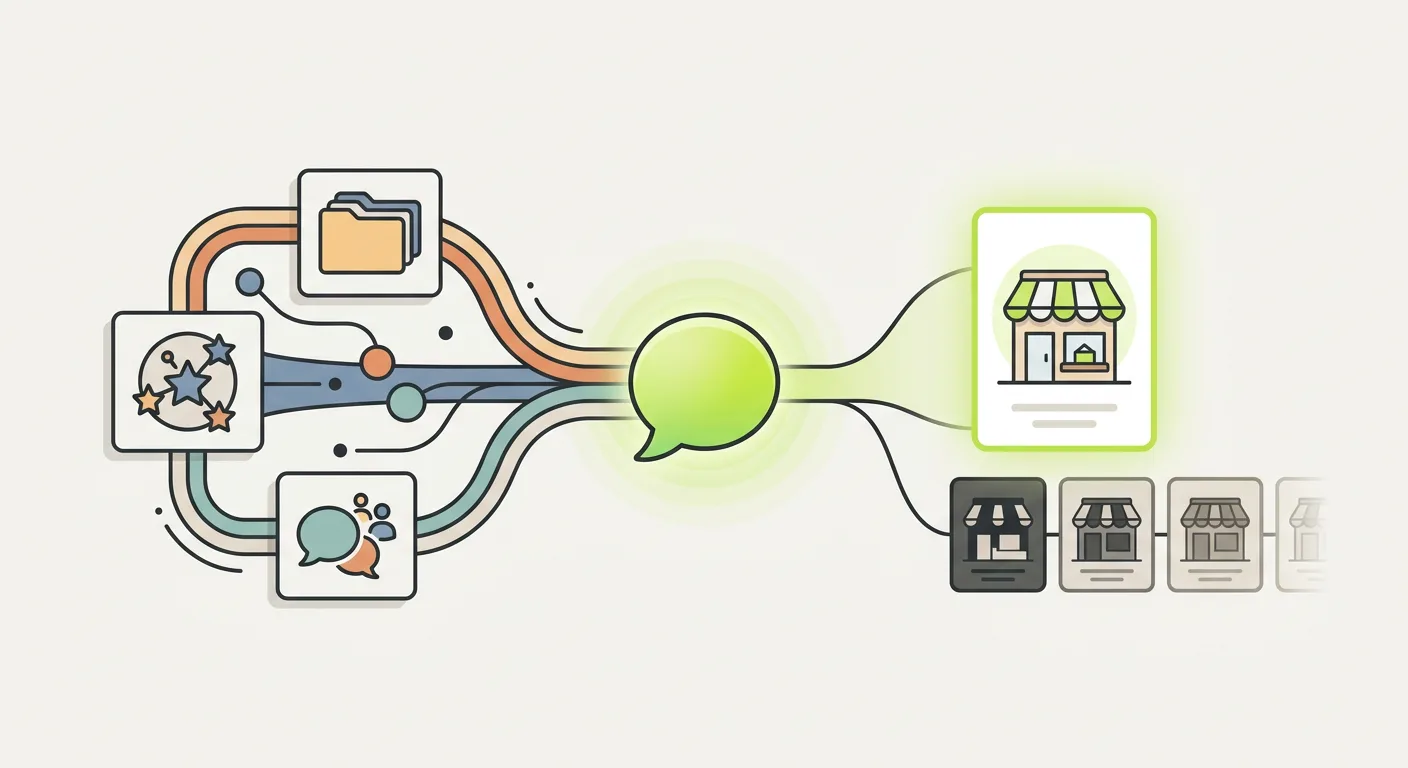
- AI picks who to recommend from third-party sources, directories, booking platforms and review sites. Your own website mostly gets cited once you have already been picked.
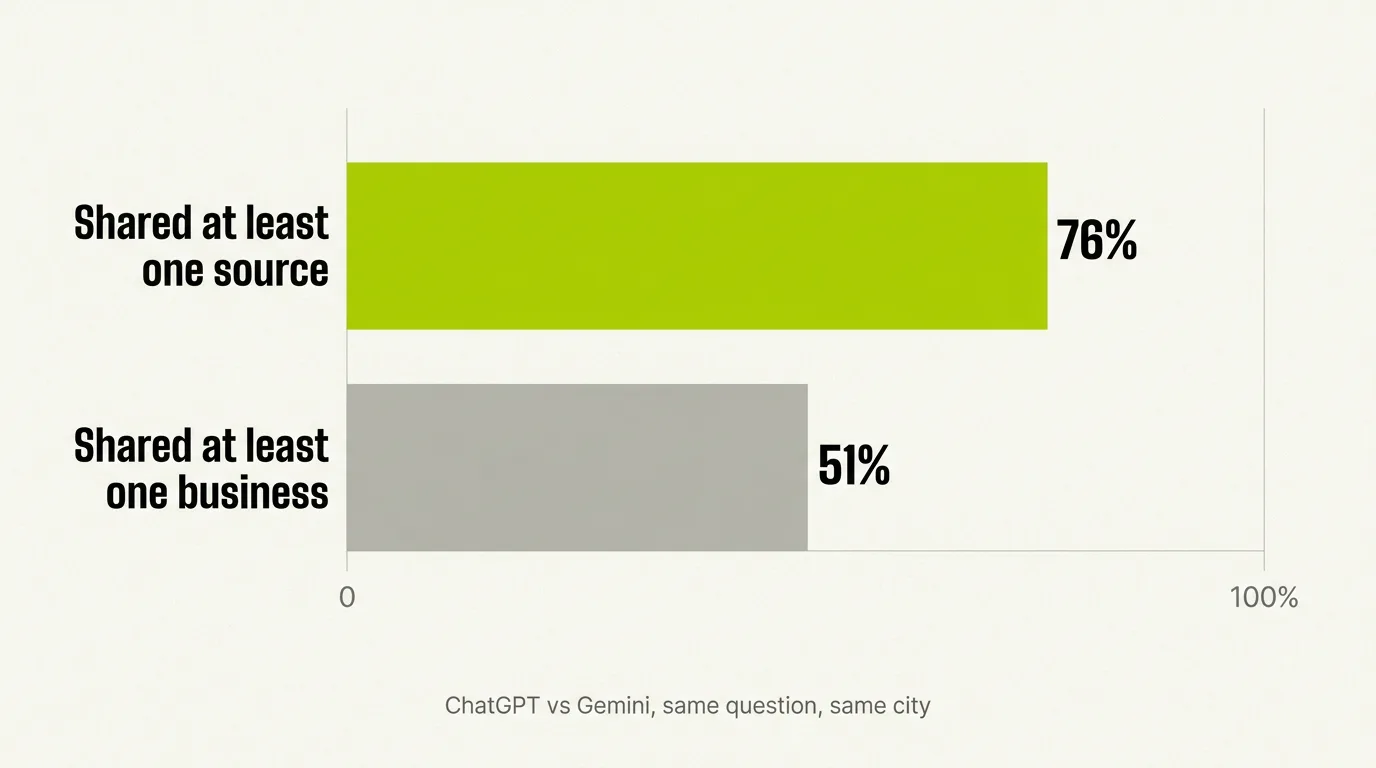
- ChatGPT and Gemini rarely agree on who to name: for the same trade and city, they shared at least one recommended business only 51% of the time.
- But they lean on similar sources: they shared at least one top source 76% of the time. ChatGPT favours official and professional bodies (ameli.fr, has-sante.fr, the NHS, medical associations); Gemini favours booking platforms, Reddit and Facebook.
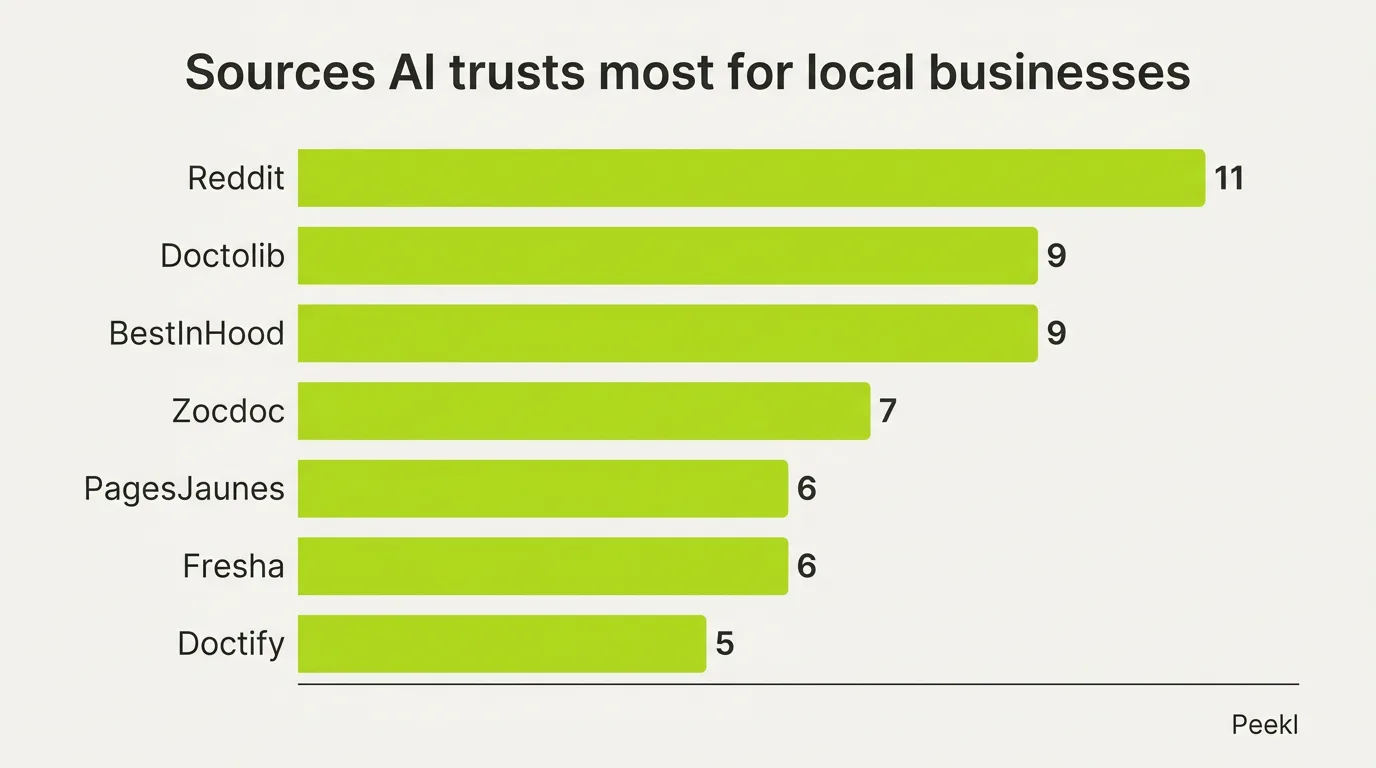
- The trusted sources differ by country too (Doctolib and PagesJaunes in France; Zocdoc and the NHS in the US and UK), and Doctolib was the single most-cited source overall.
- 940 different sources appeared across the study, 786 only once: a long tail of niche listings matters, and being named on the sources for your trade and town is what gets you recommended.
How we measured which sources AI trusts
We ran the questions real customers ask, like "best dentist in Chicago" or "a good plumber near me", through ChatGPT and Gemini, for seven local trades across nine cities in the US, UK, UAE and France. Then we recorded the sources behind every answer. In the latest pass we ran every trade-and-city combination through both assistants, so the two can be compared directly.
That came to 126 checks, one trade in one city on one assistant, each with about six real customer questions, for 756 answers and 940 different websites cited. It is a focused snapshot, not a web-scale study: it covers local-service businesses, two assistants and a point in time, so treat the numbers as a clear signal rather than the last word. What makes it useful is that it looks at exactly the thing most studies skip, which sources AI trusts specifically for local recommendations, and now how two assistants differ on the same question.
Which websites does AI cite most for local businesses?
Across every trade and city, the same kinds of sites kept coming back: booking platforms, directories and review sites. The chart and table below show the sources cited in the most separate checks, out of 108, with how many times each was named.
| Source | What it is | In checks | Times cited |
|---|---|---|---|
| pagesjaunes.fr | Business directory (France) | 14 | 31 |
| doctolib.fr | Health booking (France) | 13 | 48 |
| reddit.com | Community forum | 9 | 18 |
| fresha.com | Salon & spa booking | 9 | 18 |
| rotorooter.com | National plumbing service | 8 | 26 |
| ameli.fr | French health-insurance directory | 8 | 12 |
| zocdoc.com | Doctor booking (US) | 7 | 20 |
| aad.org | American Academy of Dermatology | 7 | 9 |
| planity.com | Salon booking (France) | 6 | 23 |
| thumbtack.com | Services marketplace (US) | 6 | 15 |
| treatwell.fr | Salon booking (France) | 6 | 15 |
| facebook.com | Social network, local groups | 6 | 12 |
| zillow.com | Property portal (US) | 6 | 12 |
| has-sante.fr | French health authority | 5 | 12 |
| dentego.fr | Dental network (France) | 5 | 10 |
| doctify.com | Doctor review platform | 5 | 9 |
Does AI cite your own website?
The clearest finding is about the order of events. Businesses' own websites do get cited, and often: about 62% of all citations pointed at one. But almost all of those were the sites of businesses the assistant had already chosen, linked as the place to visit. The choosing itself leaned on third parties, directories, booking platforms, review sites and forums that list many businesses. No single company site carried an answer on its own; a handful of clinics surfaced across a few checks, which reflects many practices in aggregate. For how to tell the two kinds of citation apart in your own results, see how to track AI sources.
That is the heart of it for an owner. A polished website reassures the customers who already found you, but it does little to get you named in the first place, because the assistant is reading the directories and booking platforms, not your homepage. Being present and well-reviewed on those third-party sources is what puts you in the answer. This is why a great business can still be invisible to AI.
Do different AI assistants recommend the same business?
This is the finding that surprised us most, and it only appeared because we asked both assistants the same questions. For a given trade and city, ChatGPT and Gemini shared at least one recommended business only 51% of the time. On average they overlapped on less than one business per question. Almost half the time, the two assistants your customers use hand out completely different names.
For an owner the implication is blunt: being recommended by one assistant tells you almost nothing about the other. You cannot check ChatGPT, see your name, and assume Gemini agrees, the odds are roughly a coin flip. This is exactly why it is worth measuring across the assistants your customers actually use, several times each, rather than trusting a single lucky answer. For how the three main assistants diverge, see do the assistants recommend the same businesses.
Which sources does each assistant trust?
The reason they disagree becomes clearer when you look at what each one reads. ChatGPT and Gemini shared at least one top source 76% of the time, so they draw on a similar pool, but they weight it very differently. ChatGPT leaned toward official and professional bodies; Gemini leaned toward booking platforms, community forums and social sites. Same question, different instincts about who to trust.
| Assistant | Leans toward | Its most-cited sources |
|---|---|---|
| ChatGPT | Official & professional bodies | ameli.fr, aad.org, has-sante.fr, economie.gouv.fr, the Dubai Health Authority, PagesJaunes, Doctolib |
| Gemini | Booking platforms & communities | Doctolib, Reddit, Zocdoc, Facebook, Thumbtack, Bark |
Which sources does AI trust in each country?
There is no single global list. The sites AI trusted in France were almost entirely different from the ones it trusted in the US and UK, because the assistants reach for the directories and platforms that dominate each market. France produced 278 distinct sources, the US 436, the UK 127 and the UAE 120.
| Market | Sources AI leaned on most |
|---|---|
| France | Doctolib, PagesJaunes, Ameli, Has-sante, Planity, Treatwell, SeLoger, MeilleursAgents |
| US & UK | Zocdoc, the NHS, Rotorooter, Reddit, Thumbtack, Zillow, RealTrends, AAD |
| UAE (Dubai) | Dubai Health Authority, the Dubai Land Department and local directories |
Which sources does AI trust for each trade?
Within a country, each trade has its own set of trusted sources too. A dentist and a hair salon are recommended from almost entirely different places, so a generic "get on the big directories" misses the ones that actually matter for you.
| Trade | Sources AI leaned on most |
|---|---|
| Dentists | Doctolib, Dentego, Zocdoc, Ameli |
| Aesthetic clinics | Doctolib, AAD, medical-spa directories, clinic sites |
| Physiotherapists | Doctolib, Has-sante, the NHS, Libheros |
| Plumbers | Rotorooter, Thumbtack, Travaux.com, Bark |
| Hair salons | Fresha, Planity, Treatwell |
| Personal trainers | Superprof, Ownsport, Thumbtack |
| Estate agents | Zillow, RealTrends, FastExpert, SeLoger, MeilleursAgents |
The long tail: the niche sources AI also cites
The well-known platforms are only part of the story. Of the 940 sources we saw, 786 appeared in just a single check, a long tail of local directories, trade-specific listings, city guides and even individual businesses' own pages that an assistant surfaced for one particular question.
So the honest picture is two-layered. The anchor platforms above are the reliable, cross-market bets, but a lot of local visibility is won on niche, trade-and-town-specific sources that never make a global top ten, and that differ between the assistants. It is worth checking which ones name businesses like yours: that long tail is where a lot of untapped local visibility sits.
What this means for your business
The practical version is short. AI recommends the businesses that the sources it trusts already carry, so the work is to become one of those names on the sources for your trade and your town, not to polish a website the assistant barely reads. And because ChatGPT and Gemini so often disagree, you have to think in terms of every assistant your customers use, not just the one you happened to check.
That means getting listed and well-reviewed on the booking platforms and directories above that fit your trade, keeping your details consistent, and earning the genuine reviews and mentions that feed the answers. For the full method, see how to improve your AI search visibility. To see which sources name you today, across ChatGPT, Gemini and Claude, and which name competitors instead, a free Peekl check traces the sources behind your own results.
Common questions
Which websites does AI use to recommend local businesses?
Do different AI assistants recommend the same businesses?
Does AI recommend businesses from their own website?
How do I get on the sources AI trusts?
Which directories does AI trust most for local businesses?
How do I find out which sources AI cites for my trade and town?
How big was this study?
See where you stand
Reading about AI search is useful; knowing your own place in it is what helps. A free Peekl check asks ChatGPT or Gemini, your pick, the questions your customers ask and shows whether it recommends you today, who it names instead, and how often. The full audit runs the same questions on all three assistants, Claude included.
More in this series: Understanding AI search
- AI searchability: the complete guide to AI search optimization
- What is AI search? A plain-English guide for small business owners
- AI search vs Google: what's changing for small businesses
- Do people really use ChatGPT to find local businesses?
- How do AI assistants decide which local businesses to recommend?
- Why your business might be invisible to AI (and why it matters)
- ChatGPT, Gemini and Claude: do they recommend the same businesses?
- What is Google AI Mode, and what it means for local businesses
- What is answer engine optimization (AEO)?
- AEO vs GEO: what's the difference?