AI search vs Google: does a good Google ranking get you named by AI?
Part of our series on Understanding AI search. The reference guide is the complete guide to AI searchability.
Not reliably. We put 242 customer questions from our Gemini study to Google Maps, word for word: only 36% of the businesses Gemini named were in Maps' top 20 for the same question, and Gemini named Maps' first result in 35% of cases. Google still handles most searches, so AI search is a second shortlist to be on, with different rules.
- Google still runs about 90% of searches worldwide (StatCounter, September 2026), but 45% of US consumers now use ChatGPT or another AI tool for local recommendations, up from 6% in the survey's previous edition (BrightLocal, February 2026).
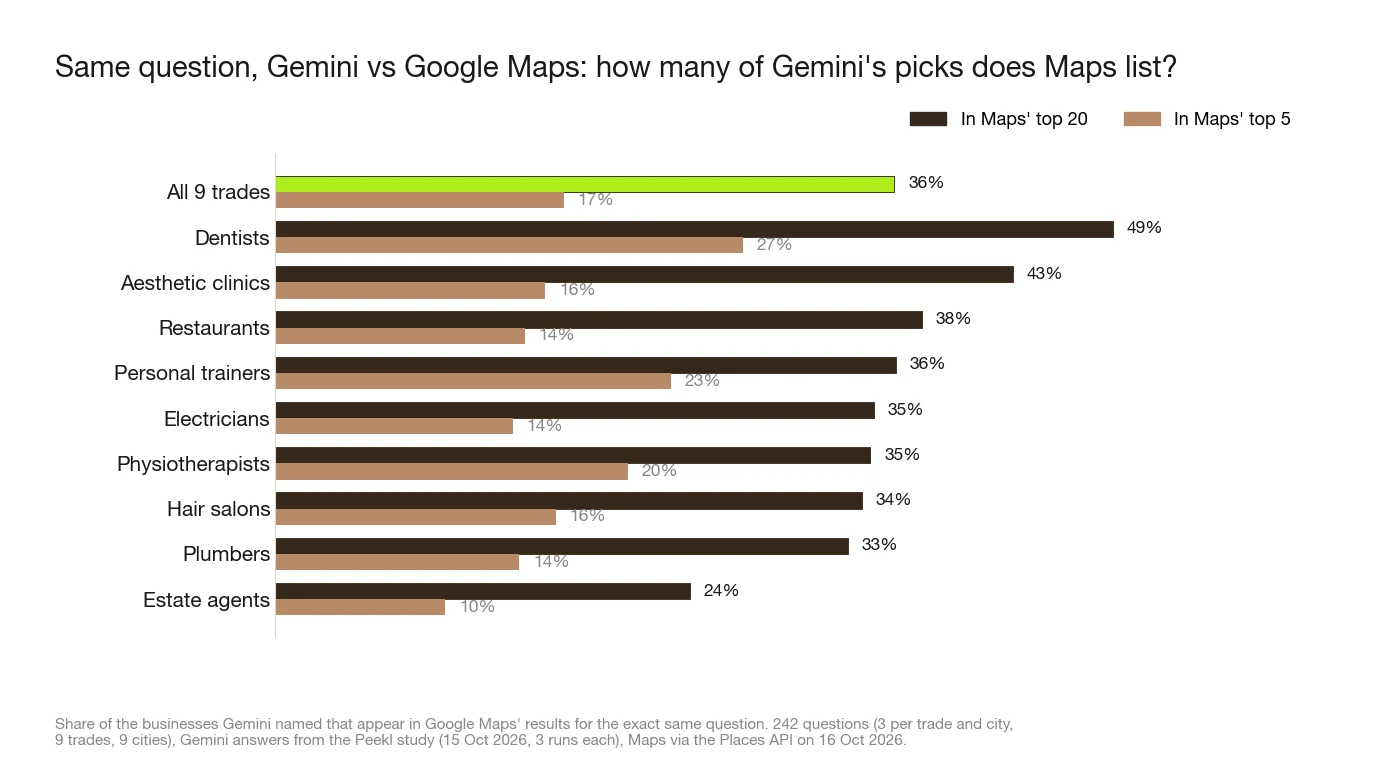
- Same question, different shortlist: 36% of the businesses Gemini named were in Google Maps' top 20 for that exact question, and 17% in its top 5 (Peekl test, 16 October 2026).
- ChatGPT looked further from Maps in a separate test: 24% of the businesses it named most in our September scans appear anywhere in Maps' results for the same trade and city.
- Among businesses in Maps' top 20, the ones Gemini named had more reviews (median 398 against 284) but the same 4.9 rating.
Is AI search replacing Google for finding local businesses?
No, it is being added on top. Google handled 89.94% of searches worldwide in September 2026, and Bing 5.29% (StatCounter). What changed is how many people also ask an assistant. In BrightLocal's 2026 survey of 1,002 US adults, use of ChatGPT and other AI tools for local recommendations rose from 6% to 45%, while Google as a source fell from 83% to 71% and Apple Maps rose from 14% to 27% (BrightLocal, February 2026).
Google is also an AI product now. It says AI Overviews have more than 2.5 billion monthly users and AI Mode passed one billion (Google, May 2026), and Ask Maps answers conversational questions inside Google Maps, in more than 150 countries in English since August 2026 (Google). On the other side, OpenAI reported 1.2 billion weekly ChatGPT users on 29 September 2026 (OpenAI). So a customer can meet your trade in three places: Google's classic results and map, Google's own AI answers, and other assistants.
| Where the customer asks | What they get | Where the names come from |
|---|---|---|
| Google search and Maps | A ranked list and a map of many businesses | Your Business Profile, ranked by relevance, distance and how well known you are |
| Google's AI: AI Overviews, AI Mode, Gemini, Ask Maps | A written answer naming a few businesses | Google's index and Maps data, plus the web pages Gemini searches |
| ChatGPT | A written answer naming a few businesses | Web pages from its search partners, plus third-party business listings |
| Microsoft Copilot | A written answer | Bing search |
If you rank well on Google Maps, will AI recommend you too?
Sometimes, but less often than most owners expect. In October 2026 we took three questions per trade and city from our Gemini study, such as "What are the top 5 plumbers in Los Angeles?" or "Quel est le top 5 des cliniques esthétiques à Marseille ?", and sent each one, word for word, to Google Maps through Google's Places API, which serves the same place data as the Maps app. Of 243 questions across 9 trades and 9 cities, 242 came back, each with Maps' top 20 and the businesses Gemini named in three separate answers. A second Gemini model matched names between the two lists, ignoring keyword-stuffed listing names; we checked a sample by hand, and a strict name-matching rule gave almost the same result (37% instead of 36%). Neither side had a user location, so a customer standing nearby would see a different map.
Of the 1,826 businesses Gemini named, 36% were somewhere in Maps' top 20 for the same question, 26% in its top 10 and 17% in its top 5. Read the other way, which measures something different, the business Maps put first was named by Gemini in at least one of the three answers for 35% of questions, and Gemini's own first name matched Maps' first result in only 11% of answers. This is Maps rank, not the ranking of your website in Google's ordinary results.
The gap depends on the trade. Dentists overlapped most: 49% of Gemini's picks were in Maps' top 20. Estate agents overlapped least, at 24%. The overlap was also lower in Paris, Lyon and Marseille (32%) than in the six English-speaking cities (38%).
Why does Gemini pick differently from Google Maps when both are Google?
Because they rank different things. Google says its local results weigh relevance, distance and prominence, meaning how well known a business is from its reviews and the sites that mention it (Google). Gemini instead writes an answer: in our study it ran about three web searches per answer and read seven or eight sources, then named the businesses those pages agreed on.
A seafood question in Dubai shows the split. Asked which seafood restaurant has the highest ratings and most consistent reviews, Maps led with casual places such as Off The Hook and Sardina. Gemini named Estiatorio Milos, Ossiano and Pierchic, the restaurants that food guides and best-of lists write about, and only one of its ten picks was in Maps' top 20. When guides and Maps agree, so do the two: for the top 5 plumbers in Los Angeles, seven of Gemini's nine picks were in Maps' top 13, including Maps' first three.
One part of Maps did carry over: review volume. Among the businesses in Maps' top 20, the 646 that Gemini also named had a median of 398 reviews, against 284 for the 3,835 it left out, while both groups had the same median rating of 4.9. That fits Google's own description of prominence. It is a link, not proof that reviews cause a mention.
Does ChatGPT use Google's results?
Not directly. OpenAI says ChatGPT search "sometimes partners with other search providers", and that it may share your approximate location with trusted third-party providers to show nearby business listings (OpenAI). How AI decides which businesses to recommend covers what is known about those partners.
ChatGPT was tested differently, so treat its figure as a pointer rather than a like-for-like comparison. Of the 420 businesses it named most often in our September 2026 scans of 42 trade and city pairs, 24% appear anywhere in Google Maps' results for the same trade and city. SOCi's 2026 index of more than 350,000 brand locations points the same way: ChatGPT named just 1.2% of those locations, against 35.9% that made Google's local three-pack (SOCi, January 2026).
What should a local business do differently for AI search?
Keep the Google work and add a second scorecard. Your Business Profile still feeds Maps, Gemini and AI Mode, so it stays the base. What AI search adds is the wider web: the guides, lists, directories and review sites the assistant reads before it answers. The table splits the work by where it pays off.
| Work | Helps on Google Maps | Helps in AI answers | How to check it |
|---|---|---|---|
| A complete, accurate Business Profile | Yes, directly | Yes, for Gemini, AI Mode and Ask Maps | Your profile's Performance tab |
| A steady flow of reviews | Yes, through prominence | Yes: named businesses had more reviews in our test | Your review count against nearby rivals |
| Being on local best-of lists and guides | A little, as mentions | Frequently what Gemini cites in our study | Search your trade and town and see who is listed |
| A Bing Places listing | No | Yes, for Copilot and possibly ChatGPT | Bing Places for Business |
| Asking the assistants your customers' questions | No | It is the only way to know | A free AI visibility check |
Common questions
Is Google Maps ranking the same as being recommended by Gemini?
Will AI search make local SEO useless?
Does Bing matter now?
How do I see which businesses AI names instead of mine?
See where you stand
Reading about AI search is useful; knowing your own place in it is what helps. A free Peekl check asks ChatGPT or Gemini, your pick, the questions your customers ask and shows whether it recommends you today, who it names instead, and how often. The full audit runs the same questions on all three assistants, Claude included.
More in this series: Understanding AI search
- AI searchability: the complete guide to AI search optimization
- Do people really use ChatGPT to find local businesses?
- How do ChatGPT and Gemini decide which local businesses to recommend?
- Why isn't my business showing up in ChatGPT and other AI assistants?
- Do ChatGPT, Gemini and Claude recommend the same businesses? We asked all three 10 times
- Which websites does AI trust when it recommends a local business?
- How Gemini recommends local businesses: a study of 1,926 answers
- Does Reddit help AI recommend your local business? What we measured
- What is Google AI Mode, and what it means for local businesses
- What is answer engine optimization (AEO)?
- AEO vs GEO: what's the difference, and does it matter?