Do people really use ChatGPT to find local businesses?
Part of our series on Understanding AI search. The reference guide is the complete guide to AI searchability.
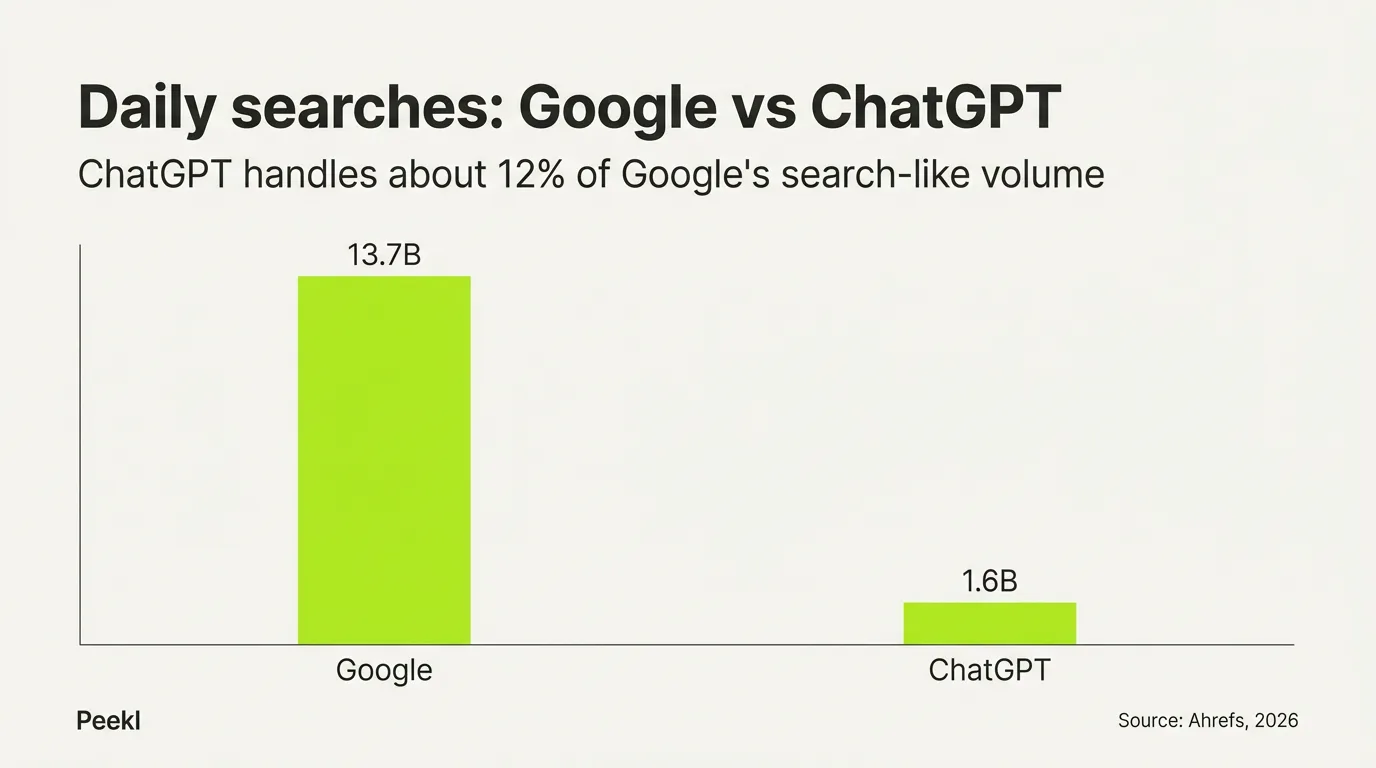
Yes. Nobody publishes a count of local-business questions specifically, but ChatGPT already handles about 12% of Google's search-like volume (Ahrefs, February 2026), and many of those questions are the decision-stage kind a local business lives on: who to call, where to go, who to trust near me. Google is still far larger, so this is a second channel to be visible in, not a replacement.
- People increasingly ask ChatGPT and other assistants for local recommendations, at the moment they are ready to choose.
- ChatGPT handles about 12% of Google's search-like volume (Ahrefs, February 2026): far smaller than Google, but a very large number of real questions.
- There is no published figure for local-business questions specifically, so treat any precise number for that as a guess.
- Whoever an assistant names wins the moment, because the customer usually acts on that short list without looking further.
How many people use ChatGPT to find local businesses?
There is no official count of people using ChatGPT specifically to find local businesses, so be wary of anyone quoting one. What is documented is the scale of the habit around it: OpenAI has said ChatGPT reaches hundreds of millions of people every week, and a growing share of them have started reaching for an assistant the way they used to reach for a search box, including for everyday, practical questions about where to go and who to hire.
How much of Google's search volume has moved to ChatGPT?
In an analysis published in February 2026, Ahrefs found that ChatGPT now handles about 12 percent of Google's search-like query volume. ChatGPT processes roughly 2.5 billion prompts a day against Google's 13.7 billion searches, but only about two-thirds of those prompts, roughly 1.6 billion a day, look like the kind of thing people used to type into Google. That narrower slice, not the full 2.5 billion, is where the 12 percent comes from.
Be honest about what that means. Google is still far larger, and it sends far more visitors to websites, so this is not the death of search. But 12 percent of Google's volume is an enormous number of real questions, and a growing share of them are the decision-stage, who-should-I-use-near-me questions your next customer asks. Being absent from that slice is not a rounding error; it is a channel you cannot see, quietly sending people to whoever gets named instead.
What do people ask ChatGPT when looking for a local business?
The local questions people put to assistants look a lot like the ones they'd ask a well-informed neighbour: the best option in a particular area, who to see for a specific problem, somewhere good for a specific occasion, a trustworthy name for an urgent job. These are decision-stage questions, asked by people ready to act.
That's what makes them valuable. Someone asking an assistant to recommend a business in your category and area isn't browsing; they're close to choosing. Whoever gets named has a real shot at the customer, often before that customer has looked anywhere else at all. Our own Gemini study asked questions like "Who is the best dentist in Lincoln Park, Chicago?" 1,926 times across nine trades and found it naming specific businesses and citing 4,474 different websites to do it; see which websites AI trusts.
When are people most likely to ask AI for a local business?
In unfamiliar moments: someone who has just moved, is travelling, or faces a problem they have never had before. They have no local habit to fall back on, so they ask. For many trades those newcomers are the main source of new customers, which is why their questions matter more than their numbers suggest. To see whether the assistants name you when they ask, read why your business might not be showing up in AI search.
Common questions
Aren't people still mostly using Google?
How many people use ChatGPT every week?
See where you stand
Reading about AI search is useful; knowing your own place in it is what helps. A free Peekl check asks ChatGPT or Gemini, your pick, the questions your customers ask and shows whether it recommends you today, who it names instead, and how often. The full audit runs the same questions on all three assistants, Claude included.
More in this series: Understanding AI search
- AI searchability: the complete guide to AI search optimization
- AI search vs Google: does a good Google ranking get you named by AI?
- How do ChatGPT and Gemini decide which local businesses to recommend?
- Why isn't my business showing up in ChatGPT and other AI assistants?
- Do ChatGPT, Gemini and Claude recommend the same businesses? We asked all three 10 times
- Which websites does AI trust when it recommends a local business?
- How Gemini recommends local businesses: a study of 1,926 answers
- Does Reddit help AI recommend your local business? What we measured
- What is Google AI Mode, and what it means for local businesses
- What is answer engine optimization (AEO)?
- AEO vs GEO: what's the difference, and does it matter?