How to check if Claude recommends your business
Part of our series on Measuring your AI visibility. The reference guide is the guide to AI visibility metrics.
To check if Claude recommends your business, open Claude and ask the questions your customers ask, like who to hire near them for what you do, then see whether it names you. If you would rather have it counted for you, the Claude visibility checker puts fifteen customer questions to Claude three times each inside the Peekl audit. Claude tends to be more careful than other assistants: it may give fewer names, or ask where you are before it answers, and that caution changes what it takes to be one of the names it does give.
This guide walks through a five-step Claude check you can run in an hour, a Yes or Not yet self-score built around the way Claude decides, and what we saw when we put 45 Claude answers about one clinic next to the same questions on ChatGPT and Gemini.
- Ask Claude the questions your customers ask, with your trade and town, and note whether it names you, names a rival, or holds back.
- When it has web search turned on, Claude looks things up rather than guessing, then tends to name only businesses it can describe with confidence.
- Because Claude is cautious, its lists are often shorter, so the bar to be included is higher, not lower.
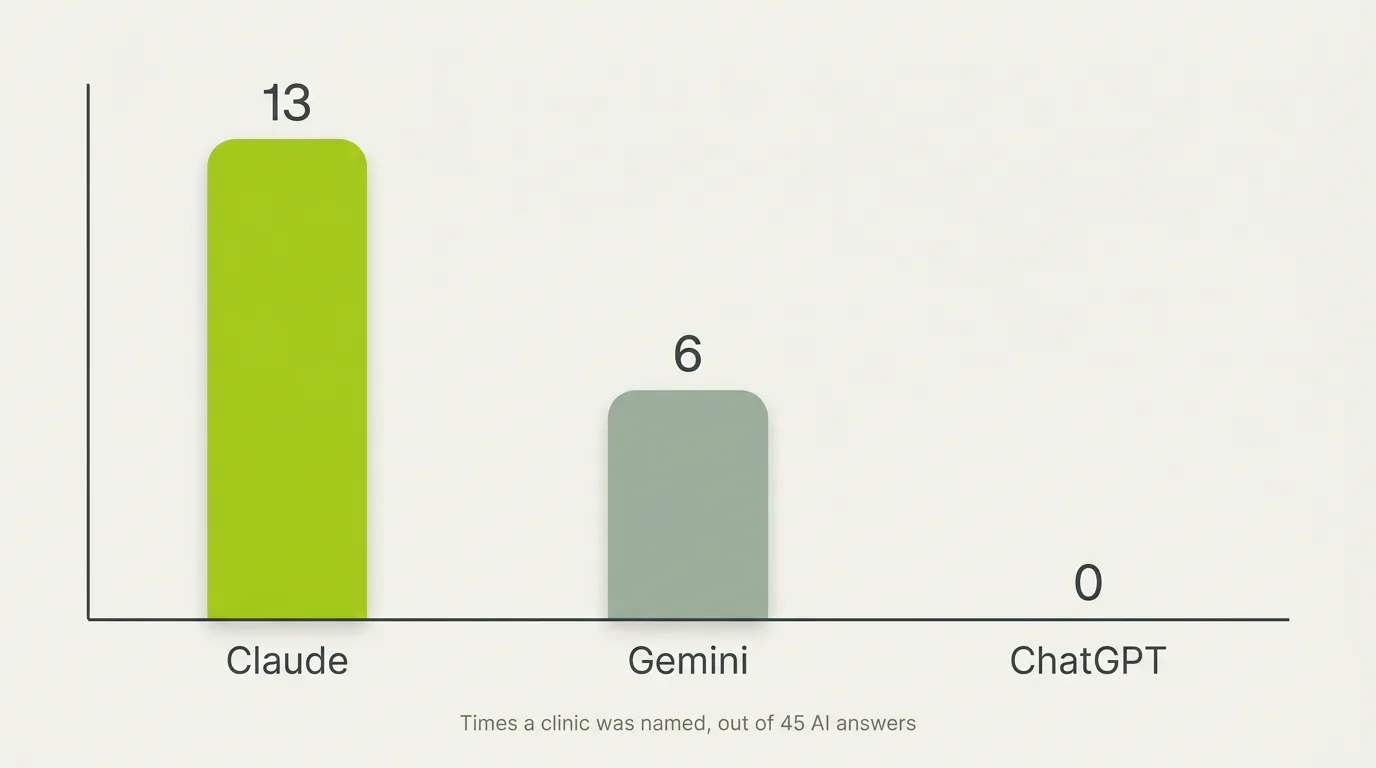
- Repeat the question. Claude named one clinic in 13 of 45 answers, yet just one question out of 15 produced its name on every run.
How to check what Claude says about you
Open Claude and ask it the questions people ask when they are close to choosing, using your real trade and town. Read the answer for whether your name is there, and also for how the answer is shaped, because Claude often behaves a little differently from other assistants.
It may name only two or three businesses rather than a long list, note that it cannot be certain, or ask for your location before it commits. None of that is a fault. It tells you Claude sets a high bar for naming a specific business, which is exactly the bar worth understanding.
- “Who should I hire for [the job you do] in [your town]?”
- “Recommend a trustworthy [your trade] in [your town]”
- “Best [your trade] in [your town], and why”
- “Who are the most reputable [your trade] near [your area]?”
- “I am in [your town] and need [a specific service] soon. Who would you go to?”
The five-step Claude check
A single question shows you Claude's manner. Five questions, asked three times each with web search on, show you whether it actually knows you. Here is the routine, tuned to the way Claude behaves.
- Step 1: pick five questions from the list above and write your town into each one. Claude will ask where you are if you leave it out, and the extra turn makes runs harder to compare.
- Step 2: open a new chat and make sure web search is switched on in Claude's settings (Anthropic's help page shows where the toggle lives). Without it, Claude answers from what it learned in training, which is older, and it will usually tell you it cannot verify current businesses. Do not mention your own company in the question.
- Step 3: score each answer in four columns, not three: you were named, a competitor was named, Claude gave no names, or Claude declined and explained why. That fourth column is common with Claude and it is information: it means nobody in your trade and town is described clearly enough for it to commit.
- Step 4: read the citations. Claude marks the pages it drew on, so you do not need to ask. Note which ones describe you and which describe the competitor it preferred. The gap between those two lists is your to-do list.
- Step 5: repeat each question three times, then run the same five on ChatGPT and Gemini. If Claude names you and the others do not, you are being described clearly somewhere Claude trusts but are missing from directories and Google's record. If the reverse, your details are out there but not stated plainly enough for a cautious reader.
Score yourself: Yes or Not yet
Claude rewards clarity, so the checklist is about how easy you are to describe. Count the Yes answers across your fifteen Claude answers. Five or six means Claude can vouch for you. Three or four means it knows you exist but hesitates. Two or fewer means the web does not yet describe you well enough for a careful assistant to commit.
| Check | Yes | Not yet usually means |
|---|---|---|
| Claude named you in at least half of your runs | You are describable and confirmed in more than one place | Claude cannot find you stated plainly on a source it trusts |
| It named you without hedging | Your details agree wherever Claude looked | Two sources disagree about your address, hours or services |
| Its sentence about you was specific and correct | Your website says what you do, for whom and where | Claude is paraphrasing a directory row rather than your own words |
| It cited a page that describes you, not only a listing | You have a quotable page | Your site is a brochure with no plain description Claude can restate |
| It named you for the specific-need question, not just the broad one | Your services are spelled out by name | Your services are implied, not stated |
| ChatGPT or Gemini also name you | Your clarity travels across the web | One clear page carries you and the rest of the web is silent |
How Claude decides which businesses to name
When web search is available, Claude answers local questions by looking things up and drawing on what it can read there, then weighs what it finds before naming anyone. Without that access, it will say so rather than guess. What tends to earn a place is being confirmed in more than one spot: being described clearly and consistently across sources it can trust, rather than being loud in one.
The cautious streak matters here. Where a business is described vaguely, or the details conflict between one site and another, Claude is more likely to leave it out than to guess. It would rather name a business it is sure about than risk a recommendation it cannot stand behind.
What earns a mention in Claude
Because Claude rewards clarity and being easy to confirm, the work that improves your Claude visibility is the work that makes you easy to describe and hard to misread. These are the things that carry the most weight.
| What Claude rewards | Why it matters | What to do |
|---|---|---|
| Clear description | Claude names what it can restate plainly | Say in plain words what you do, for whom, and where |
| Consistency | Conflicting details make Claude hold back | Keep your name, address and services identical everywhere |
| Being confirmed elsewhere | Being described across trusted sources builds confidence | Get listed and reviewed on the sites for your trade and town |
| Genuine reputation | A real, recent track record is easier to vouch for | Earn honest reviews rather than chasing a single mention |
Why Claude may name fewer businesses than ChatGPT
If Claude names fewer businesses, or none, do not read it as Claude having less to say. Read it as a higher bar. A cautious assistant gives shorter lists, which means the businesses that do make it are the ones described clearly enough to be named with confidence. In one Peekl scan, an established clinic was named by Claude in 13 of 45 answers, more than Gemini's 6 and well ahead of ChatGPT's zero, even though its Google listings and reviews were solid. That gap is what a higher bar for naming looks like in practice.
The same audit shows why one check is not enough. Spread out, those 13 mentions covered 7 of the 15 questions, and just one question returned the clinic's name in every run. Ask once and you have a one-in-three chance of a misleading answer on most of the questions where Claude knows you at all.
For a borderline business, that caution is the difference between being included and being skipped. It is also good news: the same clarity and consistency that earn a place in Claude tend to help everywhere else too, so the work is not wasted on one assistant. For the wider method, see how to improve your AI search visibility, and for how the three assistants differ, see do ChatGPT, Gemini and Claude recommend the same businesses.
Checking ChatGPT, Gemini and Google AI Mode alongside Claude
Claude is the assistant the big industry studies skip. SOCi's 2026 index of 350,000 locations measured ChatGPT, Gemini and Perplexity, finding 1.2%, 11% and 7.4% of locations recommended, and did not include Claude at all. Our own audits are the only Claude data we have, which is one more reason to run your own check rather than assume.
Take the same five questions to ChatGPT, asking it which websites it used, and to Gemini, where the answer is mostly your Google Business Profile read aloud. Because Google AI Mode runs on the same signals as Gemini, what Gemini says about you is the nearest reading of AI Mode too. The free Peekl check asks ChatGPT or Gemini, your pick; Claude is in the full audit, which reads 45 answers from each of the three. For how rarely assistants name local businesses at all, see the local AI visibility guide.
Common questions
Does Claude recommend my business?
Why did Claude refuse to recommend anyone, or hedge its answer?
Does Claude browse the web to answer?
Why does Claude ask where I am before it answers?
How many times should I ask Claude before I trust the result?
Is being named by Claude harder than by ChatGPT?
Claude names my competitors but not me. What now?
See where you stand
Reading about AI search is useful; knowing your own place in it is what helps. A free Peekl check asks ChatGPT or Gemini, your pick, the questions your customers ask and shows whether it recommends you today, who it names instead, and how often. The full audit runs the same questions on all three assistants, Claude included.
More in this series: Measuring your AI visibility
- AI visibility metrics: how to measure your AI visibility (the KPIs that matter)
- How to check if ChatGPT recommends your business
- How to check if Gemini recommends your business
- How to track which sources AI cites, and whether they mention your business