ChatGPT ads: can a local business pay to be recommended?
Part of our series on Improving your AI visibility. The reference guide is the guide to improving your AI search visibility.
No. You cannot pay ChatGPT to recommend your business. What you can buy, since February 2026 in the US, August 2026 in the UK and 24 August 2026 in France, is something different: a labelled ad that may appear below ChatGPT's answer, for people on the Free and Go plans. OpenAI says ads run on separate systems and do not influence which businesses the answer names. And for dentists, clinics, physiotherapists and law firms outside the US, ChatGPT ads are not allowed in principle: OpenAI's policy calls health ads there "generally prohibited" and legal ads "currently prohibited".
This guide covers what the ad is, who sees it, which local trades may buy it under OpenAI's ad policy, what it costs, and how it compares with being named in the answer itself, the part the guide to improving your AI search visibility covers. Every rule below was checked on OpenAI's own pages on 7 October 2026.
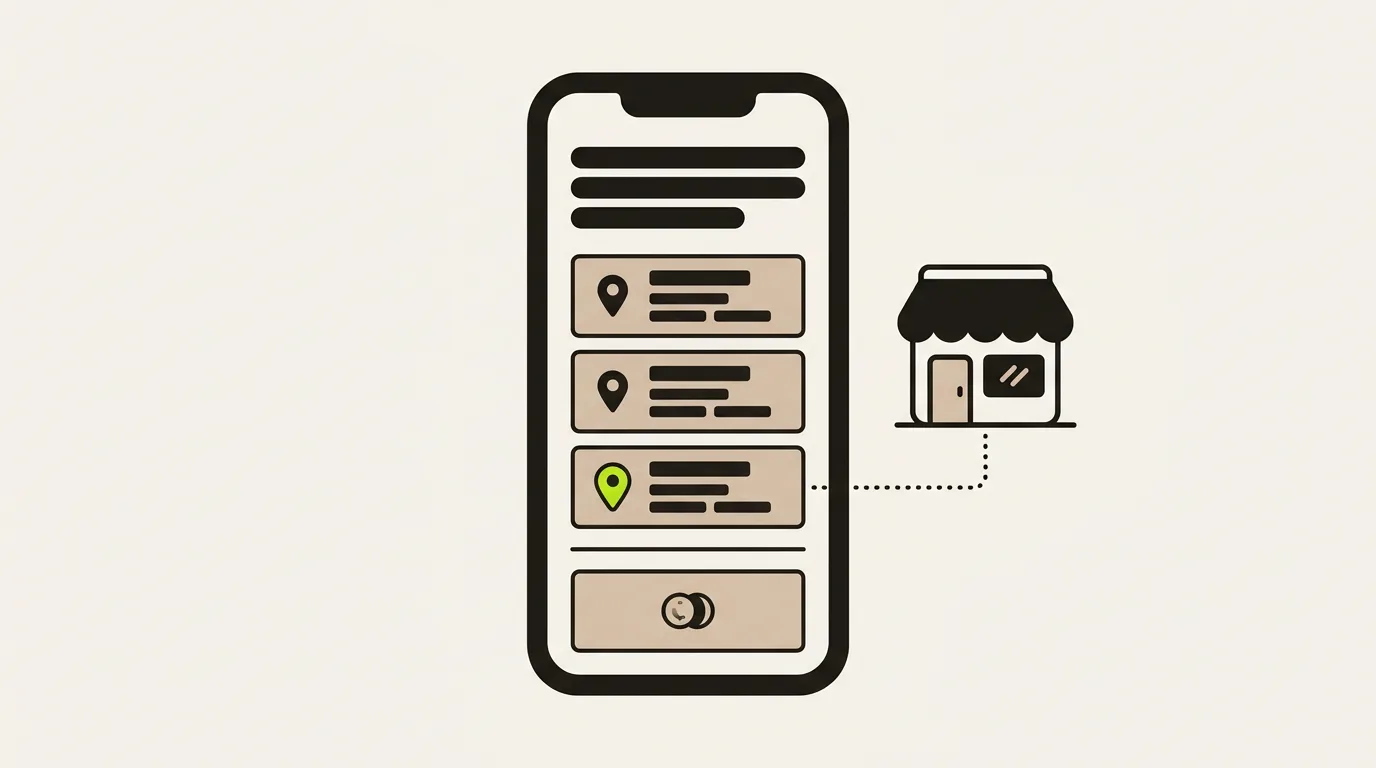
- The recommendation inside ChatGPT's answer cannot be bought. OpenAI's principle: ads do not influence the answers ChatGPT gives.
- An ad sits below the end of the answer, labelled as sponsored, and only on the Free and Go plans. Paid plans and accounts identified as under 18 see none.
- Plumbers, electricians and cleaners clearly count as local services; salons, trainers and restaurants most likely do too. Health and legal services are in principle prohibited outside the US and only partly allowed inside it.
- You can buy it yourself in Ads Manager, per click or per thousand impressions; OpenAI suggests a starting maximum bid of $3 to $5 per click. Self-service has no published minimum; agency routes in France were reported at €20,000 to €40,000 at launch, with only Havas Market's €40,000 confirmed.
- Start with the answer, not the ad: every user sees the answer, including those who never see ads, and being named in it costs nothing per click.
Can you pay to be recommended by ChatGPT?
No, and OpenAI says so in plain terms. Its help page on ads states that "advertisers have no ability to shape, rank, or alter ChatGPT's responses" and that "seeing an ad doesn't mean OpenAI endorses or recommends the advertiser" (Ads in ChatGPT). The businesses ChatGPT names in its answer draw on the pages and listings it reads, not on a purchase, as explained in how AI decides which businesses to recommend.
That also tells you what to make of anyone selling a "guaranteed ChatGPT recommendation" or a "paid placement in ChatGPT". The only thing for sale is an ad slot below the answer, bought from OpenAI or its partners.
What is a ChatGPT ad, and where does it appear?
A ChatGPT ad is a sponsored card shown after the answer. OpenAI's help page says ads "can appear below the end of a response" and are "clearly labeled as sponsored and visually separated from ChatGPT's response". Ads are chosen from the current conversation and basic context such as general location and language. In the European Economic Area and Switzerland, personalised ads based on past chats or memory are not available for now.
The table shows how that differs from being named in the answer.
| Named in the answer | A ChatGPT ad | |
|---|---|---|
| Where it appears | Inside the answer, as one of the businesses ChatGPT names | Below the end of the answer, labelled as sponsored |
| Who sees it | Any user who asks, on any plan, when ChatGPT names you | Free and Go users only; not Plus, Pro, Business, Enterprise or Edu; not accounts identified as under 18 |
| Which conversations | Any question about your trade and town | Not near sensitive or regulated topics such as personal health, mental health or politics |
| How you get it | Being described clearly on the pages ChatGPT reads | Bidding in Ads Manager, or through an agency or technology partner |
| Cost | No charge per click | Per click or per thousand impressions (CPM) |
| What it signals | ChatGPT's own recommendation | A paid placement; OpenAI says it is not an endorsement |
When did ads arrive in ChatGPT in the US, UK and France?
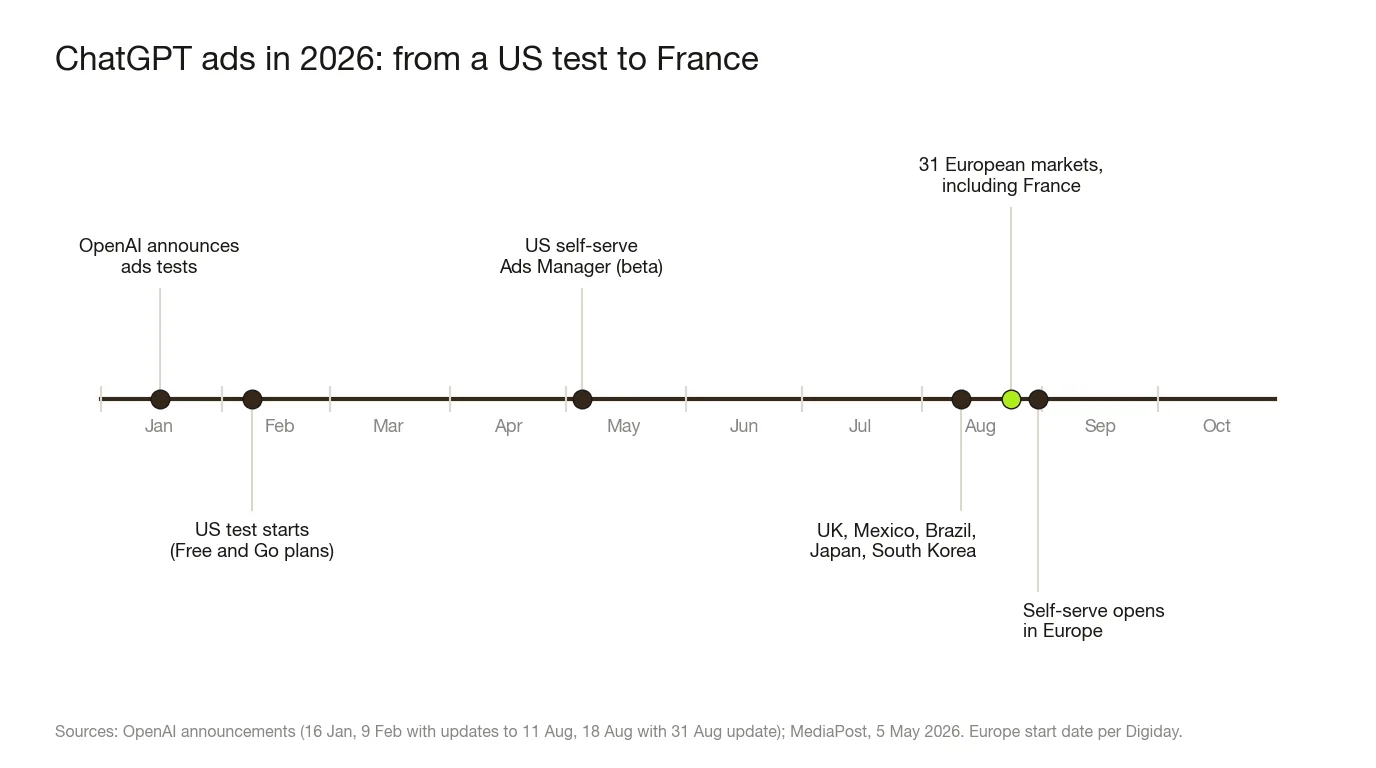
OpenAI announced its ad tests on 16 January 2026 and began showing ads in the US on 9 February, to logged-in adults on the Free and Go plans (OpenAI). US advertisers could buy them directly through a self-service Ads Manager from 5 May (MediaPost). Ads reached the UK, Mexico, Brazil, Japan and South Korea by 11 August, then 31 European markets including France on 24 August, first through OpenAI's team and partners, with a self-service Ads Manager in beta for eligible advertisers from 31 August.
Which local businesses can advertise on ChatGPT?
It depends on your trade and your country. OpenAI's ad policies, updated 10 September 2026, focus the early phase on a few consumer categories including "local services". Health services are restricted: "Ads for health services outside the US are generally prohibited", and inside the US only a listed set is reviewed case by case. Legal services are allowed only in the US, for licensed lawyers. Here is how that reads for the trades we track. OpenAI names "local services" without listing each trade, so the rows below are our reading of the policy; confirm yours when Ads Manager reviews your ads.
| Trade | In the US | Outside the US (France, UK and others) |
|---|---|---|
| Plumbers, electricians, cleaning services | Allowed as local services | Allowed as local services |
| Hair salons and barbers | Allowed | Allowed |
| Personal trainers and gyms | Allowed without medical claims; health coaching is not | Same |
| Restaurants and cafés | Allowed, without promoting alcohol | Same |
| Estate agents | Ads for a specific property are prohibited; an agency ad must not point to one | Same |
| Dentists | Case by case; proof of licence may be required | In principle prohibited (health services) |
| Opticians | Case by case (vision products and services) | In principle prohibited |
| Aesthetic clinics | Case by case for minimally invasive procedures only | In principle prohibited |
| Physiotherapists and chiropractors | Not on the list of health services OpenAI may approve | In principle prohibited |
| Law firms | Allowed only if licensed where the ad is shown | Prohibited (OpenAI: "currently prohibited") |
| Accountants | Not named; ask OpenAI before planning | Not named; ask OpenAI (financial services are generally prohibited outside the US) |
How much do ChatGPT ads cost?
You set the price by bidding. OpenAI sells ads per click or per thousand impressions, and its basics guide for advertisers recommends "starting with a maximum bid of $3–$5 USD per click". Self-service access, still labelled beta in Europe, is open in France, the UK, the US and the other countries on OpenAI's Ads Manager availability list, for eligible advertisers whose billed business is based in one of them.
Reported prices have fallen fast: trade press put impression prices in the large-advertiser pilot around $60 per thousand, dropping to about $25 by April (PPC Land, citing The Information). Those are not prices a local business should expect to match. In France, Journal du Net reported on 31 August that Havas Market had cut its entry ticket from €80,000 to €40,000, that Criteo declined to confirm a minimum its sources put at €20,000 to €25,000, and that StackAdapt's self-service and the Gamned! trading desk set none, with a Gamned! expert suggesting €5,000 over a month can be enough for a first test.
For scale: if every click cost a $4 maximum bid, $300 a month would buy at most 75 clicks. Similarweb measured an average click-through rate of 0.68% across ChatGPT advertisers (Search Engine Roundtable, May 2026); local services may differ. At that rate, 75 clicks take roughly 11,000 ad views.
Can a ChatGPT ad target your town?
Only partly, and it matters more for a local business than for anyone else. OpenAI's targeting documentation lets campaigns target countries, regions and markets, with US examples. In the US, trade press reported state, TV-market and ZIP-code targeting in Ads Manager from May (PPC Land). We could not confirm how finely locations in France can be targeted.
So check what Ads Manager offers for your area before you spend. A plumber in Lyon paying for clicks from Lille is buying traffic that cannot become a customer.
When is a ChatGPT ad worth testing?
For most local businesses, not yet, and never instead of the answer. It can be worth a small, capped test when all of these are true:
- Your trade is allowed in your country, per the table above.
- You already buy search ads and know what a lead is worth to you, so you can judge a cost per click.
- Your offer matches a question people put to ChatGPT, such as an emergency call-out, a quote or a booking.
- You can target your area tightly enough, and you can track the clicks with a dedicated landing page or tagged link.
- You are already named in some organic answers, or know why you are not, so the ad adds to the answer rather than papering over its absence.
What about ads in Google, Copilot, Gemini, Perplexity and Claude?
ChatGPT is not the only assistant with ads, and some have none. The picture on 7 October 2026:
| Assistant | Ads today | Source |
|---|---|---|
| Google AI Overviews | Ads above and below the Overview wherever it runs; inside it only for English searches in 12 countries, not the UK or France | Google Ads Help |
| Google AI Mode | Ads in the US; new formats announced in May 2026; none found in France | |
| Microsoft Copilot | Ads below answers, rolled out in English-, French- and German-speaking markets in March 2025, per Microsoft | Microsoft Advertising |
| Gemini app | No ads that we know of; Google said in December 2025 it had no current plans to add them | Search Engine Journal |
| Perplexity | Began phasing out its ads in February 2026, per Financial Times reporting | PYMNTS |
| Claude | None; Anthropic says Claude will remain ad-free | Anthropic |
Ads or the answer: where should a local business start?
With the answer. It reaches every ChatGPT user, including those on paid plans who never see ads. It is open to every trade, including the dentists, clinics and law firms that cannot advertise. And it is not charged per click. An ad can sit under an answer that names three competitors and not you, which is money spent pointing at the gap.
So find out first whether ChatGPT names you. A free Peekl check asks twelve of your customers' questions on ChatGPT or Gemini, your pick, and shows whether you are named, who is named instead and which pages the answer came from. If a rival keeps winning, why AI recommends your competitors shows how to compare yourself with it.
How we checked this guide
The Peekl team read OpenAI's ad policies, its help pages on ads in ChatGPT, its Ads Manager availability list, its targeting documentation and its launch announcements on 7 October 2026. Prices and minimums come from trade press (Journal du Net, PPC Land, Search Engine Roundtable) and may have changed since. What we could not verify is marked as such. We re-check this guide monthly, because the rules are moving fast.
Common questions
Can a small business advertise on ChatGPT?
Can I pay ChatGPT to recommend my business?
Are there ads in ChatGPT in France?
Can a dentist or clinic advertise on ChatGPT?
How much does it cost to advertise on ChatGPT?
Will buying ChatGPT ads help me get recommended in the answers?
Can I show my ChatGPT ad only in my city?
See where you stand
Reading about AI search is useful; knowing your own place in it is what helps. A free Peekl check asks ChatGPT or Gemini, your pick, the questions your customers ask and shows whether it recommends you today, who it names instead, and how often. The full audit runs the same questions on all three assistants, Claude included.
More in this series: Improving your AI visibility
- How to improve your business's visibility in AI search
- AI search and AI SEO for a small local business: what to do without a marketing team
- AI search optimization services: what agencies charge, what they deliver, and when to do it yourself
- How to appear in Google's AI Overviews
- Does Google Business Profile affect ChatGPT and Gemini recommendations?