Just opened, moved or renamed: how long until ChatGPT and Gemini know your business?
Part of our series on Improving your AI visibility. The reference guide is the guide to improving your AI search visibility.
Not from memory, and not for months. ChatGPT and Gemini learn from a snapshot of the web taken four to five months before each model launches, so a business that opened recently is missing from it. With web search on, they can find you as soon as your listings and press are live. In our test of 12 London restaurants that opened in 2026, both gave the right street every time with search, and almost never without it.
This guide shows what we found, which listings to set up in your first month and how long each takes, and what changes when you move or change your name. All platform facts were read on each company's own pages on 13 October 2026.
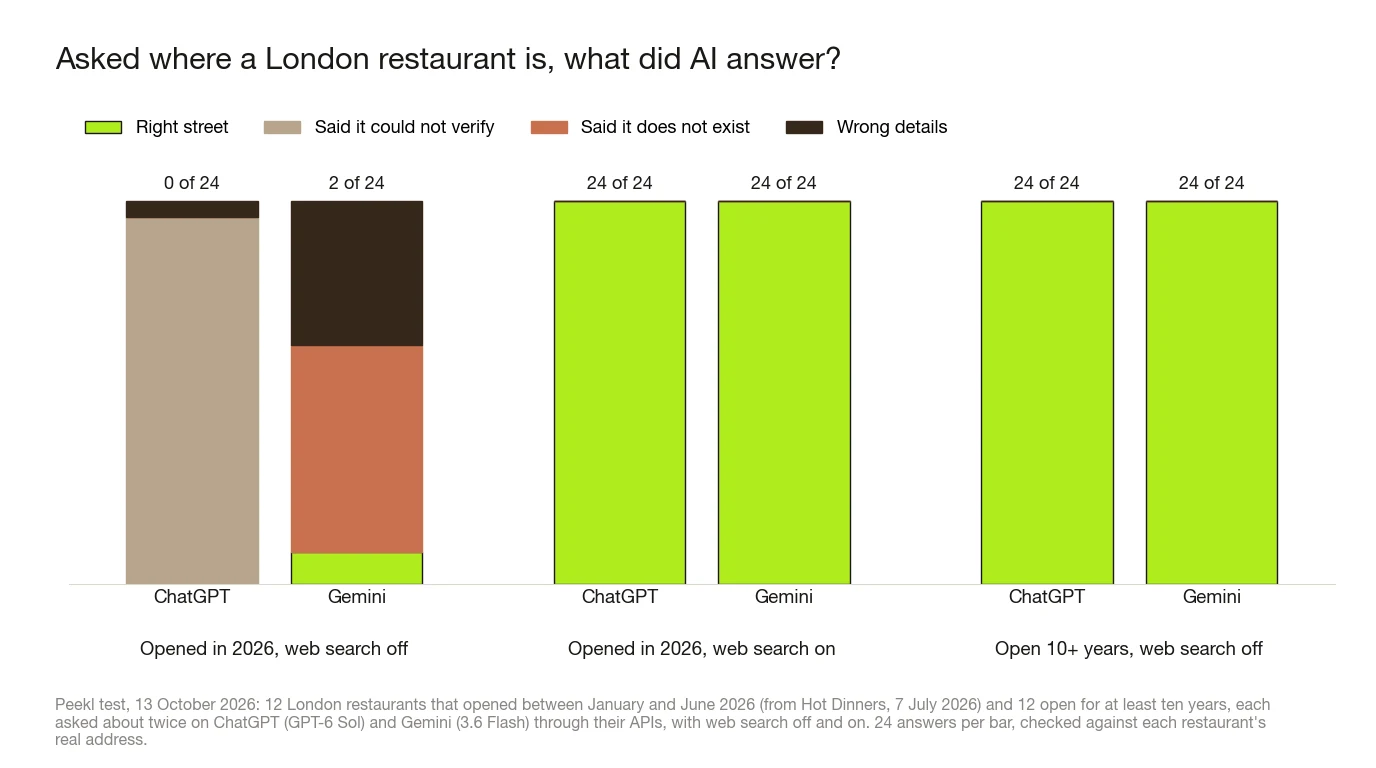
- Asked about a restaurant that opened in 2026 with web search off, ChatGPT said it could not verify 23 of 24 times, and Gemini said 13 times that the place does not exist.
- With web search on, both gave the right street in all 24 answers. For restaurants open at least ten years, they did so even without search.
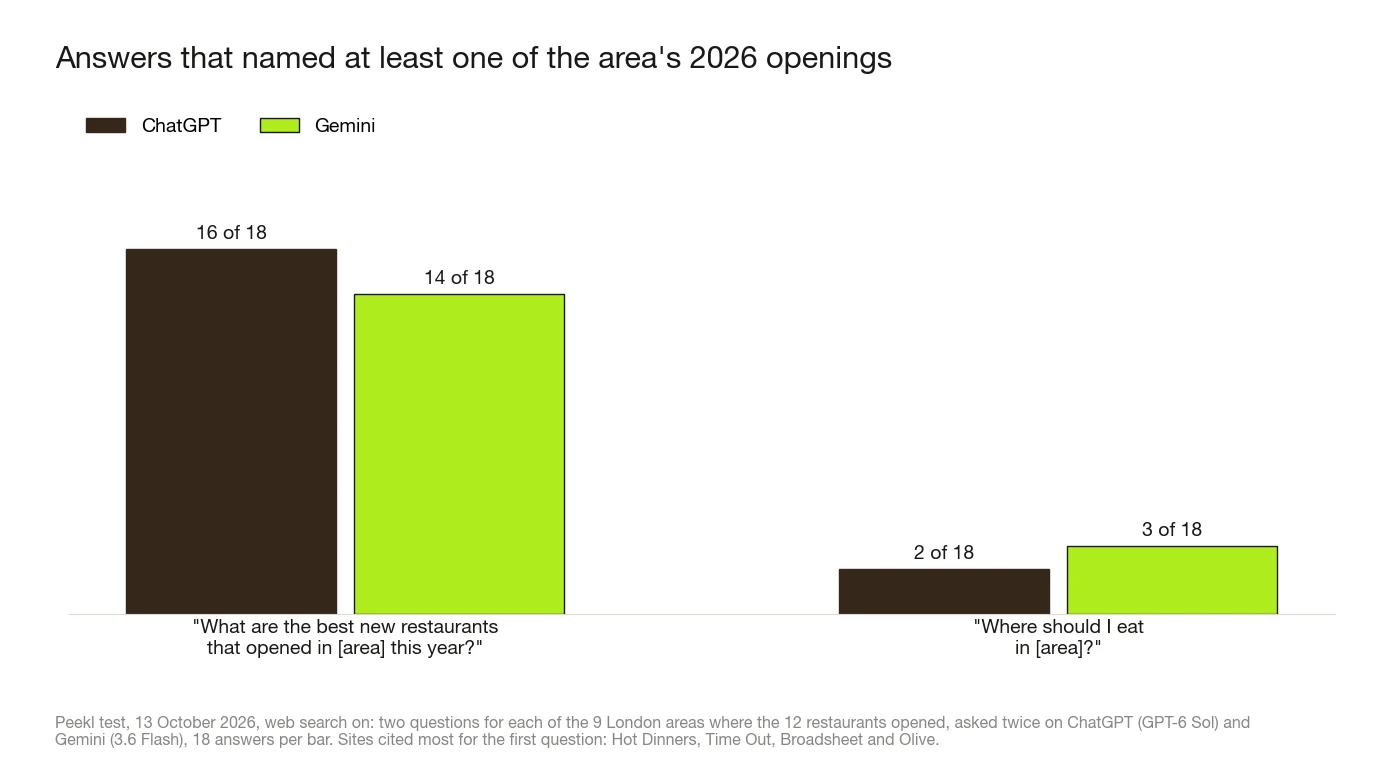
- New places came up when customers asked for new restaurants (16 of 18 ChatGPT answers), rarely when they asked where to eat (2 of 18).
- A model trained after you opened is no guarantee: ChatGPT's current model learned the web up to 20 April 2026 and still could not place restaurants that opened in January.
- After a move or a name change, the old facts stay in the assistant's memory. Asked by its old name about a Mayfair restaurant that reopened under a new name, both gave the old address in all four answers without search.
Why doesn't ChatGPT know about my new business?
Because what an assistant knows without searching comes from training data with a cut-off date, and each model reaches the public months after it. The models in use on 13 October 2026 stopped learning in spring 2026. A business that opened after that date is absent, and one that opened shortly before it is usually too thin in the data to be remembered.
Our test shows the second point. ChatGPT's current model, GPT-6 Sol, has a training cutoff of 20 April 2026, yet without search it could not place any of the eight restaurants that opened between January and April. What changes this is web search: when the assistant looks you up, the cutoff stops mattering, and what counts is what it can find.
| Assistant | Current model (13 Oct 2026) | Learned the web up to | Released |
|---|---|---|---|
| ChatGPT, paid plans | GPT-6 Sol | 20 April 2026 | 22 September 2026 (OpenAI) |
| ChatGPT, Free and Go | GPT-6 Luna | 18 May 2026 | 22 September 2026 (OpenAI) |
| Gemini, AI Plus plan (the model we tested) | Gemini 3.6 Flash (free plan: 3.5 Flash-Lite; Pro and Ultra: 3.8 Flash) | March 2026 | 21 July 2026 (Google DeepMind) |
| Google AI Mode | Gemini 3.5 Flash, the default since May 2026 | Not published | 20 May 2026 (Google) |
What happened when we asked about new and established restaurants?
We took 12 London restaurants that opened between January and June 2026, two per month, from Hot Dinners' list of the year's best openings, and 12 independents open for at least ten years. On 13 October 2026 we asked ChatGPT (GPT-6 Sol) and Gemini (3.6 Flash), through their APIs, "What do you know about [name], the restaurant in [area], London? Where exactly is it?", twice each, with web search off and then on, and checked every answer against the real address.
Without search, the two failed in different ways. ChatGPT declined in 23 of 24 answers, typically saying it did not want to give a guessed address, and gave wrong details once. Gemini told the user in 13 of 24 answers that no such restaurant exists, for example that there is "no well-known, permanent restaurant called Cafe Kowloon" in London Fields, and gave wrong details in 9 more: it sent the user to a different restaurant with a similar name, such as Gordon Ramsay's Maze for Maza, or insisted Teal by Sally Abé was in St James's rather than Hackney. It named the right street twice.
With search on, both found the right street in all 24 answers, often citing the restaurant's own website. For the 12 established restaurants, both gave the right street even without search. A customer asking about you is therefore fine as long as the assistant searches; the risk is the answers where it does not, which the apps decide for themselves. This was one city, one kind of business and two runs per question, so read it as a pattern, not a rate. We used the APIs and switched search on or off ourselves; how often the ChatGPT and Gemini apps choose to search was not measured. Free ChatGPT users get GPT-6 Luna, which learned the web up to 18 May 2026; we tested GPT-6 Sol.
Will customers find a new business when they ask for recommendations?
Mostly when they ask for something new. For each of the nine areas where the restaurants opened, we asked both assistants, with search on, "What are the best new restaurants that opened in [area], London this year?" and "Where should I eat in [area], London?". The first question named at least one of that area's 2026 openings in 16 of 18 ChatGPT answers and 14 of 18 Gemini answers. The second, the way most people ask, did so in 2 and 3 of 18.
For the "new" question, the assistants leaned on opening round-ups: Hot Dinners was cited in 25 of the 36 answers, Time Out in 22, Broadsheet in 17 and Olive in 12. All 12 restaurants came from a Hot Dinners list, so this shows what such coverage does rather than proving it is required. For a plumber or an accountant there is no openings column, which leaves your Google listing and the directories for your trade; which websites AI trusts shows which ones the assistants read.
How long does each listing take before AI can see it?
From a couple of days to two weeks, depending on the platform, and a model trained on your business is months further away. These are the waits each company publishes for a new listing. Edits to a listing you already have are faster and are covered in how long it takes to improve AI visibility.
| Listing | Why it matters for AI | How long, by the company's own account |
|---|---|---|
| Google Business Profile | Gemini uses public Google Maps information for addresses, ratings and hours (Google) | Verification reviews take up to 5 business days; some profiles are verified at once (Google) |
| Yelp | Yelp says its ratings and reviews now power ChatGPT's local experience in relevant categories (Yelp, August 2026) | New businesses are checked by moderators first, typically in two days or less (Yelp) |
| Bing Places | Bing is one of ChatGPT's search partners; OpenAI does not name Bing Places itself | Postcard PIN in 5 to 6 business days in the US; publishing in 7 to 12 days in North America, up to 2 weeks elsewhere (Microsoft) |
| Apple Business (formerly Business Connect) | Your place card on Apple Maps, Safari and Spotlight | Sent to Apple for review; Apple publishes no time (Apple) |
| A model that has learned about you | Answers without searching | GPT-6 Sol was released five months after its cutoff and Gemini 3.6 Flash four months after; without search, they almost never placed our 2026 openings, even those that opened before the cutoff |
What should a new business do in its first 30 days?
Make yourself easy to find for the moment an assistant searches. The order matters less than doing every step with one name, one address, one phone number and one set of hours, so the assistant can tell the listings are one business.
- Week 1: create and verify your Google Business Profile, then Bing Places, Apple Business and Yelp. Copy the same details into each.
- Week 1: publish a website page that states in plain text what you do, your full address, phone number and opening hours. Check that your robots.txt does not block OAI-SearchBot, the crawler ChatGPT search uses (OpenAI).
- Week 2: get onto the register or directory for your trade. In our city scans (378 ChatGPT answers, seven trades, nine cities), official and professional bodies made up 27% of ChatGPT's citations; how AI decides which businesses to recommend has the detail.
- Weeks 2 to 4: tell the local press and the "new openings" round-ups in your area. In our test they were the pages the assistants read when asked about new places.
- Weeks 2 to 4: ask your first customers for honest reviews on Google and Yelp. A listing with no reviews gives an assistant little to say about you.
- Day 30: check what each assistant says about you, using the two questions in the last section.
We moved: why does ChatGPT still show our old address?
Because the old address is in its training data, and often still on other websites. Without search, the assistants answer from memory, and memory predates your move. One restaurant in our test, which both moved and changed its name, shows it: Koyn Thai, a Mayfair restaurant that closed in 2025 and reopened in 2026 as MIKO Mei Fair on Curzon Street. Asked about Koyn Thai without search, ChatGPT and Gemini gave the old Grosvenor Street address in all four answers. With search, all four found the new restaurant, and one ChatGPT answer explained that Koyn had closed and pointed to MIKO Mei Fair.
So the fix is to make the new address the only one search can find. Update your website, including old contact pages and PDFs, and every directory that lists you. On Google, check the rules for your type of business, because Google's own pages disagree: the editing guide says a business that moves must verify again (Google), while the policy page says some venues, restaurants among them, must mark the old profile permanently closed and create a new one (Google). Bing asks for a new listing with the old one marked closed (Microsoft). If other details are wrong too, such as your hours or phone number, what to do when AI has wrong information about your business covers each source.
We changed our name: how long until AI uses the new one?
Until the next models are trained, the old name is what the assistants remember, and the new one only exists when they search. Without search, neither assistant could place MIKO Mei Fair: ChatGPT said it could not identify it and offered another Mayfair restaurant, and Gemini suggested the user had misspelled MiMi Mei Fair, the sister restaurant in the same building. With search, both found it.
Help them connect the two names. Keep a line such as "formerly Koyn Thai" on your website, your Google profile description and your social profiles for the first year, and ask the publications that covered the old name to add the new one. Expect Google to ask you to verify again after a name change (Google), and on Bing, create a new listing and mark the old one closed.
How do you check whether each assistant knows you yet?
Ask two questions on each assistant you care about, a few times, because answers change from one ask to the next. First, "What do you know about [your name] in [your area]?": it tells you whether the assistant can find you and whether the address, hours and description are right. Second, the question a customer would ask, such as "best [your trade] in [your area]" and "new [your trade] in [your area]": it tells you whether you are recommended, and to whom you lose.
If the first answer is wrong or empty, fix the listings above. If the first is right and the second never names you, you are findable but not yet chosen, which is the problem covered in why your business is not showing up in AI. Peekl's free check asks ChatGPT or Gemini twelve of your customers' questions and shows who is named instead.
Common questions
Can I submit my new business to ChatGPT?
Does ChatGPT use Bing Places?
If customers ask ChatGPT about my business, will it learn about it?
Will the next model update add my business automatically?
Should I create a new Google Business Profile after moving?
See where you stand
Reading about AI search is useful; knowing your own place in it is what helps. A free Peekl check asks ChatGPT or Gemini, your pick, the questions your customers ask and shows whether it recommends you today, who it names instead, and how often. The full audit runs the same questions on all three assistants, Claude included.
More in this series: Improving your AI visibility
- How to improve your business's visibility in AI search
- AI search optimization services: what agencies charge, what they deliver, and when to do it yourself
- How to appear in Google's AI Overviews
- Does Google Business Profile affect ChatGPT and Gemini recommendations?
- ChatGPT or Gemini has the wrong hours, phone number or details for your business: why, and how to fix it
- ChatGPT ads: can a local business pay to be recommended?