How to appear in Google's AI Overviews
Part of our series on Improving your AI visibility. The reference guide is the guide to improving your AI search visibility.
To appear in Google's AI Overviews, rank for the topic, then make your page easy to quote: a heading that matches the question, a direct answer in the first two sentences, specific facts with sources, genuine reviews and a complete Google Business Profile. AI Overviews are built on Google's core ranking, but since early 2026 Google has been citing pages well outside the top ten, so being quotable now carries as much weight as the position itself.
There is no separate button for AI Overviews, and no markup that forces your way in. This guide explains what Overviews are and how often they appear, what one does to your clicks, how Google decides what goes in, how they differ from AI Mode and from asking ChatGPT, Gemini or Claude directly, what they show for a local search like "best plumber in Miami", and the moves that actually help. Peekl does not track AI Overviews, and we say so where it matters.
- AI Overviews draw from Google's core ranking, but only 38% of the pages they cite now sit in the top ten, so quotability matters as much as rank.
- To show up, answer the exact question in your first lines under a heading that matches it, cite specific facts, and keep your Google Business Profile and reviews strong.
- An Overview costs clicks: users clicked a result on 8% of searches with one against 15% without, and being cited recovers about half the loss.
- For local searches, Overviews appear on most question-type queries but on only 15% of plain "best X in town" searches, where the map pack still decides.
- Search Console has no AI Overviews report, so tracking it means repeated manual checks or a dedicated tracker; Peekl reads Gemini as the closest Google proxy.
What are Google's AI Overviews, and how often do they appear?
A Google AI Overview is the AI-written answer that sits at the top of the results page for many searches. Google generates it from web pages and links out to the sources it used. Google said at its 2026 I/O that AI Overviews reach over 2 billion people a month.
How often you meet one depends on what you search. Pew Research tracked 900 US adults through March 2025 and found 18% of their Google searches produced an AI summary. Ahrefs found that 99.2% of the keywords that trigger one are informational. For local business queries the share is higher: Whitespark tested 540 searches across three US cities and six trades and saw an AI Overview on 68% of them, against a local pack on 39%.
What an AI Overview does to your clicks
The answer sits on the results page, so fewer people scroll. In Pew's browsing data, users clicked a traditional result on 8% of visits that showed an AI summary and on 15% of visits that did not. Clicking a link inside the summary itself happened on 1% of visits. Ahrefs compared 300,000 keywords in March 2024 and March 2025 and put the click-through loss for the top-ranking page at 34.5% when an Overview appears.
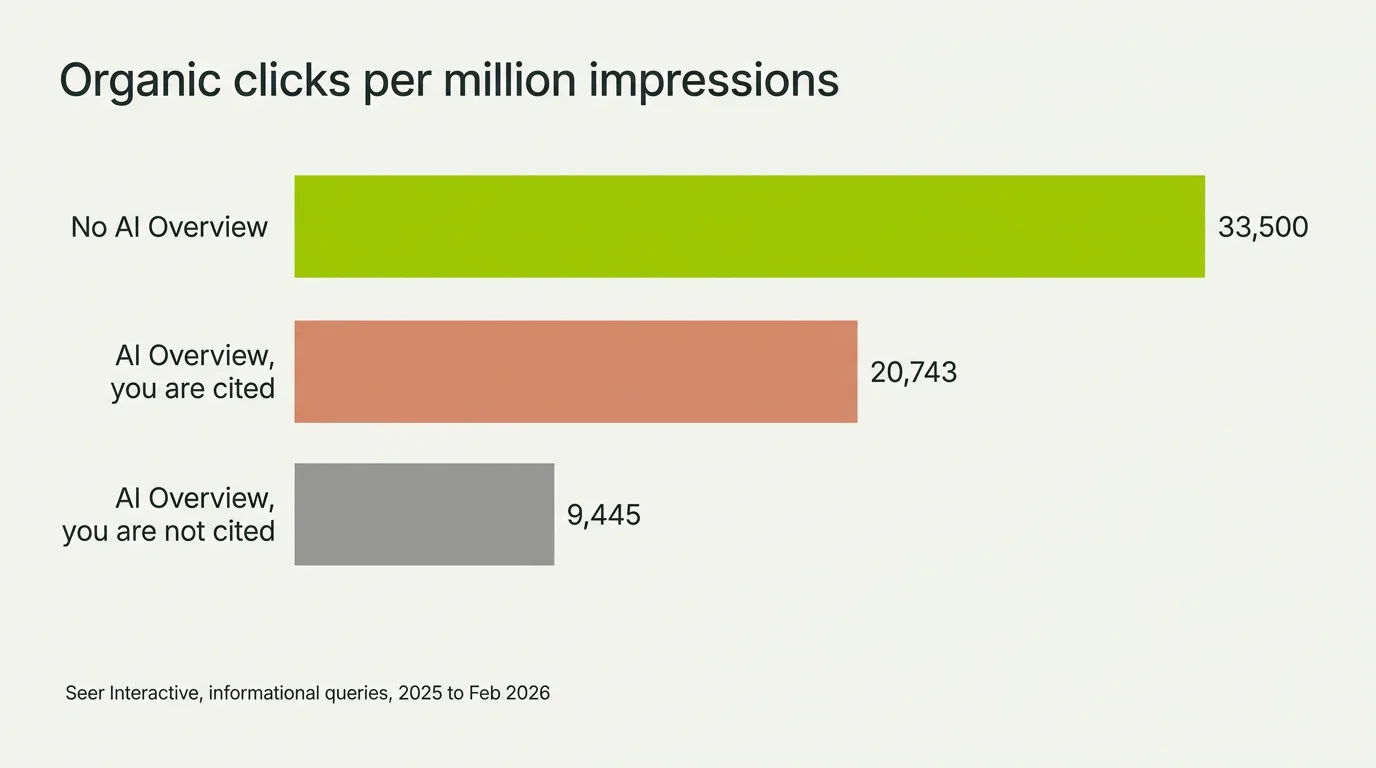
Being cited is the way back. Seer Interactive tracked 53 brands and 5.47 million queries from January 2025 to February 2026. On informational queries, a million impressions produced about 33,500 organic clicks with no Overview, 20,743 when the brand was cited in the Overview, and 9,445 when an Overview appeared and the brand was not cited. A citation more than doubles your clicks compared with being left out, even though it does not restore the old total. The same study saw organic click-through on Overview queries climb from 1.3% in December 2025 to 2.4% in February 2026, so the floor is moving.
How does Google choose what goes in an AI Overview?
Google is direct about this: its AI features are "rooted in our core Search ranking and quality systems." In plain terms, the same signals that rank a page well also make it a candidate for an Overview. Strong, helpful, first-hand content that demonstrates real expertise is what gets pulled in.
Ranking is no longer the whole gate, though. In March 2026 Ahrefs looked at 4 million URLs cited across 863,000 Overviews and found 37.9% of them ranked in the top ten for the query, 31.2% sat between positions 11 and 100, and 31% did not rank in the top 100 at all. Eight months earlier the top-ten share had been around 76%. Google is reaching further down, and sideways, for the passage that answers best.
Part of the reason is fan-out. For one search Google quietly generates related sub-questions and synthesises across all of them, so a page that answers a whole topic clearly is retrieved for more of those sub-questions than a thin page aimed at a single phrase. You do not need special markup or an "AI file" to qualify; Google says so plainly. Write for people and organise it with normal headings.
AI Overviews vs AI Mode: the box and the room
An AI Overview is a box at the top of an ordinary results page. AI Mode is a separate conversational tab in Google Search where you ask, read a longer answer and follow up. Both are Google, both run on Gemini models, and both draw on Google's index and Business Profiles, but appearing in one does not mean appearing in the other: they cite different pages far more often than they cite the same ones. The moves in this guide help with both. For the conversational side, see what Google AI Mode is and what it means for local businesses.
AI Overviews vs ChatGPT, Gemini and Claude
AI Overviews are not the same as asking an assistant directly, and the difference matters when your customers are the ones searching. Gemini shares Google's stack, so it is the closest overlap; ChatGPT and Claude pick sources their own way. In our own study of 756 AI answers about local businesses, the assistants leaned on directories, booking platforms and review sites far more than on businesses' own websites; see which websites AI trusts.
| Google AI Overviews | ChatGPT, Gemini, Claude | |
|---|---|---|
| Where it appears | On the Google results page | Inside a chat, when someone asks |
| How it picks sources | Google's core search ranking, reaching beyond the top ten | A wider mix: directories, reviews, forums, best-of lists |
| What to optimise | Rank for the topic and be quotable | Be present and consistent on the sources they trust |
What AI Overviews show for a local search like "best plumber in Miami"
For a plain "best [trade] in [town]" search, usually nothing. Whitespark's study found AI Overviews on just 15% of simple local-intent queries, where the local pack showed on 93%. When we searched "best plumber in Miami" on 18 September 2026 from a fresh US session, Google answered with the map pack: three plumbers with ratings, phone numbers and opening hours, a "People also ask" block and the usual Yelp, Angi and Reddit results, and no AI Overview. One search is not a study, but it matched the pattern.
The picture flips as soon as the search becomes a question. Whitespark saw Overviews on 92% of informational local queries ("how long does an eye exam take near me") and 97% of hybrid ones that mix a question with a place or a service. Those are the searches a customer makes before they know who to call: what something costs in your city, whether a permit is needed, how urgent a symptom is. When an Overview does show for a local query, it summarises from the pages it cites and can surface businesses drawn from Google's own records, so a complete Business Profile matters here too.
For a local business the practical reading is this: the map pack still decides the "best in town" moment, and the Overview decides the question moment just before it. A page that answers those questions plainly for your town is how you enter the second one. For the wider local picture, including how rarely assistants name local businesses at all, see the local AI visibility guide.
How to show up in Google AI Overviews: what actually helps
The moves that help you show up in AI Overviews are the same ones that build durable search visibility. None is a trick, and each one compounds.
- Rank for the topic, not just the phrase. Overviews still draw mostly from pages Google already trusts, and ordinary strong SEO is the foundation, but a third of citations now come from outside the top 100, so a clear answer on a modest page has a real chance.
- Match the question in your heading and answer it in the first two sentences. Google lifts passages, so a heading that mirrors how people ask, followed by a direct 40 to 60 word answer, is what gets quoted.
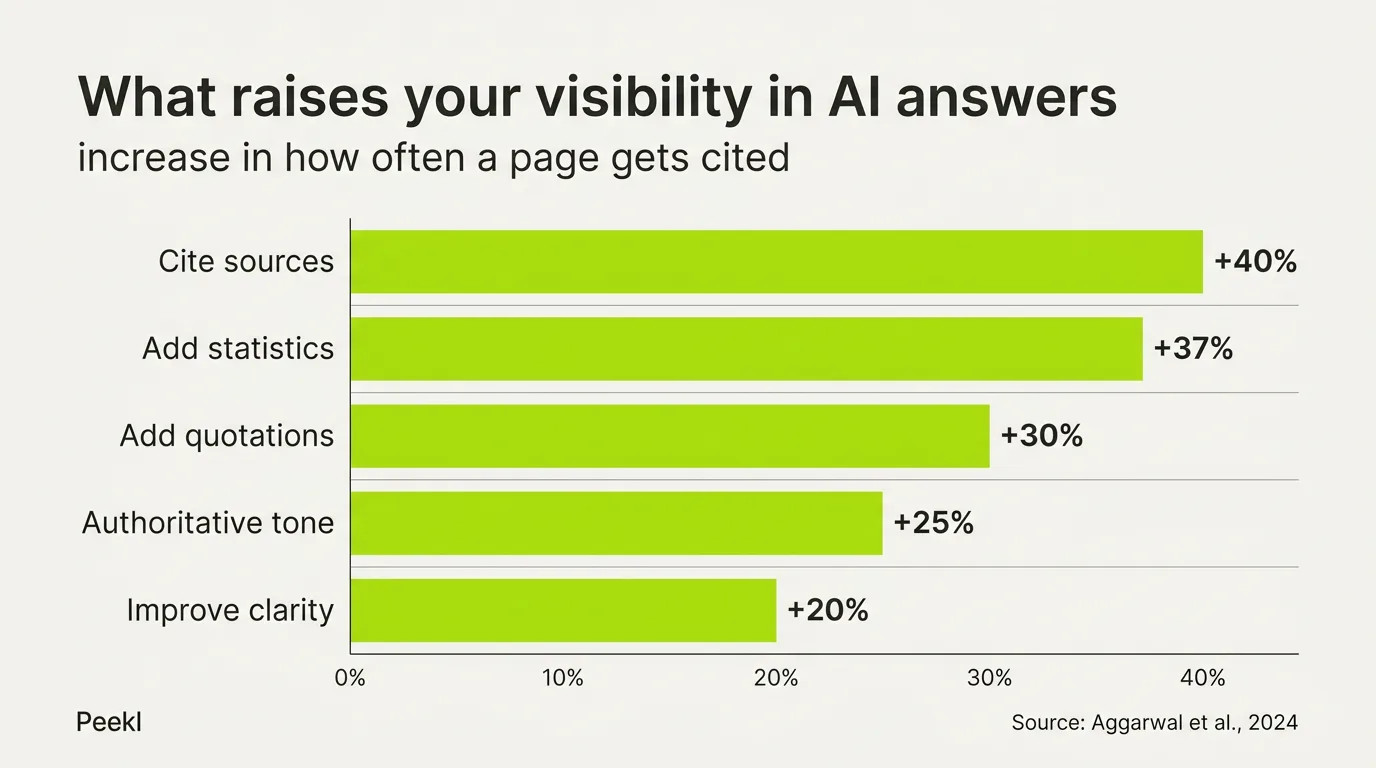
- Make the page easy to quote. Research on generative engine optimization found that adding statistics, quotations and cited sources can raise a page's visibility in AI answers by up to 40 percent (Aggarwal et al., 2024).
- Cover the whole topic, not a single phrase. Google's AI fans out into related sub-questions, so a page that also answers the neighbouring questions is retrieved for more of them.
- Answer the questions customers ask before they search for you by name: costs, timings, permits, what to expect. Those are the local searches that trigger Overviews.
- Complete your Google Business Profile. It feeds Google's own AI directly, and for local searches it is often what decides who gets named. How the profile affects each AI assistant covers the differences.
- Earn recent, genuine reviews. Rating, volume and recency act as a threshold for local recommendations.
- Show your work is current. A visible last-updated date and specific, dated content signal freshness, which AI systems weight.
What does not help
A few tactics waste time, and some can actively hurt. Google flags these itself.
- Writing a separate version of your content "for AI." Google treats that as scaled content abuse. One clear page serves people and Overviews alike.
- Chopping pages into tiny fragments to feed the AI. Google explicitly says not to. Normal paragraphs and headings are what it wants.
- Treating schema or an llms.txt file as a switch. Schema helps your overall SEO, but neither forces you into an Overview.
- Keyword stuffing. It reads badly to people and reduces AI visibility rather than raising it.
How to check whether you appear in an AI Overview (and how to track it)
Search your most important queries on Google, phrased the way a customer would, and look for the AI Overview at the top of the page. Not every query triggers one, and the same query can show an Overview one day and not the next, so a single look tells you little.
- Use a private window and your real trade and town, so your own history does not shape what Google shows.
- Expand the Overview ("Show more") and read the cited sources and links, not just the summary. That is where your business either appears or does not.
- Note whether you are cited as a source, named in the text, or absent, and which competitors take the slots.
- Repeat across five to ten query variants and on different days. Google's AI fans out into related sub-questions, so a page can appear for one phrasing and not another.
- Include question-type searches for your trade and town, not only "best X in town". For local businesses those are the searches most likely to show an Overview at all.
- Record the results somewhere simple. How often you appear across many checks is the measurement; one screenshot is not.
Is there a way to track Google AI Overviews?
Search Console does not break AI Overviews out as a separate report, so there is no official dashboard for this yet. Beyond manual checks, dedicated trackers now poll Google's AI surfaces; because AI Overviews and AI Mode run on the same Google stack, the best Google AI Mode trackers are the closest tools for it. Peekl does not read AI Overviews directly: it checks Gemini, which shares Google's signals, as the nearest proxy, alongside ChatGPT and Claude.
Remember that Overviews are only one surface. Your customers also ask ChatGPT, Gemini and Claude directly, and the answer there is often different. For the numbers worth tracking, see AI visibility metrics and KPIs; to see where you stand across the assistants, read how to improve your AI search visibility or run a free Peekl check on your own business.
Common questions
How do I rank in Google AI Overviews?
How do I get in Google AI Overviews if I don't rank in the top ten?
Do AI Overviews reduce my website traffic?
Does an AI Overview show up for "best plumber near me" type searches?
Are Google AI Overviews the same as ChatGPT?
Do I need special schema or an AI file to appear in AI Overviews?
How do I get my company mentioned in Google AI Overviews?
How can I see if I'm featured in an AI Overview?
Is there a tool to track Google AI Overviews?
How often do AI Overviews appear?
See where you stand
Reading about AI search is useful; knowing your own place in it is what helps. A free Peekl check asks ChatGPT or Gemini, your pick, the questions your customers ask and shows whether it recommends you today, who it names instead, and how often. The full audit runs the same questions on all three assistants, Claude included.
More in this series: Improving your AI visibility
- How to improve your business's visibility in AI search
- AI search and AI SEO for a small local business: what to do without a marketing team
- AI search optimization services: what agencies charge, what they deliver, and when to do it yourself
- Does Google Business Profile affect ChatGPT and Gemini recommendations?
Related reading
- What is Google AI Mode, and what it means for local businesses
- The best Google AI Mode rank trackers in 2026, compared
- Local AI visibility: what it is, and what the numbers say city by city
- AI visibility metrics: how to measure your AI visibility (the KPIs that matter)
- AI searchability: the complete guide to AI search optimization