ChatGPT or Gemini has the wrong hours, phone number or details for your business: why, and how to fix it
Part of our series on Improving your AI visibility. The reference guide is the guide to improving your AI search visibility.
Wrong details usually come from one of two places. Answering from memory, an assistant may invent details: Gemini gave a phone number that was not the business's in 59 of 80 answers in our test. When it searches, it repeats what it finds, so if your website, your Google listing and the directories disagree, it can pick the wrong one. Neither ChatGPT nor Gemini lets you correct an answer, so the fix is in those sources.
This guide shows what we found when we asked both assistants for the phone number, hours and address of 40 local businesses, where the wrong details came from, and where to correct each one. Platform rules were read on each company's own pages on 13 October 2026.
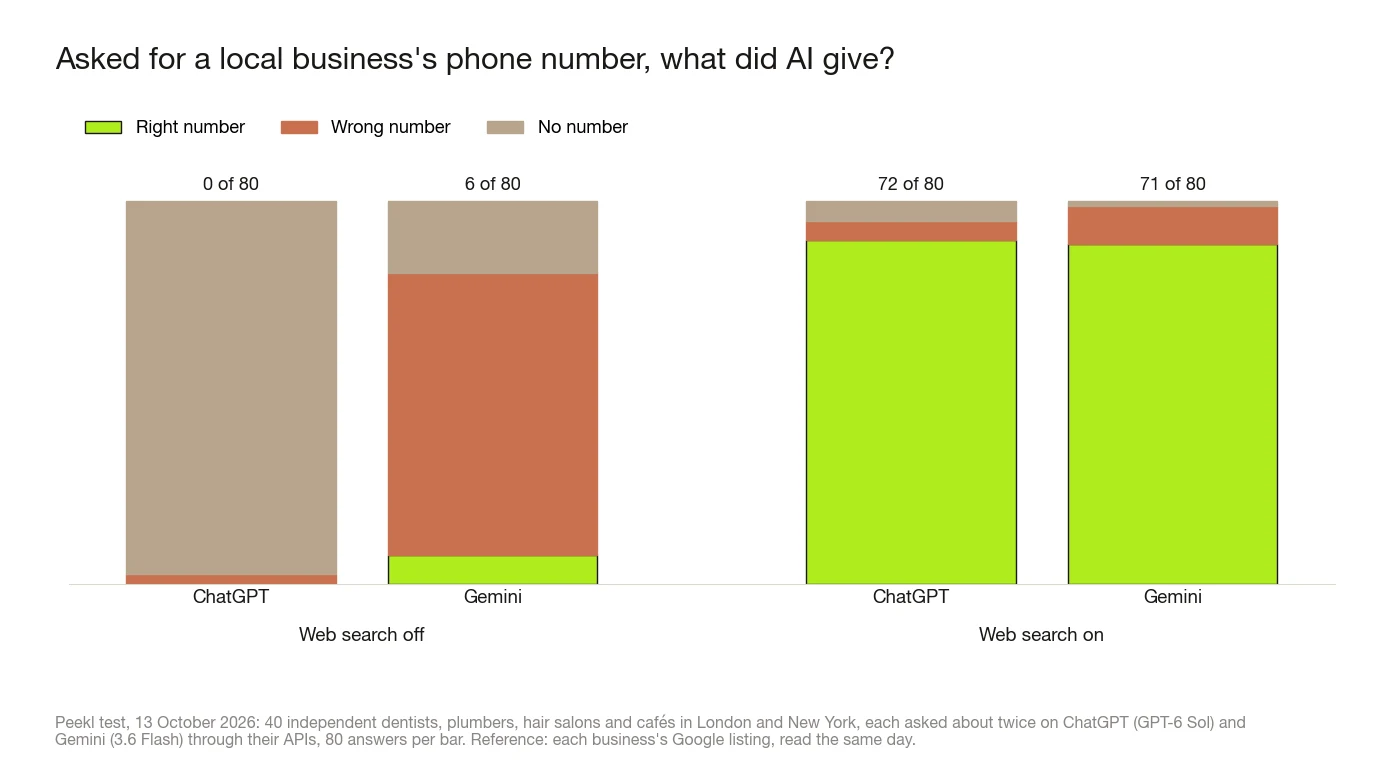
- Without web search, Gemini gave a phone number in 65 of 80 answers and 59 were wrong. ChatGPT gave none in 78 of 80.
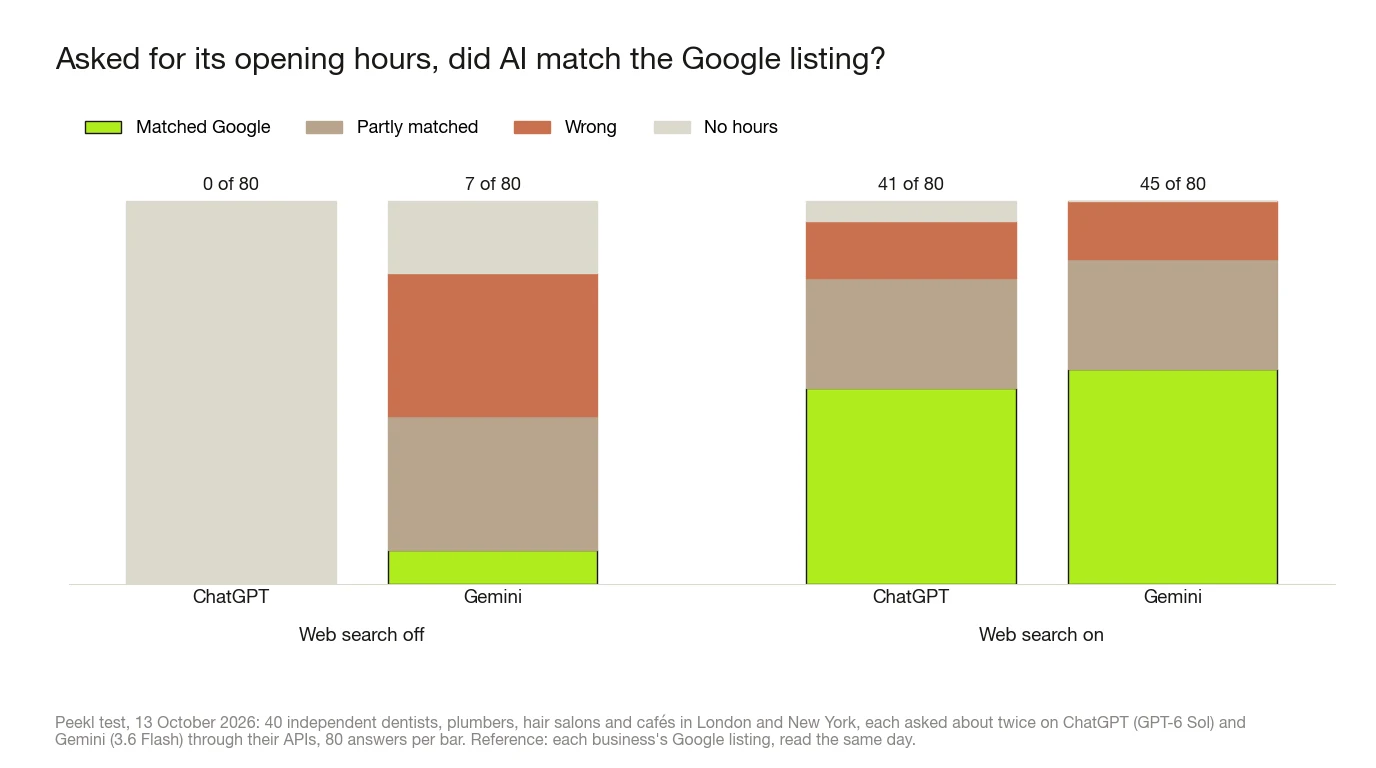
- With search, both gave the right number about nine times in ten (72 and 71 of 80), but the hours matched the Google listing in only about half (41 and 45 of 80).
- With search, most wrong numbers were real ones copied from somewhere else: of the 12 wrong numbers, 7 came from the business's own website and 1 from a practice with a near-identical name.
- Without search, Gemini said nine times that an open business did not exist or had closed. With search, neither assistant said so for any of the 40.
- Plumbers fared worst: 10 of 40 search answers lacked the right number. Every one of the 40 hair salon answers had it.
- There is no correction form in ChatGPT or Gemini. Their feedback buttons rate one reply; they do not change the sources the next reply will read.
Why does ChatGPT get my business details wrong?
Because an assistant either answers from memory or copies a source, and both can fail. From memory, it fills gaps with plausible details, such as a phone number with the right area code. With web search, it reads a few pages and repeats them, so it is only as right as the page it picks. OpenAI says its search results and citations "can be incomplete, outdated, or incorrect" (OpenAI), and Google says AI Overviews "can and will make mistakes" (Google).
Two larger studies point the same way. They measured against Google listings too, with different samples and methods from ours:
| Study | Sample | What it found |
|---|---|---|
| Insites, July 2026 | 10,000 US local businesses | 55.6% of ChatGPT's answers agreed with the business's Google profile on every detail, and 30.1% had the wrong phone number (Insites) |
| SOCi Local Visibility Index 2026 | About 350,000 locations of 2,751 multi-location brands | Listing details were accurate 68.3% of the time on ChatGPT and 100% on Gemini, which SOCi notes is grounded in Google Maps, its reference (SOCi) |
| Peekl, 13 October 2026 | 40 independent local businesses, 320 answers | With search: right phone number in 72 and 71 of 80 answers, hours matching Google in 41 and 45 of 80, on ChatGPT and Gemini |
What happened when we asked for the phone and hours of 40 local businesses?
We took five independent businesses of each trade in each city, dentists, plumbers, hair salons and cafés, in London (Hackney, Islington, Brixton, Camden) and New York (Park Slope, Astoria, Williamsburg, the Upper West Side) from Google's own results, leaving out chains and listings named after the search. On 13 October 2026 we asked ChatGPT (GPT-6 Sol) and Gemini (3.6 Flash), through their APIs, for each one's phone number, opening hours and exact location, twice with web search off and twice with it on, and compared every answer with the business's Google listing read the same day.
Without search, ChatGPT almost always declined: it gave no phone number in 78 of 80 answers. Gemini answered anyway and was mostly wrong: 59 of its 80 answers gave a number that was not the business's, often with the right area code, and 58 gave hours that were wrong or only partly right. With search, both found the right number in about nine answers in ten; ChatGPT gave no number in 4 answers and a wrong one in 4.
Hours were the weak point even with search. They matched the Google listing in 41 of ChatGPT's 80 answers and 45 of Gemini's, partly matched in 23 each, and were wrong in 12 each; four ChatGPT answers gave no hours. A mismatch means the sources disagree, not always that the assistant is wrong: sometimes the Google listing is the out-of-date one. The test used the APIs, where we chose when to search; the apps decide for themselves.
Keep the limits in mind: 40 businesses, all found through Google, so all with a web presence; the Google listing as the reference; two runs per question; and two cities. It shows patterns and where errors come from, not a rate for your trade.
Where did the wrong details come from?
Mostly from the businesses' own footprint. With search on, the business's own website was cited in 119 of the 160 answers. Of the 12 wrong phone numbers given with search, 7 were real numbers taken from the business's own website and 1 belonged to a practice with a near-identical name; we could not trace the other 4. We traced 5 of the 24 answers with wrong hours, and in each the assistant had repeated another page: an NHS page, two directory pages or the business's own site. Some examples, described rather than named:
- A Queens plumber's website shows a different phone number from its Google listing. All four search answers, on both assistants, gave the website's number.
- A Park Slope dental practice lists two numbers on its own site. ChatGPT gave the one that is not on Google.
- A Hackney dental practice has one set of hours on Google and another on its NHS page. ChatGPT quoted the NHS hours in both answers.
- A London plumber is listed as open 24 hours on Google, but two directory pages give weekday and weekend hours. ChatGPT repeated the directories.
- Two Park Slope practices have almost the same name. In one search answer, Gemini gave the phone number of the other one.
How do you fix wrong hours, a wrong phone number or a wrong address?
Find the page the assistant is copying, correct it, and make every other page say the same thing. With search on, the assistant shows its sources, which tells you where to start. Then work through the places below. Google itself builds a profile from crawled web content, licensed third-party data and suggestions from the public as well as from you (Google), so a wrong detail anywhere can come back.
| Where | What to do | What the platform says, or what we saw |
|---|---|---|
| Your website | Put one phone number, your address and your hours on the contact page and in the footer. Remove old numbers, old addresses and PDFs. | It was the most cited source in our test, 119 of 160 search answers |
| Google Business Profile | Edit the profile; use special hours for holidays. Check "Google updates" for suggested edits. | Edits are reviewed before going live. Public suggestions you do not reject within 4 days may be published (Google) |
| Yelp | Edit your page from Yelp for Business. | Changes appear at once but moderators review them and can reject them (Yelp) |
| Bing Places | Edit the listing after signing in. | Name, phone, hours and status are applied only if they agree with trusted outside data, and may be overwritten (Microsoft) |
| Apple Business | Correct your place card. | Apple reviews public reports, can edit your place card and emails you so you can contest it (Apple) |
| Registers and directories | Update the official register for your trade (for a dentist in England, the NHS page) and any directory still showing old details. | In our test, an NHS page and two directory pages carried the hours the assistants repeated |
What if AI says your business is closed or does not exist?
Check whether it searched. In our test it only happened without search: Gemini said nine times that an open business did not exist or had closed, for example that a Williamsburg salon had "permanently closed". With search on, neither assistant said so for any of the 40.
If Google itself shows you as closed, that is the source to fix first, because Gemini and AI Mode read it. Owners can reopen from Edit profile, then Hours, then "Open with main hours"; Google warns not to reopen a profile that was closed because you moved or changed your name (Google). Anyone can also suggest "Reopen" from the Maps listing (Google). On Apple Maps, owners can contest a closure reported by the public through Apple Business. If you did move or change your name, see how long until ChatGPT knows a new business.
What if AI mixes you up with another business?
In our test it happened when names were close. Without search, Gemini took a small Camden café for a bakery chain with a similar name. With search, it gave one Park Slope practice the phone number of a practice with an almost identical name.
You cannot stop people from asking with the short version of your name, but you can make the full set of your details unmistakable: the same exact name, street and phone number together on your website, Google, Yelp and the directories, with the same website address on each listing. If a similar business keeps being confused with you, your own pages can say which street you are on. Then check the answers again with search on.
Can you report a wrong answer to ChatGPT or Gemini?
You can rate an answer, but neither company offers businesses a way to correct one. OpenAI asks users to press the thumbs-down button on an incorrect answer (OpenAI), and Google has the same button on Gemini, AI Overviews and AI Mode, with a "Report a problem" option on AI Overviews. Those reports go to the model makers; they do not change the pages the next answer will read.
OpenAI's privacy request form lets a person ask for the correction of inaccurate information about themselves, and OpenAI says it cannot independently investigate disputed facts (OpenAI). It covers individuals, not businesses. So report the answer if you like, and then fix the sources.
How do you check what each assistant says about you?
Ask the question we used: "What is the phone number of [your business], the [your trade] in [your area], and what are its opening hours? Where exactly is it?" Ask it on each assistant your customers use, a few times, and note the sources it cites. Compare each answer with what you want customers to see.
If the details are wrong, the sources tell you what to fix first. If they are right but you are rarely recommended, the problem is different: see how to check if ChatGPT recommends your business. Peekl's free check puts a dozen questions your customers would ask to ChatGPT or Gemini, then lists who was named and the pages each answer drew on.
Common questions
Can I make ChatGPT forget wrong information about my business?
How long after I fix my listings will AI show the right details?
What if ChatGPT describes my business negatively?
Can a call-tracking number make AI show the wrong phone number?
Is Gemini more accurate about my business than ChatGPT?
See where you stand
Reading about AI search is useful; knowing your own place in it is what helps. A free Peekl check asks ChatGPT or Gemini, your pick, the questions your customers ask and shows whether it recommends you today, who it names instead, and how often. The full audit runs the same questions on all three assistants, Claude included.
More in this series: Improving your AI visibility
- How to improve your business's visibility in AI search
- AI search optimization services: what agencies charge, what they deliver, and when to do it yourself
- How to appear in Google's AI Overviews
- Does Google Business Profile affect ChatGPT and Gemini recommendations?
- Just opened, moved or renamed: how long until ChatGPT and Gemini know your business?
- ChatGPT ads: can a local business pay to be recommended?