Why does AI recommend your competitors instead of you?
Part of our series on Measuring your AI visibility. The reference guide is the guide to AI visibility metrics.
AI recommends a competitor instead of you when the few pages it reads for that question describe them, and not you, clearly enough to vouch for. It is rarely a verdict on who is better. The fix starts with three facts: which competitor, on which assistant, and from which pages. Then you compare yourself with that business on what the assistant can actually see.
This guide is that comparison. It draws on Peekl's scans of 756 answers from ChatGPT and Gemini about seven trades in nine cities, where the two assistants shared a most-named business in only 8 of 63 city-and-trade pairs, and where Gemini's most-named "competitor" was often not a business at all. If no assistant names you for anything, start with why your business might be invisible to AI instead.
- The competitor AI names is usually the one the pages it opened describe best, not the best business. Find those pages and you find the reason.
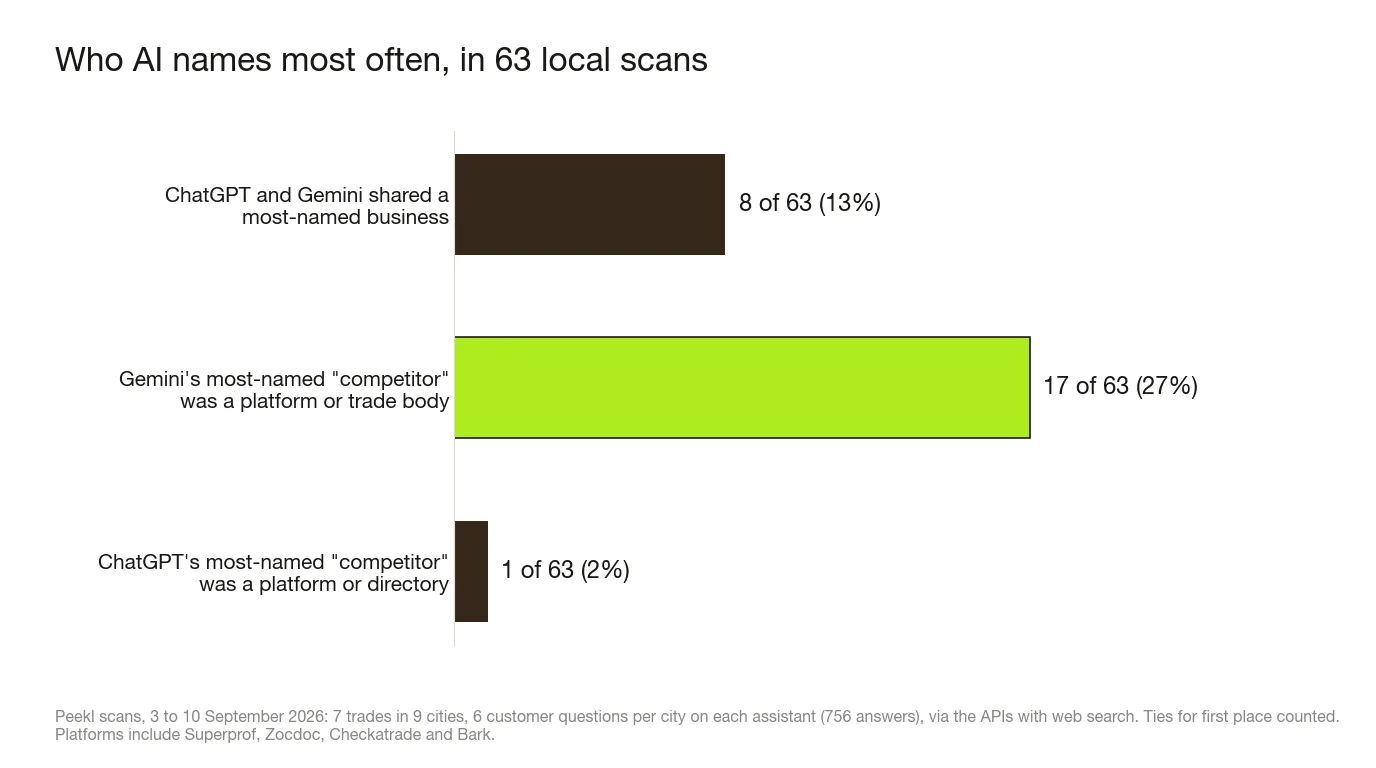
- It is rarely the same rival everywhere: ChatGPT and Gemini shared a most-named business in only 8 of 63 city-and-trade scans. Check each assistant on its own.
- Sometimes the "competitor" is a platform. Gemini's most-named name was a marketplace or trade body, such as Superprof, Zocdoc, Checkatrade or Bark, in 17 of 63 scans. A strong profile there is your way into that answer.
- Compare like for like: presence on the cited pages, recent reviews on those pages, wording that matches the question, official registers and consistent details.
- Ask the assistant why it chose them, but treat the reason as a lead to check. Models can give plausible explanations that are not what drove the answer.
Why does AI recommend my competitor instead of me?
Because, for that question, it had more to say about them. An assistant with web search turns the customer's question into a few searches, opens a small number of pages and names the businesses those pages describe. In our scans ChatGPT cited 2.4 pages per answer and Gemini 3.8. If your competitor is on those pages and you are not, or they are described with the detail the question asks for and you are not, they get named. The assistant is not weighing the two of you. It may never have seen you. (If no assistant names you for anything, that is a different problem: being invisible to AI.)
So the useful question is not "why does it prefer them" but "what can the assistant see about them that it cannot see about me". Everything below is a way to answer that, one assistant and one question at a time.
Is it the same competitor on ChatGPT and Gemini?
Rarely. For each trade in each city we asked both assistants the same six customer questions and took the business, or businesses when tied, that each one named most. ChatGPT and Gemini shared a most-named business in 8 of 63 city-and-trade pairs, 13%. In Los Angeles, ChatGPT named Nautilus Plumbing in four of six plumbing answers; Gemini named it once, and its own most-named plumbers were other firms, in a five-way tie at two of six answers. In Paris, ChatGPT's most-named plumber, San Marco, did not appear among the ten names Gemini gave most.
So "my competitor" is usually two or three competitors, one per assistant, each winning for its own reasons. The two also behave differently. ChatGPT spread its picks: its most-named business appeared in 40% of its answers for that city on average, and at least one business reached four of six answers in only 5 of 63 scans. Gemini concentrated: 57% on average, and four of six or more in 28 scans. So against ChatGPT you are less often up against one dominant rival; against Gemini you more often are. How far the shortlists diverge overall is in do ChatGPT, Gemini and Claude recommend the same businesses.
How we counted: the questions went through each assistant's API with web search on (GPT-4o for ChatGPT, Gemini 3.1 Flash-Lite with Google Search for Gemini), so the answers approximate what a customer sees in the apps rather than replicate it. In about half the scans two or more businesses tied for first place; we counted all of them, and treated spelling variants of one business, such as a clinic with and without its street name, as the same business.
What if the competitor AI recommends is a platform?
Then you are competing for a place on that platform, not against it. In 17 of 63 Gemini scans, the name Gemini gave most often was a marketplace, booking site or trade body rather than a business: on its own in 11, tied for first in 6. ChatGPT did it once, when the French health directory Annuaire Santé tied for first among physiotherapists in Marseille.
Platforms win these answers for the same reason a strong competitor does: the pages the assistant reads describe them clearly, for every city. For you the job changes. A complete, recently reviewed profile on the platform the assistant recommends is the most direct route into that answer, because the customer who follows it lands on a list where you can be. Which websites AI trusts shows the platforms that carry weight trade by trade. The clearest cases, where the platform led on its own:
| Trade and city | Gemini's most-named name | Answers naming it |
|---|---|---|
| Personal trainers, Paris | Ownsport | 6 of 6 |
| Personal trainers, Lyon and Marseille | Superprof | 5 of 6 in each |
| Plumbers, Paris | MesDépanneurs.fr | 5 of 6 |
| Plumbers, Dubai | ServiceMarket | 5 of 6 |
| Plumbers, London | Checkatrade | 4 of 6 |
| Personal trainers, New York | Bark | 4 of 6 |
| Physiotherapists, New York | Zocdoc | 4 of 6 |
| Dentists, Chicago | Zocdoc | 3 of 6 |
| Real estate agents, New York | StreetEasy Experts | 4 of 6 |
| Real estate agents, Chicago | Chicago Association of REALTORS | 4 of 6 |
How do you find which competitor AI recommends instead of you?
Ask the questions your customers ask, on each assistant, and count. One answer tells you nothing, because the shortlist changes from run to run; a count across a dozen questions shows a pattern.
- Write six to twelve real questions: the best in your town, near a specific area, urgent or open now, a specific service you offer, the affordable option.
- Ask each one on ChatGPT and on Gemini with web search on, in a fresh chat, set to your city, signed out if you can.
- Write down every business named in every answer, including platforms.
- For each assistant, the name that comes up most is your competitor there. Names that appear once are noise.
- Under each answer that names them, open the sources the assistant lists. Those pages are where the comparison happens.
How do you compare your AI visibility with a competitor's?
Side by side, on the pages the assistant read, not on your own website. For each row below, note whether they have it, you have it, both or neither. The reason is usually in the one or two rows where they have it and you do not.
To compare yourself with several rivals at once, use the same count from the steps above: for each business, the share of answers that name it. Yours against theirs is your share of voice, defined in the AI visibility metrics guide.
| What to compare | Where to look | What it usually explains |
|---|---|---|
| Presence on the cited pages | The two to four pages listed under the answers that name them | The most common reason: they are on the page the assistant opened, you are not |
| Reviews on those pages | Count and date of the latest reviews on the cited site, not on Google alone | A recent trail where the assistant reads; a 4.9 on a site it never opens does not help |
| Words that match the question | Their profile and site against yours, for the exact service asked about | Why they win "emergency plumber" or "dental implants": only their pages say it |
| Official registers and professional bodies | Licensing boards, trade registers, professional associations | In our scans, more than one in four ChatGPT citations went to official and professional bodies |
| Consistent details | Name, address, phone and hours on each cited page | Mismatched details can make an assistant less sure which business it is describing |
| Local articles and best-of lists | The pages that come up for "best [trade] in [town]" | Editorial roundups can be reused as ready-made shortlists |
A worked example: plumbers in Paris
Our Paris plumbing scan shows why the comparison has to be done per assistant. Gemini named the booking site MesDépanneurs.fr in five of six answers, followed by Travaux.com and Plombier.com in three each, and the sites it cited most included mesdepanneurs.fr, plombier.com, petitfute.com, yoojo.fr and travaux.com. ChatGPT's most-named plumber was a local firm, San Marco, in two of six answers, and its most-cited sources were PagesJaunes, Qualibat, the French economy ministry and the City of Paris.
For a Paris plumber, that is two different to-do lists. To get into Gemini's answers: a profile and recent reviews on the marketplaces it reads, and, worth testing, a mention in a local guide such as Petit Futé. To get into ChatGPT's: a complete PagesJaunes listing and, where it applies, a Qualibat certification, whose site is among ChatGPT's sources; we have not measured its effect on the answers. These are leads to check, not a guaranteed fix, and note that the cited pages were mostly not plumbers' own sites.
Does the question decide which competitor wins?
Yes, and a single answer will not show it. Across just six questions about one trade in one city, each assistant named around 22 different businesses and platforms in our scans. Even the business ChatGPT named most in a city appeared in only 40% of its answers there on average, so for most questions someone else was named. Each question, "best dentist", "emergency dentist open now" or "dentist for implants", sends the assistant to different pages.
So compare question by question. If one rival takes every "best" answer, look at the narrower questions that match what you do best, where the pages the assistant reads are thinner, and win those first. Local AI visibility, measured by city shows how concentrated each market is.
Can you ask ChatGPT why it recommended a competitor?
You can, and it is worth two follow-up questions: "why did you recommend them over others?" and "which sources did you use?". The source list is factual, those are the pages it read, and it tells you where to look. The reasons are less dependable. Research has shown that language models can give plausible explanations that do not reflect what actually drove their answer (Turpin et al., NeurIPS 2023).
So treat "they have excellent reviews and long experience" as a lead, then check it on the cited pages. If the reviews are there and yours are not, the reason holds. If the cited pages say nothing about reviews, the real reason is more likely the page itself. How to track AI sources explains how to read the sources in each assistant.
What not to do when AI recommends a competitor
Most quick fixes make things worse or break the law. Four to avoid:
- Buying, writing or trading reviews. In the US, the FTC's rule banning fake reviews and testimonials lets it seek civil penalties; in the EU, the 2019 Omnibus directive made posting fake consumer reviews a practice banned in all circumstances.
- Putting a competitor's name on your pages to borrow their answers. A page that talks about a rival may simply give the assistant more reasons to name the rival.
- Chasing the rival on every assistant at once. Fix the gap on the assistant and the questions that matter most to you, then measure again.
- Judging from one answer. A competitor named once is noise; named in most answers to the same question is the pattern worth acting on.
How Peekl shows who AI recommends instead of you
A free Peekl check asks twelve of your customers' questions on ChatGPT or Gemini, your pick, and shows whether you were named, which businesses were named instead and which pages the answers came from. The $99 audit asks fifteen questions three times each on ChatGPT, Gemini and Claude, so you see the competitor on each assistant and how often they win, rather than one screenshot.
It does not tell you a competitor is better than you. It shows what the assistants can see about each of you, which is the part you can change. For the changes themselves, how to improve your AI search visibility goes lever by lever.
Common questions
Why does ChatGPT recommend my competitor and not me?
Why does Gemini recommend Zocdoc, Checkatrade or Bark instead of a business?
My competitor has fewer reviews than me. Why is AI recommending them?
Can I stop AI from recommending a competitor?
How long does it take to overtake a competitor in AI answers?
Is the competitor the same on Claude?
See where you stand
Reading about AI search is useful; knowing your own place in it is what helps. A free Peekl check asks ChatGPT or Gemini, your pick, the questions your customers ask and shows whether it recommends you today, who it names instead, and how often. The full audit runs the same questions on all three assistants, Claude included.
More in this series: Measuring your AI visibility
- AI visibility metrics: how to measure your AI visibility (the KPIs that matter)
- How to check if ChatGPT recommends your business
- How to check if Gemini recommends your business
- How to check if Claude recommends your business
- How to track which sources AI cites, and whether they mention your business