How to track which sources AI cites, and whether they mention your business
Part of the complete guide to AI searchability.
You can track brand mentions and sources in AI search, and you do not need a marketing team to do it. When ChatGPT, Gemini or Claude answers with web search on, it shows the pages it read. Ask the questions your customers ask, record which businesses each answer names and which websites it cites, and repeat on a schedule. That log tells you two things a single screenshot never can: how often you are named, and which websites are doing the naming.
This guide is the method, what marketers call AI citation tracking. It covers what an AI citation is and how it differs from a mention, how to see the sources behind an answer in each assistant, what to write down, how to read a source gap, and when a spreadsheet stops being enough. For the sources themselves, the ones our scans found AI actually reaches for, see which websites AI trusts for local recommendations.
- A mention is your business named in the answer. A citation is a website the assistant read to build it. Track both: the citation tells you where the mention came from.
- Each assistant shows its sources differently. ChatGPT and Claude list them when web search is on; Gemini shows grounding links under the answer. Gemini cited 3.8 sites per answer in our scans, ChatGPT 2.4.
- Log five things per answer: the question, the assistant, whether you were named, who was named, and every cited website. Then count across answers, never inside one.
- The source gap is the finding that matters: a competitor named from a website that does not list you. Of 940 sources in our data, 84% appeared in a single check, so the gap is usually specific to your trade and town.
- Track monthly, the same questions each time. Answers move run to run, so only a repeated measurement shows whether your work changed anything.
Is it possible to track brand mentions in AI search?
Yes, with two conditions. The assistant has to be searching the web when it answers, because that is when it shows sources; an answer from memory names businesses but cites nothing. And you have to ask more than once, because the shortlist is rebuilt on every run. Within those limits, tracking is simply asking the same customer questions on a schedule and keeping count of the names and the websites that come back.
What you cannot do is subscribe to a feed. None of the assistants publishes a list of where a brand was mentioned, and there is no equivalent of a search-console report for ChatGPT, Gemini or Claude. Every method below, by hand or with a tool, works the same way underneath: ask, record, repeat.
What is an AI citation, and how is it different from a mention?
An AI citation is a web page the assistant read and links to when it builds an answer. A mention is your business being named inside that answer. The two are related but not the same. You can be mentioned without your website being cited, because the assistant found you on a directory. And a page can be cited without any business being named, when the assistant is explaining rather than recommending.
For a local business the useful unit is the pair. When an answer names a competitor, the citations next to that name are the websites that put the competitor there. When an answer names you, the citations show what the assistant trusts about you. Tracking mentions alone tells you the score. Tracking citations tells you the reasons, and reasons are what you can act on.
Why track the sources, not just whether you are named?
Because the sources are where the decision is made. Across 756 answers in our scans, ChatGPT and Gemini cited 2,354 web pages from 940 different websites, and 84% of those websites appeared in only one check. The set of sites that decides who gets recommended for plumbers in Miami is not the set that decides for dentists in Lyon. A generic list of big directories will not tell you which ones matter for your trade in your town. Your own log will.
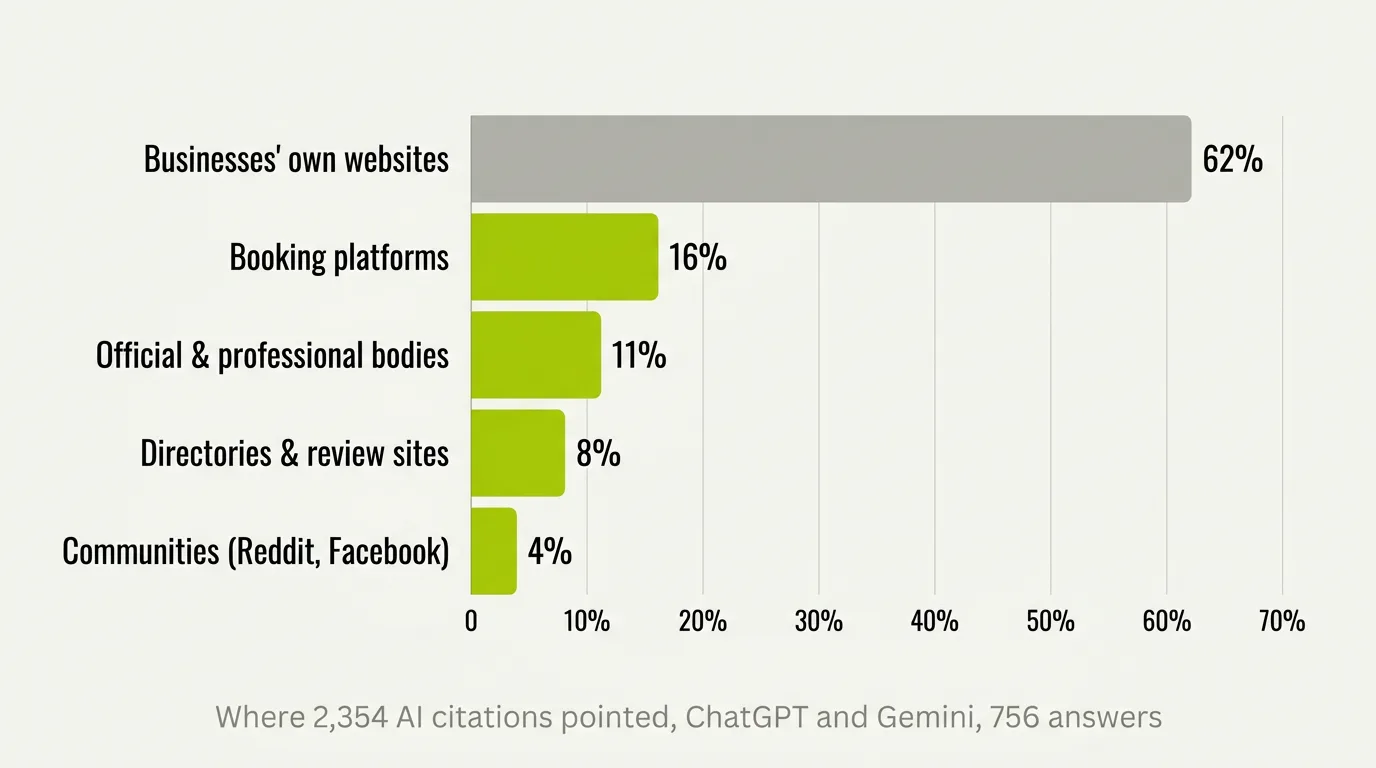
The citations also come in two kinds, and it pays to tell them apart. Some select: directories, booking platforms, review sites and forums that list several businesses, from which the assistant picks. Others point: once a business is chosen, the assistant often links its own website as the destination. In our data, 62% of all citations pointed at businesses' own websites, but those were mostly the sites of businesses that had already been chosen. The selecting kind is where a business that is not yet named needs to appear.
How do you see which sources ChatGPT cites?
Ask with web search on. In ChatGPT, a question like "best physio near Camden" triggers a search, and the answer carries small source markers that expand into a list of the pages it read. Open that list and copy every domain. If you want more detail, follow up with "which websites did you use for that answer?" and ChatGPT restates them. When no search runs, there are no citations to record, so note that too, because an answer from memory is a different kind of evidence.
ChatGPT's instincts are distinctive. Official and professional bodies, licensing boards, health authorities and trade associations, took 27% of its citations in our scans, while Gemini gave them almost nothing. If a competitor is being named from an official register you are not on, that is a ChatGPT-specific gap and worth flagging as such. For the by-hand check itself, see how to check if ChatGPT recommends your business.
How do you see the sources in Gemini and Claude?
Gemini grounds its local answers in Google Search and shows the pages it used as links beneath the answer, sometimes behind a "sources" or "show more" control. It cites generously: 3.8 websites per answer in our scans against ChatGPT's 2.4, and it leans on booking platforms, Reddit and Facebook where ChatGPT leans on official bodies. Because Gemini is Google's assistant, what it cites is a good proxy for what Google's AI Mode will cite too.
Claude shows numbered citations when its web search is enabled, with the page title and domain on hover or in a sources panel. It searches less readily than the other two for a local question, so ask it explicitly to search the web. Claude is also the assistant most tools skip, so a manual read is often the only one you will get. For each assistant's habits, see how to check if Gemini recommends your business and how to check if Claude recommends your business.
What should you log for each answer?
A spreadsheet is enough to start. One row per answer, and the same columns every time, so that a month from now you are comparing like with like. The columns that earn their place:
- Date and assistant. Answers change with time and differ by assistant, so both are part of the result.
- The exact question, word for word. Rephrasing shifts the shortlist, so keep the wording fixed between runs.
- Named or not: were you in the answer, and in which position if it gave an order.
- Every business named, in order. This is where the competitor pattern appears after a few runs.
- Every cited website, as a domain. Mark which ones list you, which list a named competitor, and which list neither.
- One line of context: did the assistant search the web, or answer from memory. Citations only mean something in the first case.
How do you read the results? The source gap
After a dozen answers per assistant the patterns are readable. Do not judge from one row. Count how often you were named, how often each competitor was named, and how often each website was cited, then look for the gaps between those counts. The table below is the reading key.
| What the log shows | What it usually means | What to do |
|---|---|---|
| A competitor is named and a directory or booking site is cited that does not list you | A listing gap. The assistant picked from a source you are absent from. | Get listed there, completely, with recent reviews. |
| You are named on one assistant and never on another | The two read different sources. Our scans found ChatGPT and Gemini shared a named business only 51% of the time. | Check what the silent assistant cites and cover those sources. |
| Your own website is cited, but you are rarely named | The assistant knows you exist but does not find you where it selects. | Work the selecting sources first, not the website. |
| The same forum thread or article is cited across many answers | A high-leverage source for your trade and town. | Earn a genuine mention there if it fits; never a fake one. |
| Sources change on every run | Normal. Answers are rebuilt each time. | Track frequency across runs, not any single answer. |
How often should you track AI sources, and for how long?
Monthly is the useful cadence for a single business. Answers shift from run to run, so a weekly check mostly records noise, and a quarterly one misses the effect of the work you did. Run the same questions on the same assistants at the start of each month, log them the same way, and read the counts against the previous month.
Give a change six to eight weeks before you judge it. A new listing or a fresh run of reviews takes time to be crawled, indexed and trusted. What you are watching for is a source that starts naming you where it did not before, and a competitor who appears a little less often next to you. Both show up as counts moving, never as a single answer flipping.
Manual, tracker or audit: which way of tracking fits you?
There are three ways to track AI sources and brand mentions, and the right one depends on how many answers you need and how often. The honest comparison:
| Method | What you get | Effort and cost | Fits |
|---|---|---|---|
| By hand, in a spreadsheet | The sources and names behind the answers you ran yourself | An afternoon per round, free | One business, one or two assistants, a first read |
| A subscription tracker | Daily runs of a fixed prompt list, charts, share of voice, source lists | Setup plus a monthly fee, from about $29 to several hundred | Marketing teams tracking many prompts across many assistants |
| A one-time audit | Every recommendation across ChatGPT, Gemini and Claude traced to its source, and a ranked plan | A few minutes to start, $99 once | A single-location owner who wants the reasons and the fixes, not a dashboard |
What a source-traced audit shows that a mention count does not
A mention count says you appeared in 19 of 135 answers. A source trace says why: in one Peekl audit of a London clinic, the assistants leaned on a medical directory 69 times, a doctor-listing site 35 times and a review platform 24 times, and the clinic was thin on two of the three. That is the difference between knowing the score and knowing the next move.
Peekl runs the questions your customers ask on ChatGPT, Gemini and Claude, several times each, and records every business named and every website cited. The free check does this on Gemini for twelve questions; the audit does it across all three assistants for 135 answers and turns the source gaps into a ranked plan. If you would rather compare the subscription trackers, see how the AI visibility tools differ. For what to do once you know your gaps, see how to improve your AI search visibility.
Common questions
Is it possible to track brand mentions in AI search?
How do I track which sources ChatGPT cites for free?
What is the difference between an AI mention and an AI citation?
Do the assistants cite the same sources?
Do AI citations send traffic to my website?
How many sources does an AI answer usually cite?
How often should I check my AI sources?
See where you stand
Reading about AI search is useful; knowing your own place in it is what helps. A free Peekl check asks the assistants the questions your customers ask and shows whether ChatGPT, Gemini and Claude recommend you today, who they name instead, and how often.
Related reading
- Which websites does AI trust when it recommends a local business?
- How to check if ChatGPT recommends your business
- AI visibility metrics: how to measure your AI visibility (the KPIs that matter)
- How to improve your business's visibility in AI search
- ChatGPT, Gemini and Claude: do they recommend the same businesses?