What is an AI visibility audit, and what does it cost?
Part of our series on Choosing an AI visibility tool. The reference guide is the AI visibility tools comparison.
An AI visibility audit is a one-time test of whether AI assistants such as ChatGPT, Gemini and Claude name your business when customers ask them for one. It puts real customer questions to the assistants, records who each answer names and which websites it relied on, and ends with a list of fixes. Published audits cost from $49 to $4,500, and the median price we found was $300.
This guide explains what an audit contains, what the prices buy at each level, when an audit makes more sense than a monthly tracker, and how to run a basic one yourself in an afternoon. Every price below was read on the provider's own page on 27 September 2026. For subscription trackers and their monthly prices, see what AI visibility tools cost.
- An audit answers one question, whether AI names you and why not, and hands you the fixes. A tracker measures the same thing every week or month for as long as you pay.
- Almost every audit we read includes the same core: a set of customer questions, several assistants, how often you are named, the competitors named instead, the websites the answers cite, and a ranked plan.
- Prices fall into three bands: self-serve reports at $49 to $300, analyst-run audits at about $400 to $1,000, and agency diagnostics from $3,500, with some agencies quoting $8,000 to $25,000.
- The difference that matters most is not the price but the method: how many questions, how many runs of each, which assistants, and whether every recommendation is traced to its source.
- You can run a basic audit by hand with 10 to 20 questions, two or three assistants and a spreadsheet. Paid audits save the time and do the counting at a scale a single check cannot.
What is an AI visibility audit?
An AI visibility audit measures how AI assistants treat your business today. It asks the questions your customers ask, in their words, on the assistants they use, and reads every answer. For each one it records whether you were named, in what position, who was named instead, and which websites the assistant leaned on to decide. The output is a baseline and a plan, not a dashboard.
It is different from an SEO audit, which checks how your pages rank in Google's list of links. An assistant does not show a list of ten links; it writes a short answer with two or three names in it. You can rank well in Google and still be missing from that answer, which is why the audit reads the answers themselves rather than your rankings.
It is also different from a tracker. A tracker runs a fixed set of prompts on a schedule and plots the result over time. An audit is done once, goes deeper on the why, and is meant to be acted on. Some providers pair the two: an audit first, optional tracking after.
What does an AI visibility audit include?
We read 21 pages that describe what an AI visibility audit contains, from self-serve reports to agency diagnostics. The same core appears on nearly all of them. The table shows how many of the 21 mention each part, so you can see what is standard and what is extra. The part most often missing is the one that matters most for a reliable result: only about 9 of the 21 ask each question more than once, although answers change from one run to the next.
| What the audit covers | Pages mentioning it (of 21) | What it tells you |
|---|---|---|
| A set of customer questions | About 20 | The questions it tests, in your customers' words. Sizes range from 8 to 500. |
| Several AI assistants | About 20 | ChatGPT on all of them, then Gemini and Perplexity, then Claude and Google AI Overviews. |
| How often you are named | About 20 | Your mention rate: the share of answers that name you. |
| Competitors named instead | About 19 | Who the assistants recommend when they do not name you, usually 3 to 5 rivals. |
| A ranked plan of fixes | About 19 | What to change first, often as a 30 or 90 day plan. |
| The websites the answers cite | About 17 | The directories, reviews and articles the assistants relied on, which is where the fixes usually are. |
| Your site's readiness | About 12 | Schema, content structure and whether AI crawlers can read the site. |
| How AI describes you | About 11 | Whether what the assistants say about you is accurate and favourable. |
| Repeat runs of each question | About 9 | Whether each question is asked more than once, because answers change from run to run. |
How much does an AI visibility audit cost?
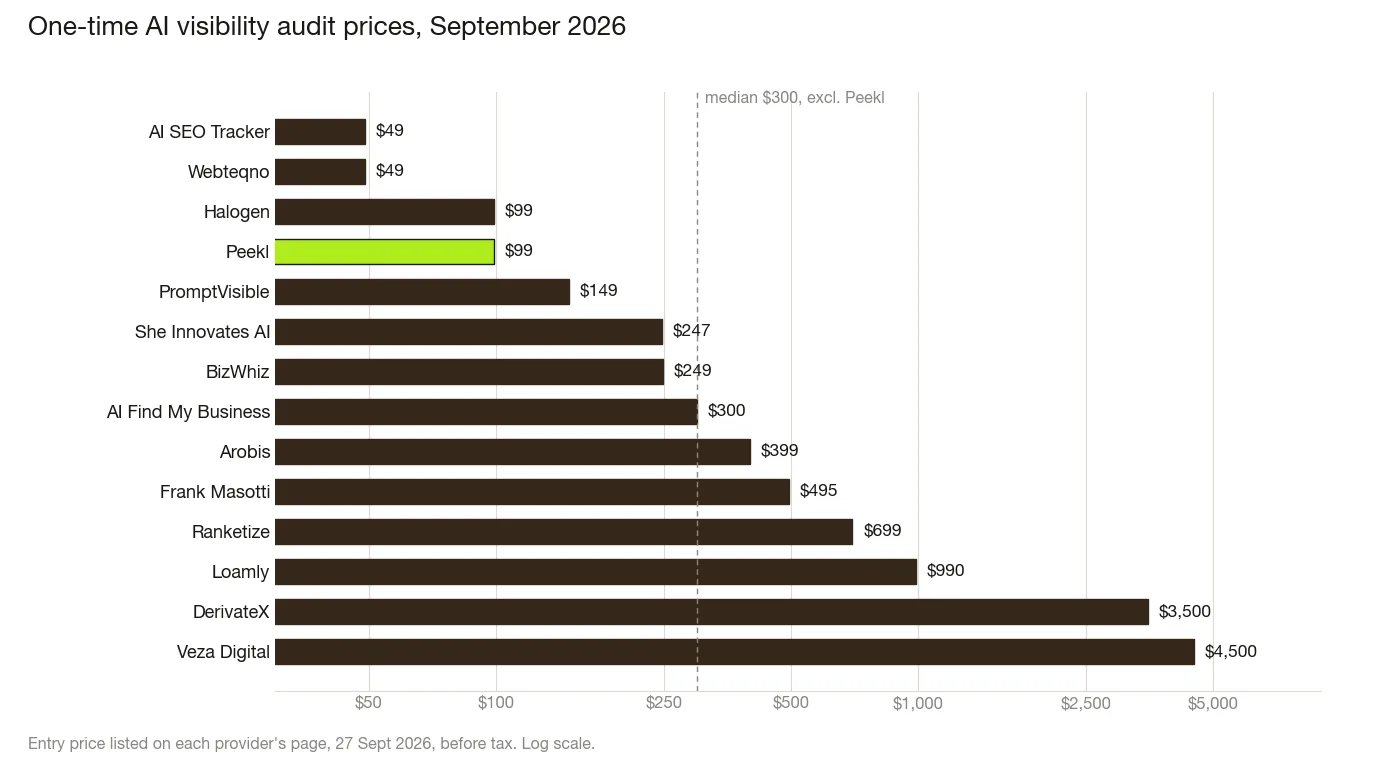
Published one-time audits cost from $49 to $4,500, and the median of the 13 entry prices we could verify was $300, not counting ours. The price follows the labour: self-serve tools automate the questions and the report, analysts read the answers themselves, and agencies add strategy, calls and a longer engagement.
The table lists the offers with a public price, as shown on each provider's page on 27 September 2026. It is not a ranking; it shows what each price buys.
| Offer | Price, once | Assistants | What you get |
|---|---|---|---|
| AI SEO Tracker report | $49 | 5, incl. ChatGPT, Gemini | 50 prompts scanned daily for 7 days, competitor gaps, cited sources, action plan |
| Webteqno audits | $49 to $199 | 2 to 4 | From a quick read on ChatGPT and AI Overviews to a full audit with a roadmap and a call |
| Halogen audit report | $99 | ChatGPT only | Visibility score, cited sources, sentiment, PDF |
| Peekl full audit | $99 | ChatGPT, Gemini, Claude | 15 questions, 3 runs each (135 answers), every competitor and source, up to 12 ranked fixes |
| PromptVisible audit | $149 to $249 | 4 | 8 buyer questions per assistant, technical checks, prioritised fixes |
| BizWhiz visibility report | $249 | 6 | 20 local questions, a 0 to 100 score, a 30/60/90 day plan, aimed at local service businesses |
| AI Find My Business snapshot | $300 | Not named | 50 buyer prompts, competitor comparison, gaps ranked by impact |
| Arobis audit | $399 | 5 | 40 buying prompts in logged-out sessions, raw answers, fix list, 30-minute call |
| Frank Masotti report | $495 | ChatGPT, Claude, Gemini | A manual read of what the three assistants understand and get wrong about a business |
| Ranketize audit | $699 | 4 | Two passes on separate days, a citation map and a 30-day plan |
| Veza Digital audit | $4,500 | 6 | 50 to 100 prompts, 30 days of tracking, a 30-page report and a 90-day plan |
What the three price bands buy
Self-serve reports, $49 to $300. Software writes or takes your questions, puts them to the assistants and builds the report. Fast, often within the hour, and cheap because nobody reads the answers by hand. Check how many assistants and how many runs you actually get: at this price some check one assistant once.
Analyst-run audits, about $400 to $1,000. A person reads the answers, checks your site and writes the plan, usually with a short call. Turnaround is one to seven working days.
Agency diagnostics, $3,500 and up. Larger question sets, several weeks of tracking, strategy and a longer report, often credited against a monthly retainer if you hire the agency afterwards. Sparkle Technologies publishes a band of $8,000 to $25,000 for this kind of engagement, as shown on its site on 27 September 2026. Several agencies also offer a free audit as a first step; expect a short snapshot and a sales call.
One-time audit or monthly tracker?
An audit suits an owner who wants to know where they stand and what to fix, once, and then do the work. A tracker suits a team that will read a trend line every week and act on it. The cost difference is real. Tracking tools run from $20 to $3,000 a month, with a median of $99 in one published survey, so the cheapest year of tracking costs $240 against a one-time audit from $49.
The two are not substitutes. An audit does not tell you next month whether your fixes worked; a tracker rarely tells you why a competitor is named instead of you. A sensible order for a single location is an audit first, the fixes second, and a re-check a few months later to see what moved. The comparison in tracker or audit and the twelve-month cost chart go further.
How to run an AI visibility audit yourself
You can run a basic audit by hand in an afternoon. It will not have the scale of a paid one, but it shows the method and often the first fix. The steps below are the ones the published guides agree on.
- Write 10 to 20 questions your customers really ask, in their words, with your town or area in the local ones: the best option near you, a specific job, a price or availability question.
- Put each question to at least two assistants, ChatGPT and Gemini, and Claude if you can, with web search on and in a logged-out or temporary chat so your own history does not help you.
- Ask each question at least twice, on different days. Answers change from run to run, so one answer is not a result.
- For every answer, note whether you were named, who was named instead, and which websites the assistant cited. The cited websites are where most fixes are.
- Count your mention rate, list the competitors named most, and pick the two or three fixes that appear most often: a missing directory listing, an out-of-date profile, a page that does not say what you do.
What to check before you pay for an audit
Most audit pages describe their method, and the method is what separates a useful audit from a screenshot. Before you pay, check four things.
- How many questions, and how many runs of each. One run of a handful of questions is a snapshot; the same questions asked two or three times is a measurement.
- Which assistants. Check the ones your customers use are covered, and whether the cheaper tier drops some of them.
- Whether every recommendation is traced to a source. A score without the websites behind it gives you a number but not the fix.
- Whether you get a plan in plain language, in order, and what is not included, such as implementation or re-checks later.
Where Peekl's audit fits
Peekl's full audit costs $99, once, with no subscription. It puts fifteen of your customers' questions to ChatGPT, Gemini and Claude, three times each, and reads all 135 answers. It names every competitor that appears instead of you and every website the answers cite, then ranks up to 12 fixes in plain English, each with the competitor to beat and the question you are losing. It also reads your own website and your Google Business Profile and reviews.
What it does not do: it does not check Perplexity, Copilot or Google AI Overviews, it does not make the fixes for you, and it is not a daily tracker. Before paying anything, you can run the free check: twelve questions, once, on ChatGPT or Gemini, your pick. To see what a check reports on one assistant, see the ChatGPT visibility checker.
Common questions
What is an AI visibility audit?
How much does an AI visibility audit cost?
What does an AI visibility audit include?
How long does an AI visibility audit take?
Is a free AI visibility audit worth it?
How often should a small business audit its AI visibility?
See where you stand
Reading about AI search is useful; knowing your own place in it is what helps. A free Peekl check asks ChatGPT or Gemini, your pick, the questions your customers ask and shows whether it recommends you today, who it names instead, and how often. The full audit runs the same questions on all three assistants, Claude included.
More in this series: Choosing an AI visibility tool
- Best AI visibility tools: an honest comparison
- The best ChatGPT rank trackers in 2026, compared
- The best Claude rank trackers in 2026, compared
- The best Google AI Mode rank trackers in 2026, compared
- What AI visibility tools cost in 2026, and what one business should pay
- The best free AI visibility tools in 2026, and what each one really checks