Generative engine optimization for a local business: what to do first
Part of our series on Improving your AI visibility. The reference guide is the guide to improving your AI search visibility.
For a local business, generative engine optimization (GEO) means getting named when customers ask ChatGPT, Gemini or Google's AI for a recommendation. In practice it is local SEO plus three things AI adds: the platforms AI reads for your trade, pages that answer price and problem questions, and checking more than once. Here is the order, with our data.
How we know: the numbers come from our study of 1,926 Gemini answers collected on 15 October 2026 and our September 2026 scans of ChatGPT and Gemini. This page is the practical side; for where the terms AEO and GEO come from and what the research says, see AEO vs GEO.
- GEO keeps the local SEO foundations. What changes is which pages matter: Gemini cited 7.6 pages per answer in our October study, mostly directories, booking platforms and forums, rarely a Google Business Profile page.
- Start with the one platform your trade lives on. In France, Doctolib appeared in 85% of Gemini's physiotherapy answers and Superprof in 83% of its personal-trainer answers.
- Write the pages AI cannot find elsewhere: prices and specific problems. Gemini named no business in 24% of value-for-money questions.
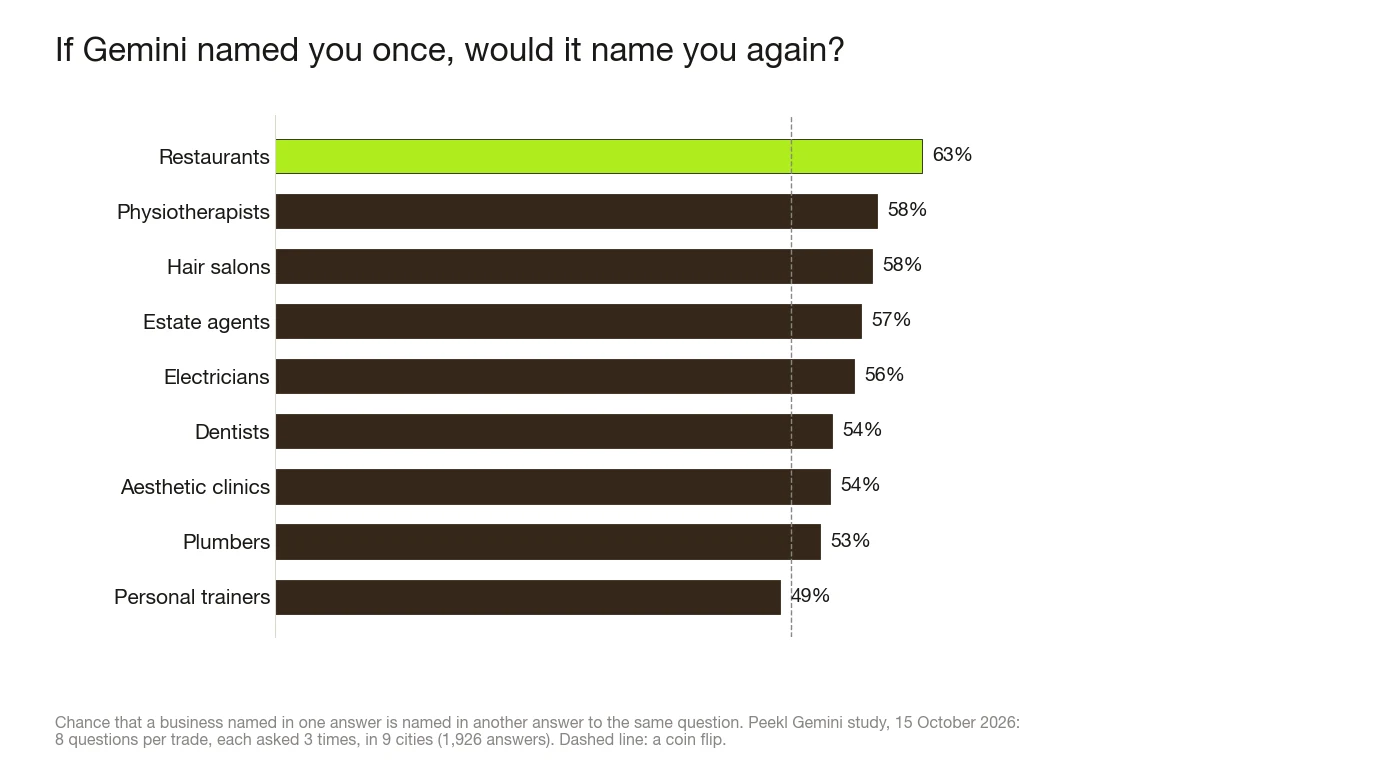
- Measure across repeated asks, not one screenshot: a business Gemini named once had a 56% chance of being named again for the same question.
Is GEO different from local SEO?
Mostly no: the foundations are the same, and a business that has done its local SEO is halfway there. Three things change. What the assistant reads is wider than the map pack: in our October 2026 Gemini study it cited 7.6 web pages per answer, and in our September scans ChatGPT opened 2.4 pages and Gemini 3.8. Either way it is a handful of pages, so being on those pages matters more than ranking first. What you measure changes from a position to a yes or no, named or not. And that yes or no moves: ask again and the list changes. The assistant also never searches the customer's exact words; what is answer engine optimization shows what it searches for instead.
The table maps the usual local SEO jobs to what changes for GEO, with what we measured.
| Local SEO job | What changes for GEO | What we measured |
|---|---|---|
| Google Business Profile | Still the main source for Google's AI Mode and Maps; rarely quoted as a page by Gemini with Google Search | Google pages were cited in 12 of 1,926 Gemini answers; Steady Demand counted 79.8% of AI Mode's local citations going to Maps or profile data (our profile guide) |
| Citations and directories | Fewer, bigger platforms per trade, often one per country | Doctolib in 85% of French physiotherapy answers; Zocdoc in 28% of English-language physiotherapy answers |
| Reviews | Feed the review summaries Google writes in Maps; we did not measure their effect on other answers | Google says each Maps summary is based on reviews from the past year |
| Website | Must answer the exact question, prices and problems included | No business named in 24% of value-for-money questions and 21% of specific-problem questions |
| Rank tracking | Becomes a named rate across repeated asks and several assistants | 56% chance of being named again; ChatGPT and Gemini shared a recommended business in only 51% of trade-and-city pairs |
What should a local business do first? A GEO checklist in order
In order: find your trade's platform, complete your profile there, complete your Google Business Profile, publish a prices page and a page per problem, let the crawlers in, and make your details identical everywhere. Work from the change that reaches the most answers for the least effort; where we have a number for a step, it is in the step.
- Find your trade's platform. Look up your trade in the table in the next section, or ask an assistant your customers' question and note which sites it cites. In French cities one platform often carries most answers; in English-speaking cities it is spread over three or four.
- Get listed there, with a complete profile. Where the platform shows reviews, as Zocdoc, Treatwell or Fresha do, collect recent ones. Gemini often reads these pages, so a missing or half-empty profile is the gap most worth closing first. We measured which sites Gemini cites, not whether a profile there gets a business named.
- Complete your Google Business Profile. It is free and quick, so do it in the first week. It matters most for Google's own AI: AI Mode and Gemini in Maps lean on it, even though Gemini with Google Search rarely quotes it as a page.
- Publish the two pages AI cannot find elsewhere: one with your prices or price ranges, and one for each problem you fix ("leaking boiler", "cracked tooth"). In the study, value-for-money and specific-problem questions were the ones Gemini most often answered without naming anyone.
- Let the crawlers in. Allow OAI-SearchBot in robots.txt for ChatGPT search, and make sure Google and Bing index your service pages; how to get into ChatGPT search has the details.
- Make your details identical everywhere. Asked for the phone numbers of 40 established businesses with search switched off, Gemini got the number wrong 59 times out of 80. With search on, it was right 71 times out of 80, taking the number from the pages it read. Every mismatch on those pages is a risk (wrong information guide).
Does GEO work differently for a restaurant, a dentist or a plumber?
Yes. Which sites Gemini reads, and how often it names anyone, depends on the trade and the country. The table comes from our October 2026 study of Gemini 3.1 Flash-Lite with Google Search, run through Google's developer platform rather than the Gemini app: 8 customer questions per trade, each asked 3 times, in six English-speaking cities and in Paris, Lyon and Marseille. The Gemini app may behave differently.
Two patterns stand out. Health trades in France are the hardest: Gemini often names no practice and sends people to Doctolib, so for a French dentist or physiotherapist the Doctolib profile is the first thing to get right. Restaurants are the opposite: Gemini almost always names places but spreads its picks across dozens of them, so press, guides and community posts matter more than any single listing; our Reddit analysis shows which threads it reads. The full study has every trade and city.
| Trade | Gemini read most (English / French cities) | Answers naming nobody (English / French) | Where GEO work starts |
|---|---|---|---|
| Restaurants | Reddit, Time Out, Instagram / Le Bonbon, TheFork | 0% / 6% | Guides, food press, Reddit and Instagram mentions |
| Dentists | Zocdoc, Reddit, Opencare / Doctolib (61%), PagesJaunes | 21% / 25% | Zocdoc profile and reviews; Doctolib profile in France |
| Physiotherapists | Zocdoc / Doctolib (85%), Libheros, Maiia | 6% / 54% | Doctolib in France; Zocdoc in the US |
| Plumbers | Roto-Rooter, ConsumerAffairs, Angi / travaux.com (57%) | 6% / 32% | Home-services platforms and review sites |
| Electricians | ConsumerAffairs, Angi, Thumbtack / travaux.com (60%) | 15% / 26% | Home-services platforms and review sites |
| Hair salons | Fresha, Booksy / Treatwell (65%), Planity (64%) | 2% / 4% | Your booking platform profile |
| Personal trainers | Find Your Trainer, Thumbtack / Superprof (83%), Ownsport | 12% / 18% | Trainer marketplaces |
| Estate agents | FastExpert, Reddit, YouTube / Immodvisor, SeLoger | 25% / 7% | Agent-rating and listing sites |
| Aesthetic clinics | The Clinic Compass, lifestyle press / clinic sites, Le Bonbon | 1% / 11% | Your own site and press coverage |
How do you measure GEO for one location?
Your GEO score is a rate: the share of answers that name you, over a handful of real questions asked more than once, per assistant. One screenshot is not a measurement: in our study, a business Gemini named once had a 56% chance of being named again for the identical question, and only a quarter of the businesses named for a question came back in all three asks.
- Pick five to eight questions your customers really ask, including a price question and a problem question. Ask each one three times on each assistant, with web search on and the city named in the question. Your score is the share of answers that name you; an answer written without search shows what the model remembers, not what a customer sees.
- Check ChatGPT and Gemini separately. In our September scans they shared at least one recommended business in only 51% of trade-and-city pairs, so a good result on one says little about the other.
- Note the sources cited when you are not named: they are your to-do list.
- Watch the visits too. Since May 2026, Google Analytics 4 has an AI Assistant channel for visits from ChatGPT, Gemini, Copilot and other assistants; visits from Google's AI Overviews and AI Mode still count as organic search. Search Console now has a generative AI report with impressions, not clicks, from AI Overviews and AI Mode (both read on 15 October 2026).
- Repeat monthly with the same questions. Our guide to AI visibility metrics explains how to read the trend, and the free AI visibility checker runs the questions for you.
Should you hire a GEO agency or do it yourself?
For a small business with one location, most of the checklist is owner work: claiming and completing two or three profiles, asking customers for reviews, checking robots.txt and writing a prices page need no specialist. Where help earns its fee is the slower work: writing pages for each service and problem, and getting covered by local press and guides, which is what moves the needle for restaurants and aesthetic clinics.
Published agency retainers for AI search ranged from $150 to more than $3,000 a month when we read them on 5 October 2026. Our guide to AI search optimization services lists who charges what and the red flags; if you want a one-off diagnosis first, an AI visibility audit (or GEO audit) shows where you stand before you pay for anything monthly.
Common questions
Is GEO worth it for a small business?
Is GEO geographic or generative engine optimization?
Do I need llms.txt or schema markup for GEO?
Can I pay to appear in ChatGPT or Gemini answers?
Does GEO replace local SEO?
See where you stand
Reading about AI search is useful; knowing your own place in it is what helps. A free Peekl check asks ChatGPT or Gemini, your pick, the questions your customers ask and shows whether it recommends you today, who it names instead, and how often. The full audit runs the same questions on all three assistants, Claude included.
More in this series: Improving your AI visibility
- How to improve your business's visibility in AI search
- AI search optimization services: what agencies charge, what they deliver, and when to do it yourself
- How to appear in Google's AI Overviews
- Does Google Business Profile affect ChatGPT and Gemini recommendations?
- Just opened, moved or renamed: how long until ChatGPT and Gemini know your business?
- ChatGPT or Gemini has the wrong hours, phone number or details for your business: why, and how to fix it
- ChatGPT ads: can a local business pay to be recommended?