AI search for opticians: what owners need to know
Part of our series on AI visibility by trade and city. The reference guide is the AI visibility directory by trade and city.
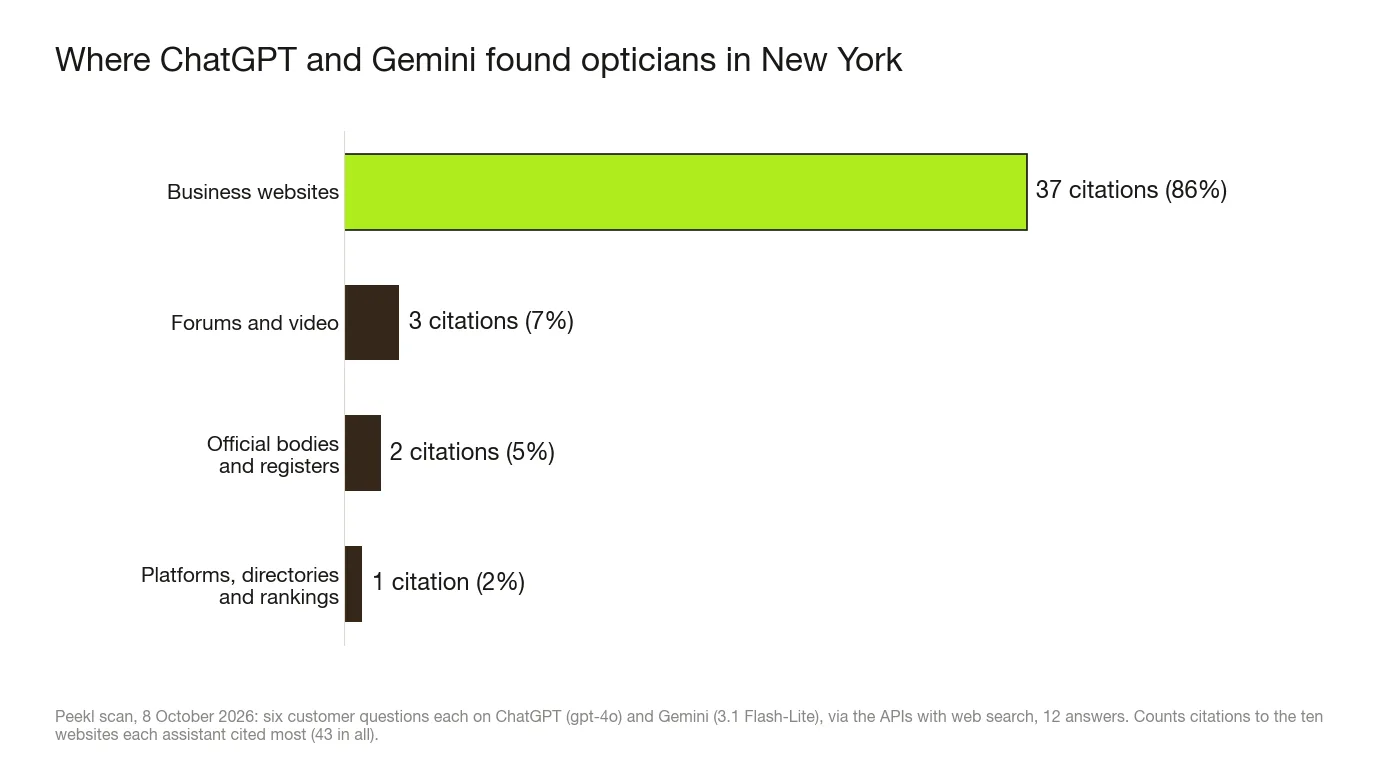
AI search for opticians means patients asking ChatGPT or Gemini where to get glasses or contact lenses. In our New York scan, business websites carried 86% of the citations, the highest share of the eleven trades we scanned.
An optician sits between healthcare and retail, and both sides of the decision now often start with a question to an assistant about who to see nearby. Whether someone needs an eye test, new glasses or help for a child, the search increasingly begins in a conversation, not a search bar.
More customers now ask ChatGPT, Gemini or Claude where to get an eye test or new frames before they walk in anywhere, and the way those assistants choose which practices to name decides whether that booking is yours. It pays to know why some practices stay invisible to AI and to check where you stand now rather than later.
What customers ask AI when they need glasses or an eye test
Optician questions span eye care and eyewear, tests, children, brands, the occasional urgent issue. The answer decides where a first visit lands, and first visits become years of repeat custom:
- “Best optician near me”
- “Optician for kids in the area”
- “Eye test near me”
- “Optician with designer frames nearby”
- “Emergency optician close by”
What AI actually says about opticians in New York: our scan
On 8 October 2026 we put six patient questions to ChatGPT and to Gemini about opticians in New York, from "Who should I see in New York if I need new glasses for a strong prescription?" to "Which opticians in New York are best for contact lens fittings?". We recorded the practices and sources in all twelve answers, which shows the pattern in one city rather than a ranking.
ChatGPT named 21 practices and Gemini 26. The most-named independent optician appeared in 5 of the 12 answers, and the two top tens shared three names, one of them a national chain. ChatGPT also named two eye hospitals, which treat eye disease rather than fit glasses, a sign that a vague question gets a vague answer.
Business websites made up 86% of the citations for opticians, the highest share of the eleven trades in this scan, though that includes chains, an online retailer and two eye hospitals. Gemini cited three independent practices' sites and an online glasses retailer's site in 4 of its 6 answers each. The rest was Reddit, two chain websites and New York State's Office of the Professions, where opticians' licenses can be verified. For an owner the takeaway is that the site is the listing: what you specialise in (strong prescriptions, contact lens fittings, frame brands, repairs) stated plainly is what the assistants quote.
| Website | What it is | Citations in the 12 answers |
|---|---|---|
| Business websites (16 different: opticians, chains, a retailer, two eye hospitals) | Business websites | 37 |
| of which three independent opticians and an online retailer | Business websites | 4 each (Gemini) |
| Forum | 3 (Gemini) | |
| of which two chains' websites | Business websites | 3 each |
| NYS Office of the Professions | State license register | 2 (ChatGPT) |
How AI decides which opticians to recommend
Assistants recommend opticians mostly from opticians' own websites, with forums and the state license register far behind, sources that capture services, brands stocked and specialisms. A practice clearly present and well reviewed across those, with its services legible, is easy to recommend for a specific need.
More in local AI visibility, city by city and which websites AI trusts. The ChatGPT visibility checker, the Gemini visibility checker and the Claude visibility checker show what each assistant reads.
Common questions
Do people choose an optician via AI?
We're an established practice, is this a concern?
How do I check what AI says about my practice?
Where does AI find opticians to recommend?
See where you stand
Reading about AI search is useful; knowing your own place in it is what helps. A free Peekl check asks ChatGPT or Gemini, your pick, the questions your customers ask and shows whether it recommends you today, who it names instead, and how often. The full audit runs the same questions on all three assistants, Claude included.
More in this series: AI visibility by trade and city
- AI visibility by trade and city: every scan we run
- Local AI visibility: what it is, and what the numbers say city by city
- AI search for restaurants: what owners need to know
- AI search for cafés: what owners need to know
- AI search for electricians: what owners need to know
- AI search for gyms and fitness studios: what owners need to know
- AI search for law firms: what owners need to know
- AI search for accountants: what owners need to know
- AI search for estate agents: what owners need to know
- AI search for veterinary practices: what owners need to know
- AI search for barbers: what owners need to know
- AI search for cleaning services: what owners need to know
- AI search for chiropractors: what owners need to know
- AI search for dentists: what owners need to know
- AI search for plumbers: what owners need to know
- AI search for hair salons: what owners need to know
- AI search for physiotherapists: what owners need to know
- AI search for personal trainers: what owners need to know
- AI search for aesthetic clinics: what owners need to know