AI search for accountants: what owners need to know
Part of our series on AI visibility by trade and city. The reference guide is the AI visibility directory by trade and city.
AI search for accountants means clients asking ChatGPT or Gemini which firm to use. In our New York scan the two assistants' top tens shared no firm at all: ChatGPT leaned on the state's license register, Gemini on business directories.
Choosing an accountant is a long-term, trust-heavy decision, and many business owners and individuals now begin it by asking an assistant which practices near them to consider. Rather than comparing firms cold, they ask for a shortlist and start from there.
More clients now ask ChatGPT, Gemini or Claude for an accountant before they ask their network, and how those assistants decide which practices to name decides whether the new client is yours. It pays to understand why some practices stay invisible to AI and to check where you stand well before year-end.
What clients ask AI when they need an accountant
Accountancy questions centre on fit and specialism, a small business, the self-employed, a limited company, a specific need. The answer shapes who gets the first call, and first calls become long relationships:
- “Accountant for a small business near me”
- “Tax accountant in the area”
- “Accountant for the self-employed nearby”
- “Bookkeeper close by”
- “Accountant for a limited company near me”
What AI actually says about accountants in New York: our scan
On 8 October 2026 we put six client questions to ChatGPT and to Gemini about accountants in New York, from "Who should I see in New York for help fixing back taxes and filing overdue returns?" to "Which accountants in New York specialize in small-business tax preparation?". The twelve answers were logged firm by firm and source by source; treat one city on one day as a snapshot.
Accountants were the only trade in this round where the two assistants' top tens shared no firm at all. ChatGPT named 29 firms and Gemini 28. Gemini answered the "top" questions with three of the Big Four and large regional firms, and its most-named firm appeared in 4 answers. ChatGPT spread its picks across mid-size and small practices, none named more than twice, and once named the state CPA society itself.
The sources split the same way. ChatGPT leaned on official pages: New York State's Office of the Professions, where CPA licenses are verified, in 3 of its 6 answers, plus the IRS and the state tax department. Gemini read business-software blogs and B2B directories such as Clutch, The Manifest and Thumbtack. For a practice the takeaway is clear: a license entry that matches your firm name, and complete profiles on the directories small businesses use, cover both assistants.
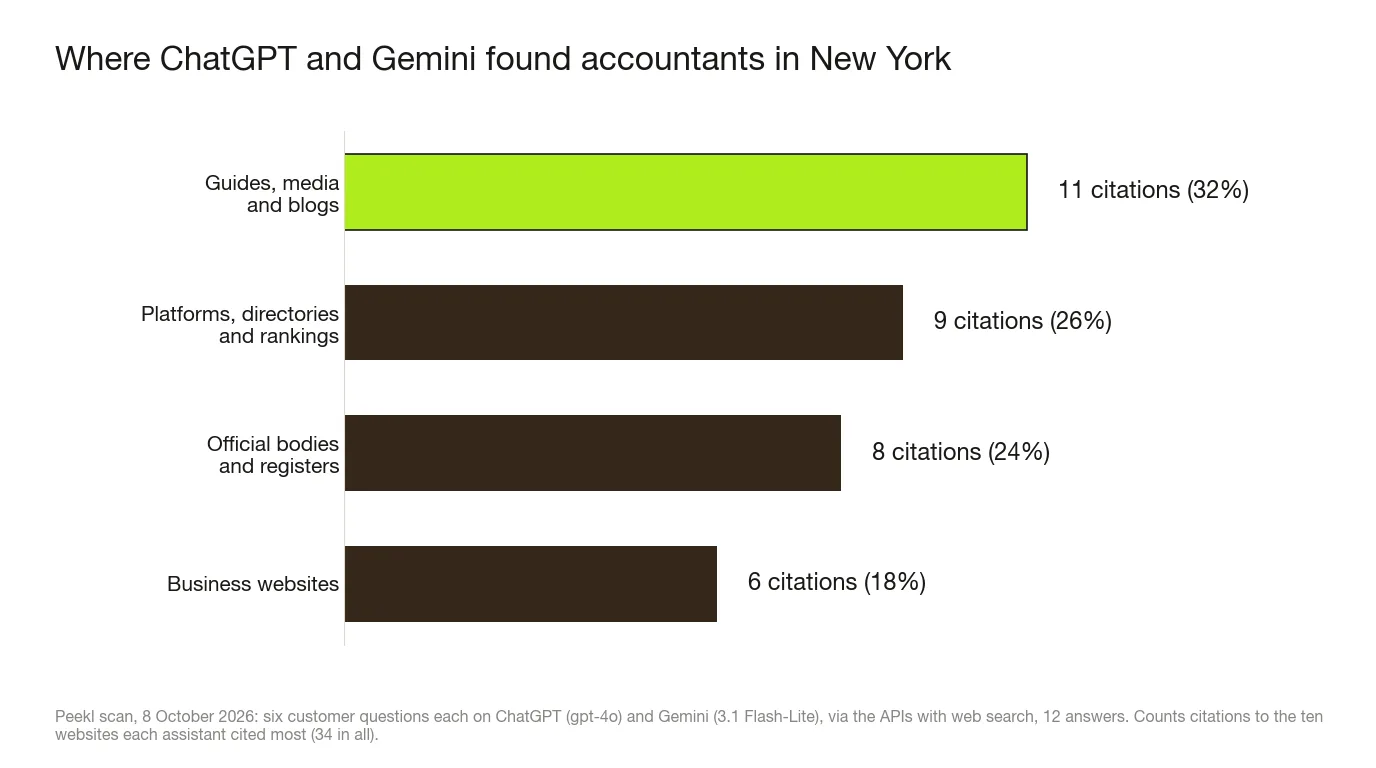
| Website | What it is | Citations in the 12 answers |
|---|---|---|
| Firms' own websites (4 different) | Business websites | 6 |
| A sales-tax software company's blog | Business blog | 4 (Gemini) |
| NYS Office of the Professions | State license register | 3 (ChatGPT) |
| IRS | Federal tax agency | 2 (ChatGPT) |
| Clutch, The Manifest, Thumbtack | B2B and service directories | 2 each (Gemini) |
How AI decides which accountants to recommend
Assistants recommend accountants using professional directories, review platforms and clear service listings, sources that signal credibility, specialism and a track record. A practice that is well represented and reviewed across those, with its focus areas stated plainly, is easy to recommend to the right client.
More in local AI visibility, city by city and which websites AI trusts. The ChatGPT visibility checker, the Gemini visibility checker and the Claude visibility checker show what each assistant reads.
Common questions
Do businesses find accountants through AI now?
Isn't accountancy all about referrals?
How do I check what AI says about my practice?
Do ChatGPT and Gemini recommend the same accountants?
See where you stand
Reading about AI search is useful; knowing your own place in it is what helps. A free Peekl check asks ChatGPT or Gemini, your pick, the questions your customers ask and shows whether it recommends you today, who it names instead, and how often. The full audit runs the same questions on all three assistants, Claude included.
More in this series: AI visibility by trade and city
- AI visibility by trade and city: every scan we run
- Local AI visibility: what it is, and what the numbers say city by city
- AI search for restaurants: what owners need to know
- AI search for cafés: what owners need to know
- AI search for electricians: what owners need to know
- AI search for gyms and fitness studios: what owners need to know
- AI search for law firms: what owners need to know
- AI search for estate agents: what owners need to know
- AI search for veterinary practices: what owners need to know
- AI search for barbers: what owners need to know
- AI search for cleaning services: what owners need to know
- AI search for opticians: what owners need to know
- AI search for chiropractors: what owners need to know
- AI search for dentists: what owners need to know
- AI search for plumbers: what owners need to know
- AI search for hair salons: what owners need to know
- AI search for physiotherapists: what owners need to know
- AI search for personal trainers: what owners need to know
- AI search for aesthetic clinics: what owners need to know