AI search for restaurants: what owners need to know
Part of our series on AI visibility by trade and city. The reference guide is the AI visibility directory by trade and city.
AI search for restaurants means diners asking ChatGPT or Gemini where to eat, then booking one of the places named. In our New York scan, those names came mostly from restaurant guides and food media, led by the Michelin Guide, rather than from review sites.
Deciding where to eat used to mean scrolling reviews, comparing photos and reading a dozen menus. Now a growing number of diners skip all of that and simply ask an assistant to choose for them. They describe the occasion, and ChatGPT, Gemini or Claude answers with a short list of specific restaurants that fit.
More diners now ask ChatGPT, Gemini or Claude where to eat before they ask a friend, and the way those assistants choose which restaurants to name decides whether tonight's booking is yours or a rival's. It pays to know why some restaurants stay invisible to AI and to check where you stand before the quiet nights arrive.
What diners ask AI before they book
Restaurant questions are almost never generic. Diners ask about an occasion, a cuisine, a group or a constraint, and the assistant replies with named places that match. These are the high-intent moments that fill tables, and each one is a chance to be chosen or ignored:
- “Best Italian restaurant near me for a date night”
- “Where can I take the family for dinner in the area?”
- “Romantic restaurant for an anniversary nearby”
- “Best vegan restaurant near me”
- “Good spot for a business lunch close by”
What AI actually says about restaurants in New York: our scan
On 8 October 2026 we asked ChatGPT and Gemini six questions each that a diner in New York might type, from "What is the best restaurant in Brooklyn?" to "Which restaurants in New York offer a chef's tasting menu?". We recorded every restaurant named and every website cited in the twelve answers. A single city on a single day cannot rank restaurants, but the pattern is clear.
Restaurants produce the longest lists of any trade we scan: ChatGPT named 37 different restaurants and Gemini 52. The most-named one appeared in 6 of the 12 answers, and the two assistants' top tens shared three names, all high-end tasting-menu rooms. Below that top tier, a diner who switches assistant hears almost entirely different restaurants.
The sources are where restaurants differ from every other trade. Guides, food media and blogs made up 56% of the citations to the most-cited websites, and ChatGPT cited the Michelin Guide in 5 of its 6 answers, alongside Eater and the James Beard Foundation. Gemini leaned on YouTube, travel blogs and local news. No review platform or booking site made either assistant's most-cited list. Our scan uses the APIs, which do not show the reservation cards the ChatGPT app can display, but the takeaway for an owner holds: what gets a restaurant named in the answer itself is being written about, by critics, guides and local food writers.
Our October 2026 Gemini study adds scale: eight diner questions, each put to Gemini three times, across nine cities. It named restaurants in every answer outside France and named 79 different places per city at the median, so no restaurant appeared in more than 8 of a city's 24 answers. Reddit (30% of answers), Time Out (28%) and Instagram (28%) were cited more often than the Michelin Guide (17%).
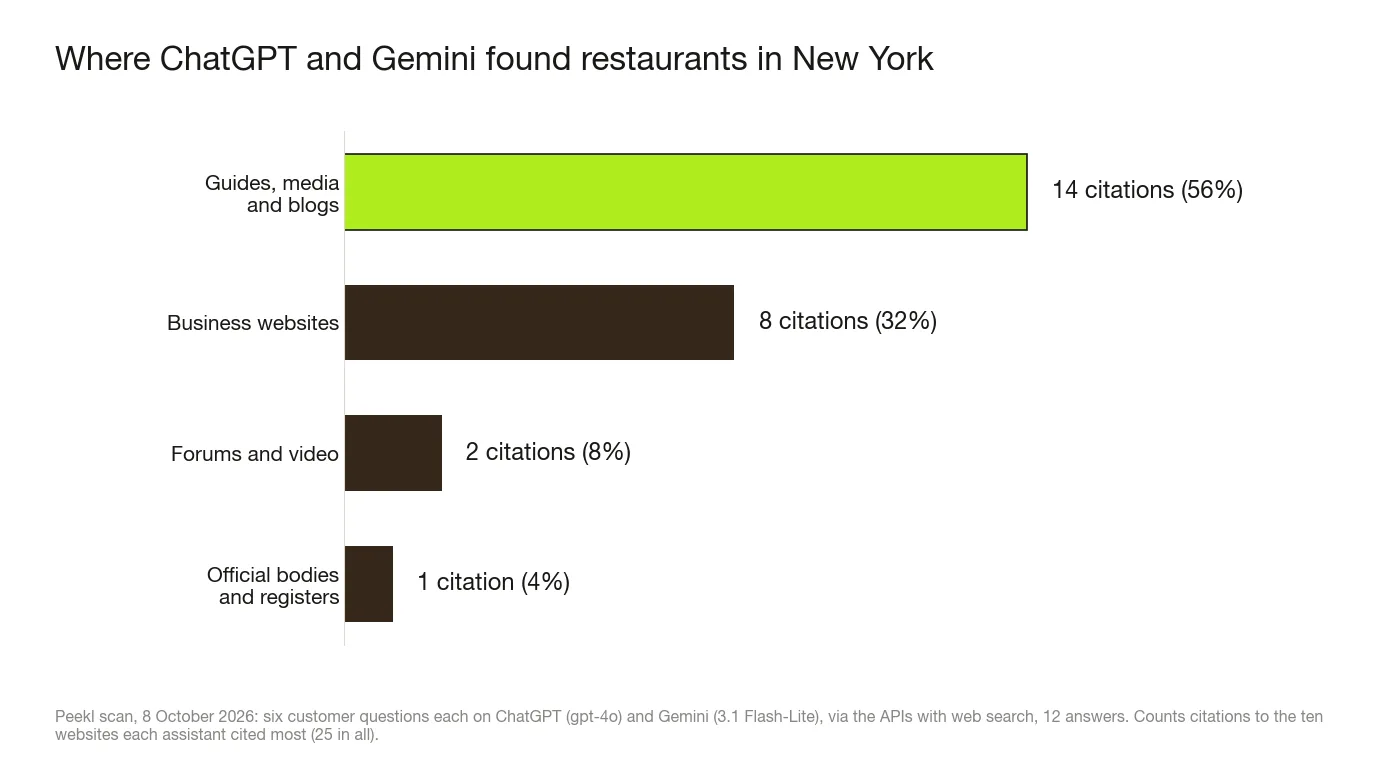
| Website | What it is | Citations in the 12 answers |
|---|---|---|
| Michelin Guide | Restaurant guide | 5 (all ChatGPT) |
| Restaurants' own websites (8 different) | Business websites | 8 |
| YouTube | Video | 2 (Gemini) |
| Eater New York | Food media | 1 |
| James Beard Foundation | Culinary awards body | 1 |
How AI decides which restaurants to recommend
For restaurants, assistants lean on the sources that already write about dining: restaurant guides, food media, local roundups and restaurants' own sites, while review and booking platforms barely showed up in what they cited in our New York scan. A restaurant that is well represented and warmly reviewed across those is easy for an assistant to name with confidence, because it can point to a clear, corroborated picture of what you offer.
More in local AI visibility, city by city and which websites AI trusts. The ChatGPT visibility checker, the Gemini visibility checker and the Claude visibility checker show what each assistant reads.
Common questions
Do people really ask ChatGPT where to eat?
My restaurant has great reviews, isn't that enough?
How does ChatGPT get information about restaurants?
How would I even know if AI recommends my restaurant?
Which websites does AI use to recommend restaurants?
See where you stand
Reading about AI search is useful; knowing your own place in it is what helps. A free Peekl check asks ChatGPT or Gemini, your pick, the questions your customers ask and shows whether it recommends you today, who it names instead, and how often. The full audit runs the same questions on all three assistants, Claude included.
More in this series: AI visibility by trade and city
- AI visibility by trade and city: every scan we run
- Local AI visibility: what it is, and what the numbers say city by city
- AI search for cafés: what owners need to know
- AI search for electricians: what owners need to know
- AI search for gyms and fitness studios: what owners need to know
- AI search for law firms: what owners need to know
- AI search for accountants: what owners need to know
- AI search for estate agents: what owners need to know
- AI search for veterinary practices: what owners need to know
- AI search for barbers: what owners need to know
- AI search for cleaning services: what owners need to know
- AI search for opticians: what owners need to know
- AI search for chiropractors: what owners need to know
- AI search for dentists: what owners need to know
- AI search for plumbers: what owners need to know
- AI search for hair salons: what owners need to know
- AI search for physiotherapists: what owners need to know
- AI search for personal trainers: what owners need to know
- AI search for aesthetic clinics: what owners need to know